

At the heart of Silicon Valley lies NASA’s Advanced Supercomputing (NAS) facility. There are few places on Earth with such a concentration of computing power: for forty years, NASA’s supercomputing division has been using it to simulate missions, conduct aerodynamic research, study climate and ocean currents, and design and develop spacecraft.
Earlier this year, one of these supercomputers, through high-precision simulations, discovered a structure made up of billions of comets mirroring the shape of the Milky Way — something that would have been impossible through traditional astronomical observations. Right now, these supercomputers are working on the Artemis program, modeling various phases of the mission, providing scientists and engineers with unique data to support decision-making and ensure astronaut safety.
Just how large-scale can supercomputing tasks be? Where have they already had a tangible impact on Earth? And have they brought us any closer to understanding the universe? That’s what this article explores.

Source: nas.nasa.gov
A history of NASA’s supercomputers
“NASA uses supercomputers to solve some of the nation’s most challenging problems – from understanding the universe to designing launch systems that will take us to the Moon and Mars as part of the Artemis missions,” says William L. Thigpen, one of the leaders at NASA’s Ames Research Center, describing the work of NAS.
Currently, the facility operates three petaflop-class computers, Pleiades, Aitken, and Electra, which are capable of performing up to 10¹⁵ floating-point operations per second. It also houses the teraflop-class Endeavour supercomputer, capable of 10¹² operations per second.
The first supercomputer arrived at NAS in 1984, and the division itself was officially established a year later with the construction of a dedicated facility for housing these systems. Several inventions and developments that emerged from NAS later influenced commercial supercomputing, particularly in the creation of client-server architecture, global networking, and mass data storage systems.
Today, all of NAS’s supercomputers are based on SGI and HPE architectures, equipped with the latest Intel processors, and are accessible to more than 1,500 NASA scientists and engineers. Let’s take a look at the kinds of tasks this supercomputing division is tackling.

Source: nas.nasa.gov
Support for missions to the Moon
The Artemis program, which aims to return humans to the Moon, would be impossible without high-performance computing. A significant portion of the computing power of the supercomputers located at the Ames Research Center is currently dedicated to supporting this program and its future lunar missions. The primary focus of these supercomputers is to test, in advance of the mission, the heating, aerodynamics, and acoustics during the launch and descent phases of the spacecraft.
For example, Orion, the Artemis program’s reusable capsule, can carry up to four crew members. To ensure their safe journey to the Moon and back to Earth in April 2026, which is the planned date for the Artemis II mission, numerous tests must be conducted and every possible scenario simulated, from liftoff to landing.
Back in 2021, NASA’s Aitken and Electra supercomputers simulated an abort scenario during the launch of the Orion spacecraft, modeling what would happen if an emergency occurred at liftoff and the crew capsule had to be moved to safety.
Watch the visualization of this process here:
This simulation helped scientists visualize and evaluate the potential vibrations generated by the engine plumes in the event of a launch abort. In the video, you can track what happens to gas flows during an emergency, colored by pressure levels: blue indicates areas of low pressure, and red indicates high pressure. By understanding how pressure waves are distributed, researchers can predict the behavior of the crew capsule and assess how safe it would be for astronauts.
Using LAVA (Launch, Ascent, and Vehicle Aerodynamics) software, the research team ran three such simulations for different scenarios in which the rocket was at various altitudes and moving at different speeds.

Source: nas.nasa.gov
Aitken, named after a prominent American astronomer known for his work on binary star systems, is one of two petaflop-class supercomputers housed in the Modular Supercomputing Facility (MSF). Aitken’s configuration is notable for offering highly efficient cooling while requiring minimal resources.
The second computer providing computational power for future Artemis missions is Electra, named after one of the seven stars in the Pleiades cluster in the constellation Taurus. It was the first prototype of NASA’s supercomputing system.

Source: nas.nasa.gov
Aitken and Electra are also valuable for other tasks related to launch condition simulations. For example, how will the Space Launch System (SLS) engines behave in various scenarios? What about the Exploration Ground Systems (EGS) or the sound suppression system? These processes are difficult to model and test manually, which is why such tasks are assigned to supercomputers. Under the guidance of several research teams, they perform complex calculations to generate the data necessary for successful and safe missions.
For instance, predicting aerospace loads helps determine whether cameras might detach from the spacecraft in the time window between 20 seconds after liftoff and the separation of the launch vehicle. Engineers use this data to ensure the spacecraft’s body is resilient to any factors that would be impossible to anticipate without advanced computer modeling.
To ensure success, NASA also shares the results of supercomputer simulations with the Artemis program’s partners, including Boeing, Lockheed Martin, and Northrop Grumman. In addition, supercomputers help derive lessons from past missions. For example, computer modeling made it possible to understand how the engine jets of NASA’s Apollo 12 lunar module interacted with the Moon’s surface when the spacecraft landed there in November 1969.

Source: space.com
After the mobile launch platform was damaged during the Artemis I launch in 2022, the launch conditions were simulated to prevent the incident from recurring in future missions. During the modeling process on the Aitken supercomputer, which lasted about 25 days, more than 400 TB of data were generated, including load statistics, acoustic data, and pressure created by probes at attachment points.
Here’s how Derek Dalle, a researcher at NASA: “Although Apollo showed that it is possible to get to the Moon without modern HPC, NASA supercomputing resources provide different kinds of information than other types of testing. The improved understanding we obtain by analyzing the simulation data reduces risk and enhances safety.”
Weather and climate change forecasting
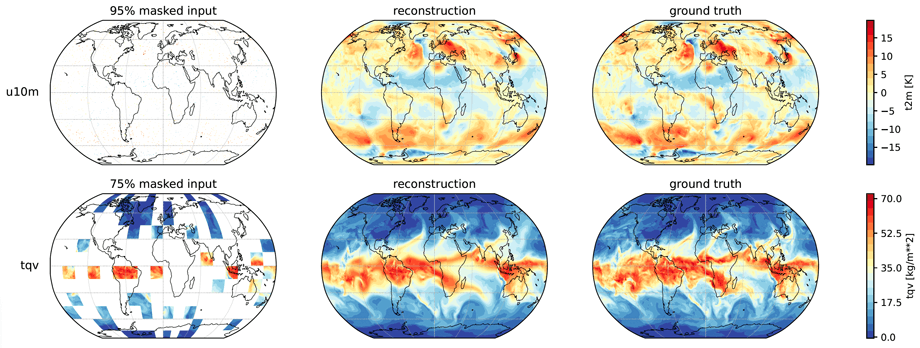
Developing machine learning models that can accurately predict weather and climate changes also requires massive computing power. One such model has been developed at NASA using top-tier NVIDIA A100 graphics processors, optimized for AI workloads. The Prithvi Weather-Climate Foundation (Prithvi WxC) enables the modeling of hurricane paths, targeted weather forecasting, and the visualization of gravity waves, which influence cloud formation and precipitation, can cause severe turbulence, or trigger stratospheric warming.
Source: huggingface.co
Modeling the Universe
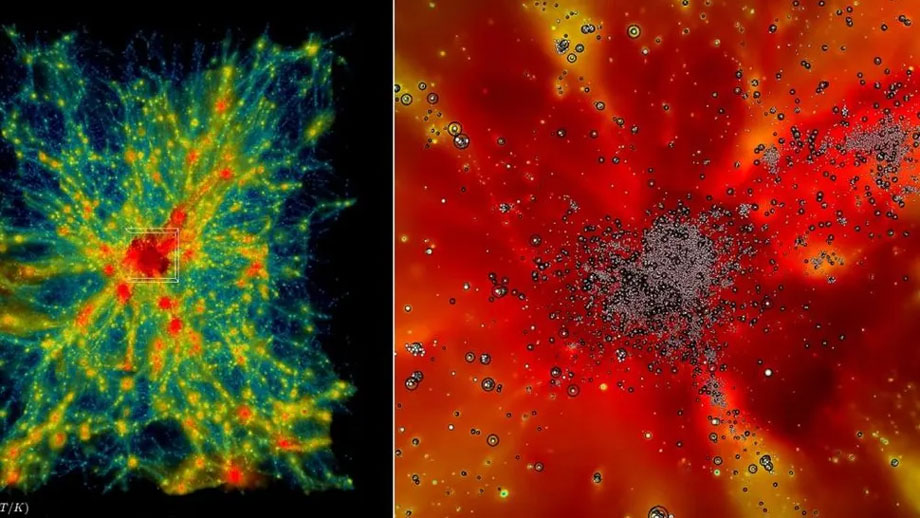
One of NASA’s supercomputers, Pleiades, named after the star cluster of the same name, was used to support the Kepler space telescope mission. It was used to calculate the sizes, orbits, and locations of planets surrounding the observed region of space, which contained over 200,000 stars. And in February 2025, using Pleiades, scientists discovered another cluster of billions of comets arranged in a spiral, just like in our galaxy, the Milky Way. This spiral consists of billions of icy bodies surrounded by a shell of comets, the Oort Cloud, a previously little-studied region.

Source: space.com
Looking into the distant corners of the Universe and better understanding its structure is the task of other supercomputers as well. The world’s second most powerful supercomputer, Frontier, runs the largest simulation of the Universe, specifically testing what researchers call cosmological hydrodynamics. Frontier is located at the Oak Ridge National Laboratory, the largest scientific research institution within the U.S. Department of Energy’s national laboratory system. This exascale supercomputer (capable of performing 10¹⁸ floating-point operations per second) allows researchers to study models of the Universe, asking questions about the nature of dark matter and energy or exploring alternative models of gravity.
Source: space.com
Optimization of aircraft design
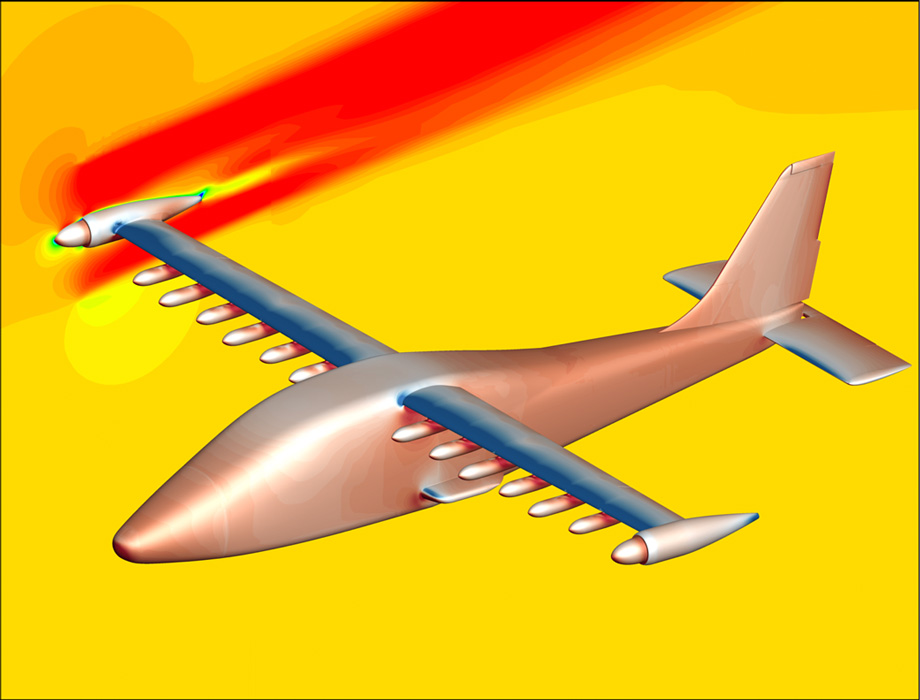
Using the LAVA software, NASA can also test flight scenarios for existing and future aircraft on supercomputers at the Ames Research Center, improving their design to reduce drag and the likelihood of head-on collisions. For example, the agency is developing electrified aircraft, which are predicted to become widely used by the mid-2030s. These planes are more environmentally friendly, consume less energy, and produce fewer emissions. The first such aircraft, the X-57 Maxwell, announced nearly ten years ago and having successfully completed tests in 2020, was designed with the help of the Pleiades supercomputer. The aerodynamic properties of its powerplant, which included 14 engines and propellers arranged along the wings, were also tested. Many flight scenarios for the X-57 were simulated on Pleiades, analyzing the stability and behavior of the propulsion system. As a result, drag was reduced by 4%, leading to significant fuel savings in actual flights.
Source: nasa.gov
Studying neutron stars
Neutron stars are cosmic objects that form as a result of the evolution of ordinary stars (most likely from supernova explosions) and have densities that far exceed those of their progenitors. Although their masses are comparable to that of the Sun, their sizes are thousands of times smaller: up to about 20 km in radius. The existence of neutron stars was initially predicted through theoretical calculations and later confirmed by indirect observations. Further study of these stars remains an incredibly challenging task, partially aided by computer modeling. Using data from the Fermi Gamma-ray Space Telescope, scientists created a three-dimensional simulation of the magnetosphere of a rotating neutron star with a strong magnetic field on the Aitken supercomputer. With the help of artificial intelligence and deep learning, they calculated the mass and radius of these stars and determined the structure of their magnetic field.

Source: nasa.gov
Modeling the sun
Three-dimensional simulations of the Sun are truly mesmerizing, but even more important are the conclusions that researchers are able to draw thanks to such modeling. These conclusions concern the influence of the Sun’s rotation on the structure of the solar convection zone, the behavior of solar jets and tornadoes, the generation of sound waves, and many other phenomena occurring inside our star and in its atmosphere. The supercomputers Pleiades, Electra, and Aitken have already helped simulate the dynamics of the Sun and have discovered a near-surface layer with a thickness of 6,200 miles, a finding important for understanding how surface magnetic fields reorganize before emerging on the surface.
Watch how the evolution of turbulent flows in the Sun’s upper layers looks:
Realistic visualization of complex space processes
The most powerful data visualization system is also located at NASA, and although it’s not a supercomputer in the traditional sense, its computational capabilities are nevertheless impressive. The “hyperwall” covers an area of 300 square feet and consists of 128 screens (16 horizontally and 8 vertically) with a total resolution of over one billion pixels. Each screen is directly connected to the Pleiades supercomputer, allowing photo and video content to be processed in real time. For example, when displaying an image from Spitzer, which includes about 800,000 frames capturing parts of the Milky Way galaxy, researchers can zoom in on any star they wish, identify anomalies, and detect patterns.

Source: mv-voice.com
Computing on Earth is just the beginning of a much larger story, during which we will better understand the Universe and the processes occurring within it. Soon, supercomputers will be able to operate directly in space to analyze data on-site, avoiding the complexity and expense of sending it to ground infrastructure. The first of these, AItech S-A2300, will perform operations in low Earth orbit: processing images in real time, providing autonomous navigation, and tracking space debris. It turns out that a revolution in space supercomputing may be very close, and we will soon witness it: the first AItech S-A2300 launches are scheduled for the first half of 2026.


