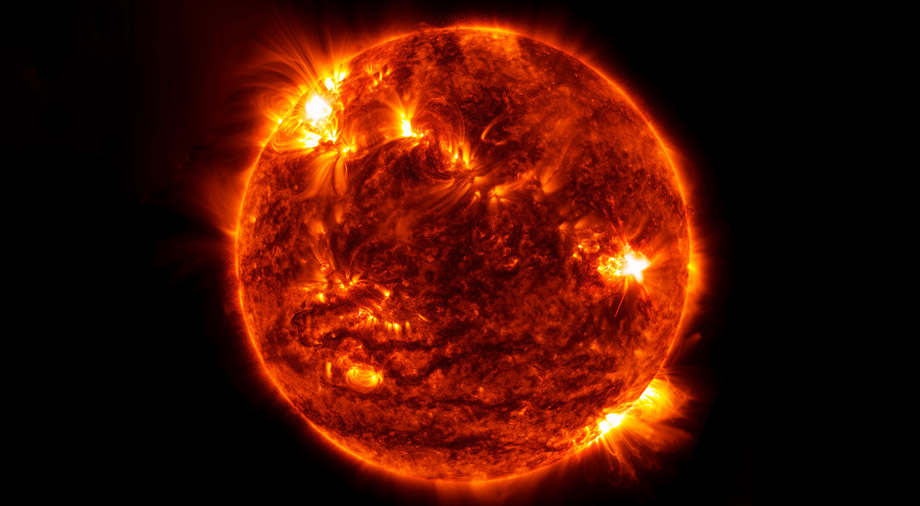
In the previous section, we looked at the main types of power sources for spacecraft, including chemical batteries, fuel cells, radioisotope thermoelectric generators, and even full-fledged nuclear power generators. However, most spacecraft in low Earth orbit or operating within the inner Solar System are powered by converting the Sun’s thermal energy into electricity.
This process involves the use of solar panels: devices with sunlight-absorbing surfaces that now power thousands of active satellites. Communication, weather, navigation (GPS, GLONASS, Galileo), scientific satellites, and even the crewed ISS meet nearly all of their power needs with onboard solar panels. But technology is constantly evolving, and increasingly bold concepts are being developed, including using space-based solar power generators not only to power spacecraft but also to meet energy needs on Earth. So let’s dive into the world of solar energy.
Long before orbit: the emergence of solar technology
As with the vast majority of space technologies, solar power generation was originally developed for use on Earth. Prototypes of solar panels actually first emerged during the Industrial Revolution in the 19th century. In 1839, the French physicist Alexandre Edmond Becquerel discovered the principle of the photoelectric effect, which underlies the operation of all modern solar panels.
At the age of 19, Becquerel was experimenting in his father’s laboratory. His father, Antoine César Becquerel, was a renowned physicist and researcher of electrochemical phenomena. For his part, young Edmond’s experiments involved creating an electrolytic cell made of two metal electrodes submerged in an electrolyte solution. One of the electrodes was coated with a light-sensitive material, silver chloride (AgCl). When the young scientist exposed this electrode to sunlight, he noticed that an electric current and voltage appeared in the circuit. This observation was revolutionary since it demonstrated that, in certain materials, light could directly generate an electrical current. Becquerel called this phenomenon the photogalvanic effect, which was later known as the photoelectric effect.
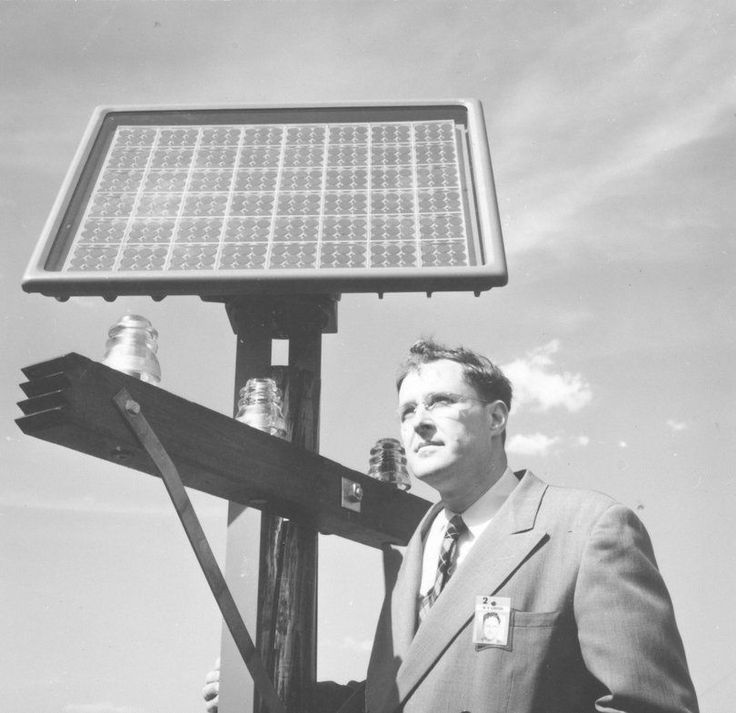
However, as has often been the case with brilliant discoveries in physics, it took nearly 115 years before Becquerel’s photogalvanic effect found practical application. It wasn’t until 1954 that three researchers at Bell Laboratories, Gerald Pearson, Calvin Fuller, and Daryl Chapin, invented the first practical silicon solar cell: a device capable of generating electricity from the Sun’s energy.
For the light-sensitive semiconductor material, the inventors chose silicon, which proved more absorbent and cost-effective compared to alternatives like selenium. Their solar cell featured special PN junctions that separated two types of silicon layers (positively and negatively doped). This made it possible to artificially create an internal electric field that efficiently separated photogenerated electrons and “holes” (the absence of an electron), directing them in opposite directions, and thereby generating an electric current.
Source: pinterest.com
The development of solar panels came precisely at the moment when they were most needed. The dawn of the space age was approaching, and aerospace engineers realized that Bell Laboratories’ new invention was perfectly suited for spacecraft and would be significantly more efficient in orbit than on Earth. In space, sunlight encounters no atmospheric resistance: it doesn’t scatter while passing through Earth’s atmosphere, and its radiation is relatively constant. For example, when a spacecraft is in a sun-synchronous orbit, it remains exposed to solar radiation 24 hours a day, meaning it could theoretically be powered exclusively with solar panels.
Always growing: from the smallest solar panels to the giants on the ISS
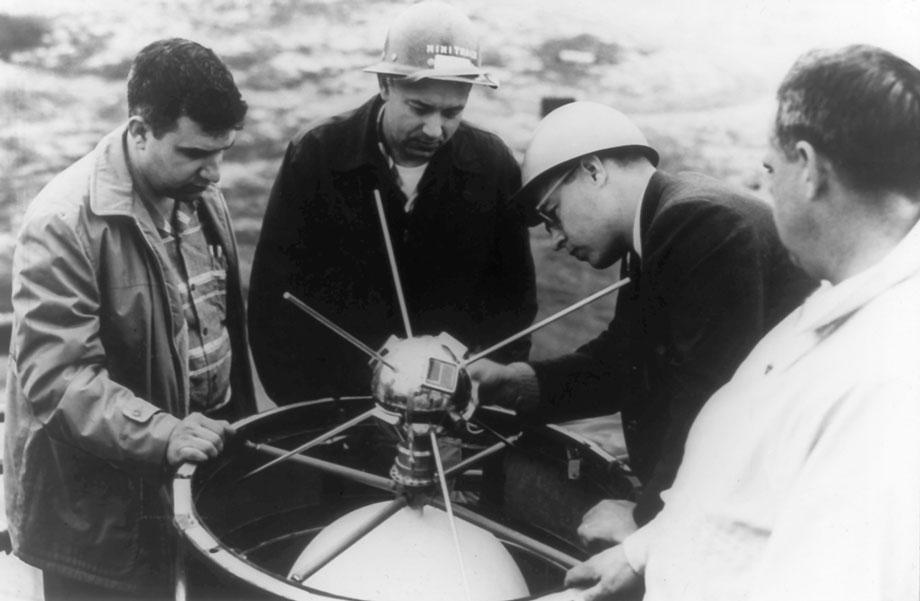
The first spacecraft equipped with solar panels was the United States’s second artificial satellite, Vanguard 1, which was launched on March 17, 1958. We mentioned this small spacecraft in our previous article, since it marked the first time nickel-cadmium chemical batteries were used to power satellites. However, it was also the first to demonstrate the potential for generating electricity from sunlight. Small solar panels mounted on the outside of the probe’s body, combined with chemical batteries, allowed it to operate for six years, ending in 1964. Even after the mission officially ended, the solar cells continued to power Vanguard 1, allowing NASA to periodically track its activity.
Source: scilogs.spektrum.de
Since the launch of Vanguard 1, solar power systems for spacecraft have undergone significant evolution, which can be roughly divided into four main periods.
Initial stage (1950s–1960s). In the early days of the technology, solar panels had very low efficiency (around 6–8%). This was due to the use of silicon wafers as absorbing elements and the limited surface area of the panels. Most often, solar panels of that era were integrated directly into the satellite’s body. However, by the late 1950s, the Soviet Sputnik-3 (launched in May 1958) and the American Explorer 6 (August 1959) were equipped with deployable solar panels. This innovation played a key role in the early development of the technology: the deployable design made it possible to significantly increase the absorbing surface area and, consequently, the amount of electricity generated.

Source: nasa.gov
The main problem for solar panels in the early period was the high risk of their absorbing elements rapidly degrading as a result of constant exposure to cosmic radiation. The relentless bombardment of silicon wafers by protons and electrons of cosmic origin inevitably reduced the already low efficiency of solar panels to just a few percent. This problem was later solved by introducing various types of transparent protective coatings, mainly made of borosilicate glass or fused silica, which covered the light-absorbing coating. It also turned out that the arrangement order of negatively and positively doped elements on the panel was quite important. In early versions, positively doped elements were placed on top of the panel (“P-on-N”). However, the energetically more efficient arrangement turned out to be the opposite (“N-on-P”), where the negatively doped silicon elements were on top.
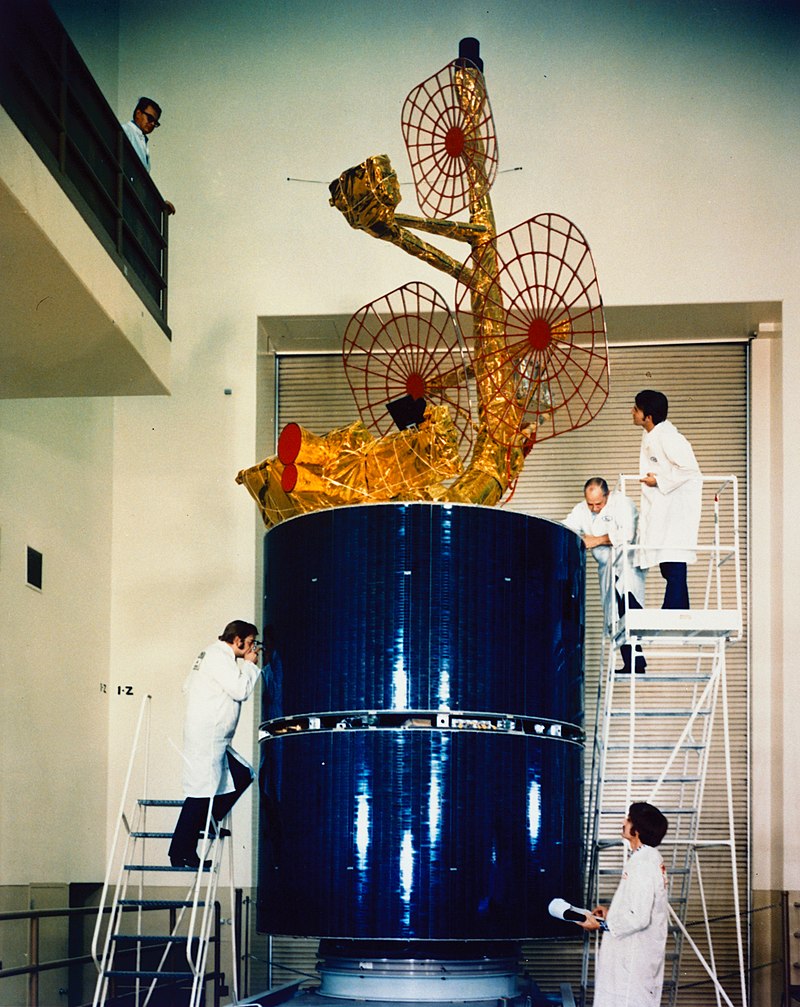
Second stage: performance enhancement (1970s–1980s). By the early 1970s, almost all spacecraft were equipped with deployable solar panels. This, along with the use of new types of lightweight materials, including aluminum alloys, composite materials, and thin metal foils, in solar panel construction, allowed engineers to equip spacecraft with even larger solar panels. The main innovation of this period was the emergence and implementation of trackers, a system for orienting solar panels, which appeared at the turn of the 1970s.
Source: Wikipedia.org
The tracker’s movable mechanisms allowed the adjustment of the panels’ position, so that they would always be directly exposed to sunlight. The introduction of solar trackers meant that it was no longer necessary to have huge panels for generating the required electricity. In other words, panel size could be reduced, freeing up kilograms for other payloads.
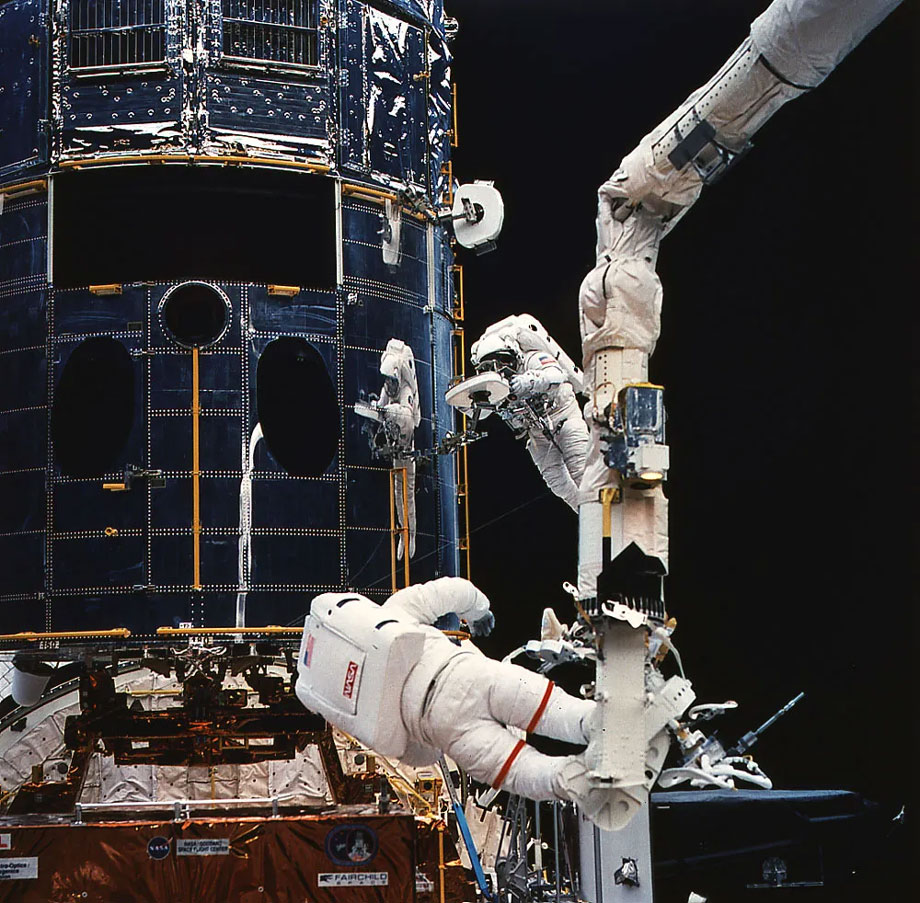
The most famous example from this period was the space-based Hubble telescope. Although it was launched in 1990, its development took place mainly in the 1970s and 1980s. From the beginning of its mission, the telescope was equipped with two deployable solar panels with a total area of about 40 m², capable of generating 2.4 kW of electricity. In 1993 and 2002, two manned servicing missions visited Hubble and replaced its original solar panels with more modern multi-junction solar cells based on gallium arsenide, which increased its power generation to 5 kW (in total, Hubble was serviced by four missions).
Source: nasa.gov
Although silicon wafers remained the main energy-absorbing element throughout the 1970s and 1980s, scientists increased their efficiency to 10–14% by employing new types of anti-reflective coatings made of silicon dioxide, better geometric design of the panel cells, and new methods of silicon purification that improved its absorption capacity. By the late 1980s, solar panels had been created boasting efficiency approaching 20% in laboratory conditions. It was also at the end of the 1980s that early commercial implementations of thin-film solar cells made from cadmium/copper sulfide and gallium arsenide appeared.
Third stage: high-efficiency cells (1990s–2000s). This period represented a true revolution in solar panel technology, since it marked the emergence of what are known as multi-junction solar cells. This new technology involved applying several thin layers of semiconductors made from different materials to absorb different parts of the solar spectrum. This innovation helped significantly increase the efficiency of new solar panels to an unprecedented 28–30%.
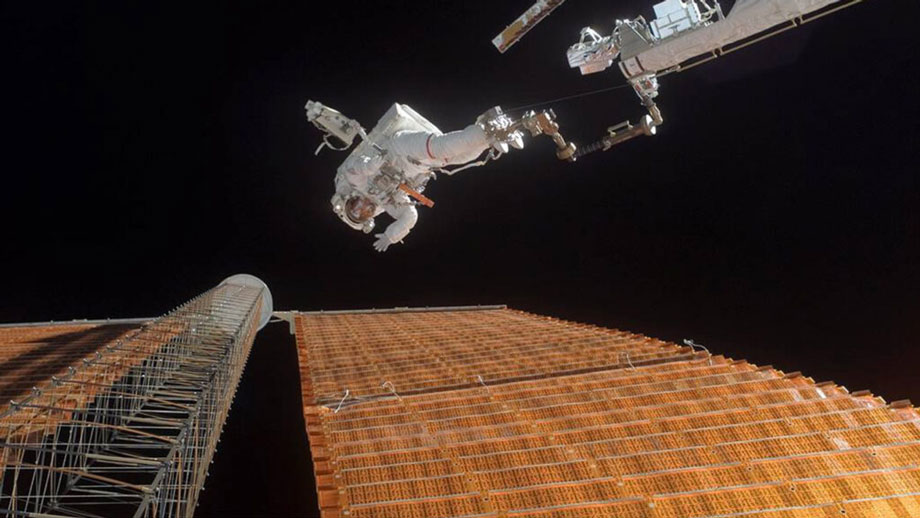
Multi-junction solar cells, most often composed of a triple layer of GaInP/GaAs/Ge (gallium indium phosphide/gallium arsenide/germanium), gradually eliminated the need for silicon wafers altogether. Gallium arsenide-based solar panels were used on the first ISS modules but were later replaced by a triple-layer multi-junction element based on GaInP/GaAs/Ge. Currently, the total surface area of solar panels on the ISS is 2,500 m². At their peak, they can generate 240 kW of electricity (under conditions where all panels are exposed to direct sunlight).
Source: issnationallab.org
The present day. The latest stage in the evolution of solar panels began in the 2010s and continues to this day. It is characterized by a continuous increase in efficiency of new types of solar panels, which now reach up to 40% efficiency under laboratory conditions. Another trend is a reduction of panels’ weight and volume thanks to the use of new types of lightweight composite materials. Complex new mechanical deployment and solar tracking systems also significantly enhance electricity generation, allowing the use of increasingly powerful types of sensors, optical cameras, and communication systems on spacecraft. The protective properties of solar panels have also evolved significantly: they now feature enhanced resistance to solar radiation, extreme temperatures, and other space environment conditions, which is especially important for planetary surface missions.
We have also seen upgrades to the solar array on the ISS. Since 2021, NASA has initiated a major replacement program, called ISS Roll-Out Solar Arrays (iROSA), to install more efficient solar panels on the station. The upgrade process is organized so that the old multi-junction solar panels do not need to be removed, since the iROSA panels are actually installed over them. Each new pair of iROSA panels adds about 20 kW of power to the orbital station. So far, three out of the six planned pairs of iROSA solar panels have been installed, with the next scheduled installation planned for this year.
Meeting Earth’s energy needs: space-based solar power stations
With the introduction of new, more efficient solar panels, scientists realized that they could be used not only to power artificial satellites, but also, potentially, to meet energy needs on Earth as well.
Peter Glaser, an American engineer of Czech descent, proposed his concept for space-based solar power stations (Space-Based Solar Power, SBSP) in 1968. His main idea was to harvest solar energy in orbit using large arrays of solar panels, after which thermal energy would be converted into microwave radiation (later concepts also proposed laser radiation) and transmitted to Earth. There, in specialized hubs, it could be converted back into electrical energy to power ordinary enterprises or ordinary consumer needs.
The first SBSP design concepts included several main elements:
- A huge array of solar panels that needed to be launched into orbit;
- An energy conversion system for converting the electrical energy collected by the solar panels into microwave radiation (the most common option) or a laser beam;
- A transmission system to be implemented as gigantic antennas (or laser systems) that would direct the energy beam to ground-based receiving stations;
- A rectenna (rectifying antenna) consisting of a ground receiving station that would convert microwave radiation back into an electric current for integration into the local power grid.

Source: rolandberger.com
As with conventional solar panels powering satellites, the key advantages of this method lie in the absence of night cycles (on certain types of orbits, energy is available 24 hours a day), as well as avoiding absorption of solar radiation by the Earth’s atmosphere.
Theoretically, space-based power stations could also transmit energy from space to any specially equipped point on Earth where power is needed. Another advantage, similar to terrestrial solar power plants, is that this form of energy is considered “green,” producing no greenhouse gas emissions and requiring no polluting substances in the generation process. Of course, this argument can be contested, since launching such space power stations would require at least one rocket launch, which inevitably produces greenhouse gas emissions.
However, the closer scientists came to implementing SBSP power stations, the more apparent various complex technological challenges became. First and foremost, to generate large amounts of electricity, orbital solar power stations would have to be truly enormous, which would require numerous space launches for modular assembly in orbit. Since economic feasibility plays an important role in energy production, SBSP’s deployment costs would far exceed the potential revenues from their use. One of the latest NASA reports on Space-Based Solar Power, published on January 11, 2024, warns that generating 1 kWh of electricity in orbit would currently cost on average 12x more than generating it on Earth.
Another problem lies in organizing the safe wireless transmission of high-intensity microwave or laser radiation from orbit to Earth. No-fly zones would need to be established in these areas, since traversing such intense radiation would be fatal for aircraft. While aviation protection can be properly organized, Earth’s natural biodiversity would also be at risk. In particular, potential harm to birds and plants poses a major obstacle that will require further research.
Another major challenge will be the development of reliable systems for energy conversion and wireless transmission over long distances to Earth, as well as designing efficient types of ground receiving stations. Space-based solar stations, moreover, would be unlikely to be located in high orbits (like geostationary), since energy transmission from such orbits would threaten to disrupt satellites on lower orbits.
It might seem that such challenges would be nearly insurmountable. However, the first such station is actually scheduled to be launched this year: a demonstration satellite weighing 180 kg has been developed as part of the Japan Space Systems’s OHISAMA SBSP technology development program.
The spacecraft will be placed in low Earth orbit (LEO) at an altitude of 400 km, and its solar panels will have an area of only 2 m². Despite its small size, however, Japan Space Systems claims that the satellite will be able to generate 1 kWh of electricity, which will then be transmitted to Earth as microwave radiation. The ground receiving antenna system will occupy an area of 600 m². OHISAMA’s chief engineer, Koichi Ijichi, predicts that the entire transmission process will last about 5 minutes. Besides deploying the satellite solar power station, Japan Space Systems also plans to demonstrate a power station of their own design, which will be installed onboard an aircraft.

Source: European Space Agency
Besides Japan, China and the United States also have their own orbital solar power projects. Both countries see the concept as a potential source of clean, sustainable energy for Earth in the future. In 2023, the California Institute of Technology (Caltech) successfully tested a wireless power transmission system in space as part of its Space Solar Power Project (SSPP).
Soon, we will see whether the SBSP technology is viable in practice. Perhaps, much like the first space solar panels, whose coverage area was only a few dozen square centimeters, orbital solar power stations will evolve and eventually be able to generate gigawatts of electricity to meet the energy needs of people on Earth.