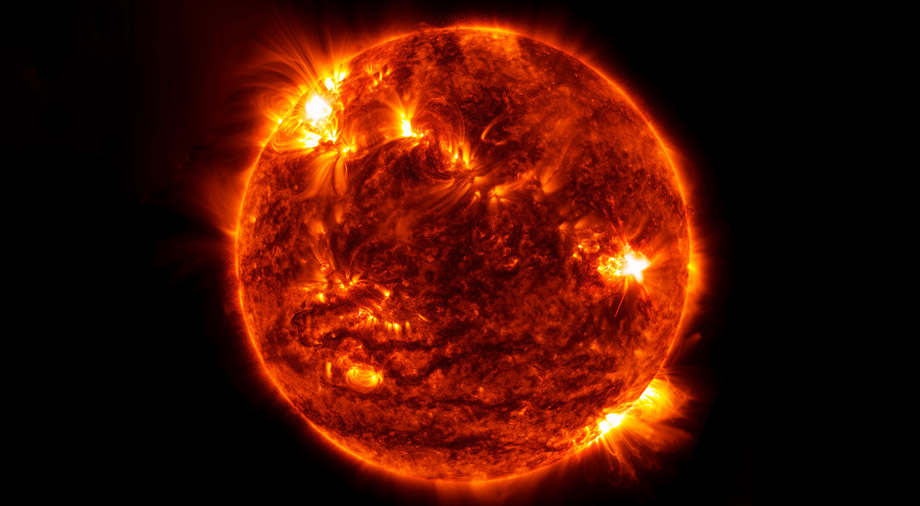
On July 18, 2025, NASA’s new SNIFS (Solar EruptioN Integral Field Spectrograph) instrument was launched aboard a Black Brant IX sounding rocket from the White Sands Missile Range in New Mexico. Designed to observe the Sun, the spectrograph’s mission lasted only a few minutes, but even in that short time, it managed to capture more precise data on our star’s chromosphere than had ever been possible before. Here’s why this mission is so important, and how its results could reshape our understanding of the Sun and its impact on Earth.

Source: science.nasa.gov
What is the chromosphere, and why is it so difficult to study?
According to the U.S. National Solar Observatory, the Sun’s chromosphere is considered “one of the most mysterious objects in astrophysics.” This is the place where the Sun’s temperature, pressure, and magnetic field undergo “dramatic changes” and where “the real magic happens.” For example, the temperature in the chromosphere begins to rapidly rise from six thousand to over a million degrees Celsius. The chromosphere’s distinctive color results from the fact that hydrogen in the Sun emits a reddish light precisely at these high temperatures.
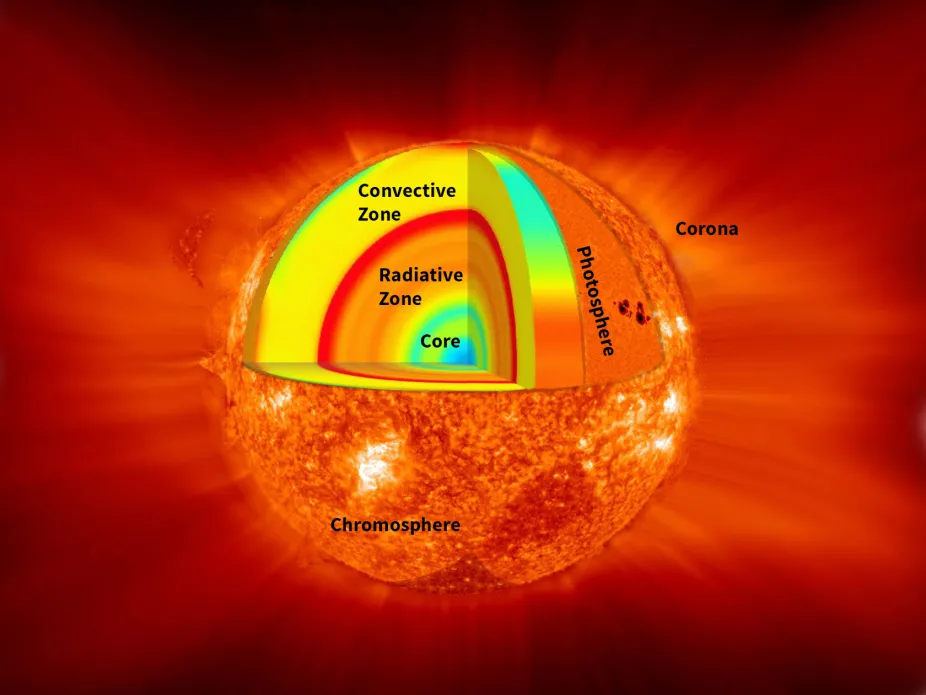
The chromosphere is located between the Sun’s visible surface, known as the photosphere, and its outer layer, the corona. Because of this, scientists call the chromosphere the “gateway to the corona,” which is almost 300 times hotter than the Sun’s already scorching surface.
Researchers have been able to study the various layers of the Sun’s atmosphere in detail for several decades. Still, the chromosphere has long remained an enigma, even though it is there that powerful solar flares and massive coronal mass ejections, phenomena that shape space weather, regularly occur. In turn, space weather directly affects the safety of astronauts, satellites, and space infrastructure.
For example, high-energy solar particles can impact the electronic components of satellites, causing malfunctions and equipment failure. Disturbances in the ionosphere triggered by space weather can lead to the loss of navigation signals. And astronauts who are on missions during solar flares face an increased risk of radiation sickness and other health problems.
Source: scied.ucar.edu
SNIFS Mission Objectives
The SNIFS mission was designed to study how energy is transformed and propagated through the chromosphere, where it can ultimately fuel powerful solar eruptions. In this regard, SNIFS became the first mission of its kind designed for in-depth investigation of solar ultraviolet radiation. SNIFS is equipped with two key instruments: a spectrograph and a camera. These tools make it possible not only to “see” the Sun in different wavelengths, but also to record video of its activity. This will allow scientists to observe individual layers and elements of the Sun from a new perspective, as well as to detect features that were previously invisible in ordinary light.
For many years, solar research missions were equipped with cameras that could only capture the Sun’s rays and layers. To gain a complete picture of the thermal energy emitted by the star and that of sudden solar flares, something more sophisticated than a camera is required. What is ultimately needed is a spectroscope: an optical instrument for visually observing the radiation spectrum. In the context of solar study, a spectroscope splits the Sun’s light into individual colors (a spectrum) and then analyzes its composition and physical properties. This allows scientists to determine which elements are present in the Sun’s atmosphere and how they interact with solar light.

Source: yahoo.com
It wasn’t just a lack of specialized equipment that hindered the study of the chromosphere: it turns out that this layer of the sun is also genuinely difficult to investigate for several reasons. For one thing, the chromosphere is a chaotic mixture of ionized plasma, neutral atoms, and tangled magnetic fields. Standard physical models simply don’t work here because particles in such conditions behave in completely unpredictable ways: they collide, become charged, and accelerate in defiance of established thermodynamic laws. The SNIFS mission was able to overcome this limitation by capturing instantaneous snapshots of solar activity in real time.
According to Souvik Bose, a heliophysics researcher at Lockheed Martin and one of the scientists on the SNIFS project, “We have several very powerful telescopes on Earth that use spectroscopy to study the Sun. But the problem is that Earth’s atmosphere filters out a significant portion of ultraviolet rays before they reach us.” That’s why it was so important to send a spectrograph into space to record ultraviolet rays, which contain vital information about the Sun, including its composition. And that’s exactly what the SNIFS mission’s spectrograph did, allowing scientists to finally learn more about the nature of the chromosphere, which has remained a subject of debate for many years.

Source: science.nasa.gov
Understanding the processes taking place in the chromosphere is critically important for predicting solar flares and other space weather phenomena in the future. According to Vicki Herde, a graduate student at the University of Colorado, who dedicated four years to developing the SNIFS project, “If we want to protect Earth from the effects of space weather, we need to be able to model it.”
Technical details of the SNIFS mission
The SNIFS project was completed under the leadership of NASA’s Goddard Space Flight Center, the University of Colorado, and Queen’s University Belfast. It was a suborbital sounding rocket mission, which involved years of instrument preparation for a brief but extremely data-rich flight lasting less than 15 minutes, during which everything truly happened very quickly. First, the Black Brant IX sounding rocket launched SNIFS into space in just 90 seconds. Then it deployed the payload toward the Sun for an experiment that lasted about seven to eight minutes. Another three to five minutes were required for the rocket to return to Earth. White Sands was chosen as the landing site for the sounding rocket, and for good reason: it’s a vast and sparsely populated area, ideal for a safe landing.
As its payload, the SNIFS mission carried the first-ever integral field ultraviolet solar spectrograph combined with an imaging device. This equipment combination enables the observation of integrated light over a wide field of view while simultaneously taking photographs and recording video. The spectrograph in SNIFS separates light into different wavelengths (also called spectral lines), identifies their components, and determines their temperature and direction of motion. Among these spectral lines are the hydrogen line, the brightest in the Sun’s ultraviolet spectrum, as well as two spectral lines from silicon and oxygen. The data collected on these elements will help scientists better understand how the chromosphere interacts with the upper layers of the atmosphere and track how solar matter and energy pass through it.
Look at the design of SNIFS: the two left sections house the telescope and the spectrograph itself, while the telemetry components and auxiliary equipment are located on the right.

Source: researchgate.net
How will scientists use data from the SNIFS mission?
SNIFS will significantly advance the study of solar activity by analyzing energy flows in the Sun’s chromosphere. This, in turn, will enable more accurate space weather forecasting: for example, predicting solar storms that threaten the stable operation of satellites, navigation systems, and global power grids. The mission also aims to solve one of the Sun’s greatest mysteries: the enigma of coronal heating. SNIFS will allow scientists to determine exactly how massive amounts of energy are transferred from the chromosphere to the superheated corona. In addition, the detailed 3D maps created during the mission will help update and refine existing models of the Sun developed in previous studies. This will give researchers a unique opportunity to test their theories about plasma behavior and improve the modeling of solar eruptions under extreme magnetic field conditions.
SNIFS, therefore, is truly unique: it’s the world’s first integral spectrographic mission in the ultraviolet range that has helped shed light on how energy is transferred from the chromosphere to the corona. At the same time, however, it is not the only project observing the Sun. Previously, NASA’s Parker Solar Probe approached the corona closely, studying its lower layers and the Sun’s magnetic field. Another probe, Solar Orbiter, launched jointly by NASA and ESA, has been observing the Sun’s polar regions for several years. The Solar Dynamics Observatory also continuously captures our star in multiple UV ranges. Soon, these missions will be joined by Europe’s Proba-3, which will create an artificial eclipse to study the inner corona in detail, and China’s Solar Polar Orbit Observatory, which will provide the first detailed view of the Sun’s polar regions.
One can only wonder: what other secrets does the Sun still hold?