Quantum mechanics emerged as a full-fledged science 100 years ago. In 1925, three German physicists, Max Born, Werner Heisenberg, and Pascual Jordan, jointly developed the fundamental equations of matrix mechanics. These scientists were inspired by the new concept of quanta as the smallest particles of matter, an idea introduced in the early 1900s by another German physicist, Max Planck, in his lectures.
Later, the general principles of quantum mechanics were expanded by the Austrian physicist Erwin Schrödinger, who introduced the concept of the wave function, providing a mathematical description of the “superposition principle.” These works had a profound influence on an entire generation of scientists, including Albert Einstein, the father of the General Theory of Relativity, and Robert Oppenheimer, the creator of the atomic bomb.
The current century has elevated innovative quantum technologies to new heights, and even further: to near-Earth orbit, where the theory of the tiniest particles in our universe is paving the way for a revolution in satellite communication and data encryption.
Basic principles of quantum theory as applied to encryption
It is quite difficult to explain how quantum encryption works without delving into complex mathematical formulas, but we will try to provide at least a surface-level understanding.
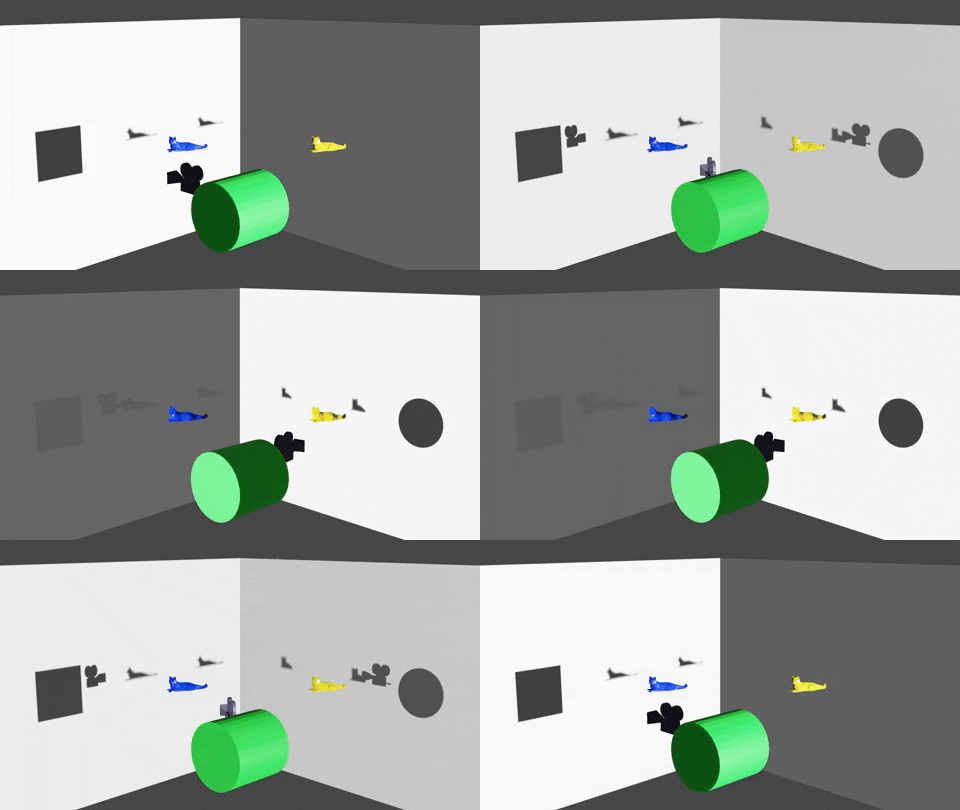
One of the key principles of quantum mechanics is Heisenberg’s “uncertainty principle,” which states that it is impossible to simultaneously determine all the parameters that describe a quantum particle. When a scientist measures one parameter of a quantum system (such as its position, momentum, or spin), all other parameters immediately become indeterminate. This means that, until the moment it is measured, a quantum particle exists in a state of “superposition,” or indeterminacy.
The principle of quantum superposition is fundamental to describing any quantum system, and all matter at the subatomic level (the level of elementary particles such as photons, neutrons, electrons, quarks, and others) adheres to it. Essentially, it asserts that, until a measurement is actually made on an elementary particle, that particle exists in multiple states simultaneously.
Source: giphy.com/RatherBeEmbed
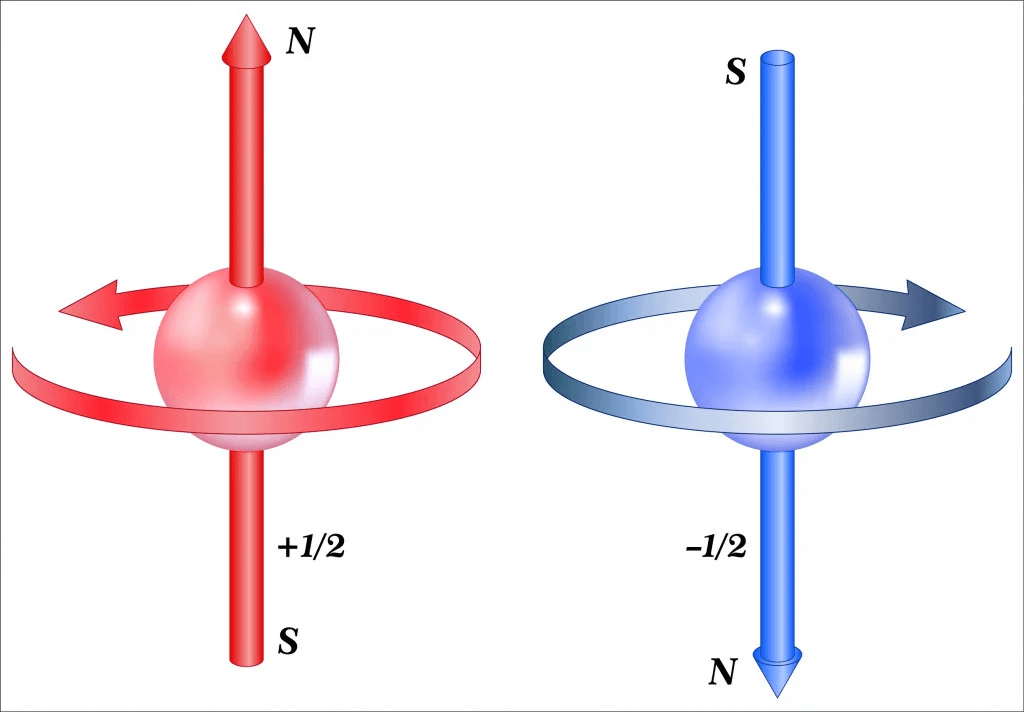
Every quantum particle is characterized by a set of parameters, one of the most important being its spin, or angular momentum. The spin of an elementary particle represents its intrinsic angular momentum. However, unlike classical physics in our macroscopic world, this rotation is not tied to the actual movement of mass or the physical dimensions of the quantum particle. It is now known that even the smallest point-like particles, which lack mass or finite size, possess spin. Depending on the type of elementary particle, its spin can be expressed in quantum numbers: a set of parameters specific to that particular quantum entity.
A century ago, scientists discovered that the spin of an electron creates magnetism. Therefore, according to our understanding of electromagnetism, the spin can be oriented either upward or downward. It is also worth noting that Heisenberg’s uncertainty principle prohibits measuring a particle’s spin relative to more than one axis simultaneously.
Source: Fouad A. Saad/Shutterstock
Another fundamental principle of quantum mechanics is the concept of entangled particles or entangled quantum states. This state, characteristic of a group of quantum particles (two or more), endows the group with a hidden interconnection that is independent of the physical distance between the particles. The primary feature of this connection is the complete dependence of the particles on one another. If something happens to one entangled quantum particle, it immediately affects the state of the other, and vice versa.
The phenomenon of quantum entanglement allows scientists to artificially create quantum pairs (or larger sets) of entangled particles that can instantly interact even over great distances. In this case, the speed of information transfer surpasses the fastest known in nature, the speed of light. Due to this “instantaneous aspect” inherent to entangled particles, Albert Einstein humorously referred to the principle of quantum entanglement as “spooky action at a distance.”
The key property of entangled particles is understanding that entangled pairs, such as electrons, always have opposite spins. Thus, even though it is impossible to know the spin of an entangled electron before it is physically observed in a detector, we can be certain that the spin of its entangled pair will have the opposite value.
These two principles, quantum superposition and quantum entanglement, form the foundation of quantum computing and quantum cryptography (QC), as well as quantum key distribution (QKD) technology.
From theory to practice: how does QKD technology work?
The main problem with existing data exchange systems lies in the potential for intercepted information during transmission between parties. This is the so-called “man-in-the-middle” attack, allowing a hacker to infiltrate the connection and capture the data during its transfer from Party A to Party B.
Current encryption protocols can protect information even if it is intercepted, thanks to complex, multi-layered encryption systems that require significant time to crack. Nonetheless, even the most advanced encryption systems cannot guarantee absolute security. Moreover, the advent of fully functional quantum computers is drawing closer, threatening to reduce the time needed to decrypt encoded data to mere minutes—or even seconds.
Quantum key distribution (QKD) technology offers a fundamentally different approach to cryptography, relying on the physical properties of quantum physics rather than traditional mathematics. As we know, measuring one entangled quantum particle instantly affects its pair. QKD leverages this principle to detect third-party interference in the communication channel. Any reading or copying of elementary particles would alter their quantum state, making the intrusion immediately noticeable.
This ability to detect “man-in-the-middle” attacks with 100% certainty renders a quantum encryption key compromised and unusable. This instant detection of third-party interference in the communication channel is a unique feature of QKD, unattainable with traditional cryptographic methods.
Technically, QKD is implemented by transmitting millions of quantum particles (such as photons or electrons) from sender to receiver. Let’s examine the principle of quantum key distribution using the first known QKD protocol—BB84.
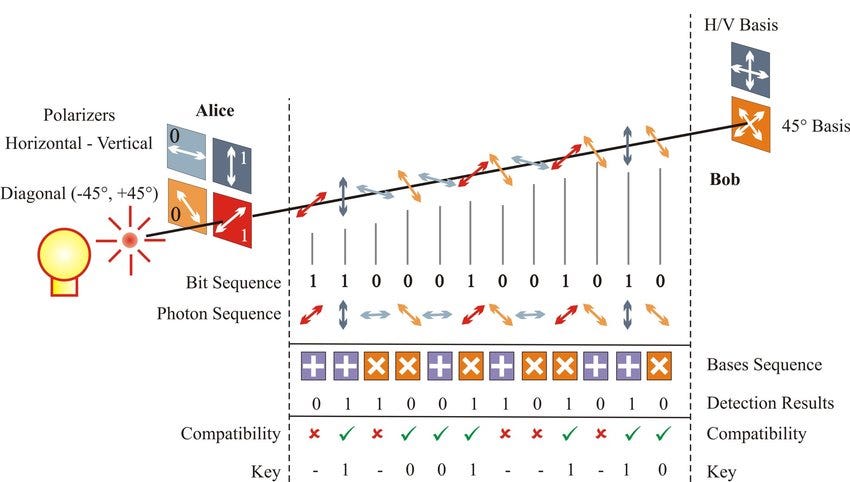
In this protocol, the generation of a unique encryption key occurs by transmitting millions of photons (essentially light quanta) through a fiber-optic cable from one user to another. Each of these photons has a specific quantum state that can be described by various parameters. For photons, this is their polarization, which can be vertical/horizontal or diagonal. (For electrons, it might involve spin states, among other possibilities.) As the photons reach the detector, they form a bitstream of information (familiar 0s and 1s).
A unique quantum key is created when the receiver detects the photons’ polarization. Detection occurs randomly since the receiver does not know which beam splitter was used for each photon when the sender transmitted the signal. This process builds a random sequence of polarization states for the received photons, which is then compared with the polarization sequence of the sent signal. Any mismatched values are discarded while matching ones form a unique encryption key known only to the two participants in the data exchange process.
Source: researchgate.net
The above data encryption protocol is called ВВ84, where the first two letters В refer to the names of the computer physicists who were behind its creation (Charles Bennett and Gilles Brassard), and 84 refers to the year 1984 when the protocol was developed. Since this time, a whole series of protocols appeared, among which the most famous are: BB84, E91, B92, SARG04, and Lo05, as well as the Goldenberg-Weitman protocol and the Koashi-Imoto protocol.
The BB84 QKD protocol uses a fiber-optic cable to transmit the signal. However, its transmission can also occur using other means of signal transmission: for example, the transmission of photons through laser radiation. This is the principle that was used in the first quantum satellite, the Chinese Micius/Mozi, or QESS (Quantum Experiments at Space Scale), which was put into orbit in 2016.
The First Quantum Pioneer Reaches Orbit: The Launch of QUESS
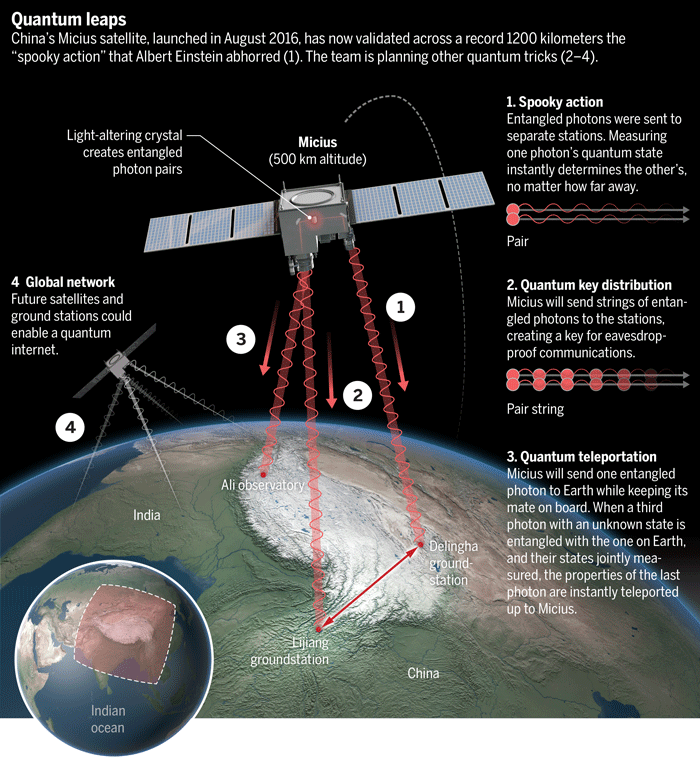
On August 15, 2016, the world’s first quantum satellite, Micius/Mozi, was launched into space aboard a Chinese Long March 2D rocket. Its primary mission was to demonstrate space-to-earth QKD technology. The satellite settled into its operational orbit at an altitude of 500 km.
The first experiment conducted by the quantum satellite was a demonstration of QKD technology between two remote Chinese observatories in Xinjiang and Xinglong. The ground distance between them was approximately 2,500 km. The next milestone was a demonstration of the “spooky action at a distance” that so perplexed Einstein. The satellite performed partial teleportation, transmitting the state of an entangled electron to the Ali Observatory in China (full electron teleportation was achieved five years later, in 2021). In both cases, the quantum teleportation distance was 1,200 km.
The generation of entangled photons used for key encryption took place directly on board the satellite, using a Sagnac-effect interferometer.
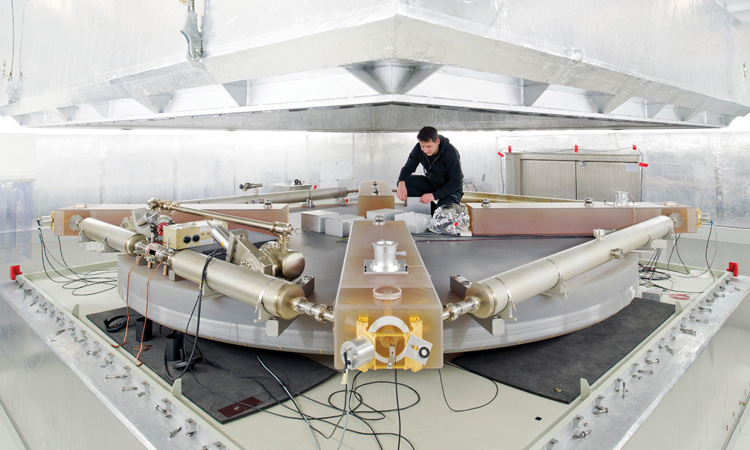
Source: optica-opn.org
Ultimately, Micius/Mozi was used to establish the world’s first international quantum communication channel from Beijing to Vienna, a distance of 7,456 km. Scientists employed satellite-based QKD technology to encrypt a video call from a Beijing laboratory to their colleagues at the Institute for Quantum Optics and Quantum Information in Vienna. This groundbreaking achievement demonstrated the feasibility of space-based quantum cryptography.
Since the QKD technology utilized by Micius/Mozi relied on laser transmission of photons, the satellite faced certain limitations, such as only being able to transmit signals at night. Additionally, the ground-based receiving station had to remain within the direct line of sight of its sensors.
Despite its initial planned operational lifespan of just two years, the QUESS satellite remains in orbit to this day, continuing to conduct new experiments with QKD and the teleportation of entangled particles. In 2022, China expanded its capabilities in space-based quantum encryption by launching another satellite, Jinan-1, into orbit.
Source: science.org
In 2025, China plans to increase the number of experimental satellites for quantum cryptography. Over the course of the year, two or three satellites similar to Micius/Mozi are expected to be launched, but with more powerful instruments for generating entangled particles at higher orbital altitudes. The higher orbital ceiling is needed to increase the time the satellite spends passing over the ground-based receiving station, as the low Earth orbit of Micius/Mozi required high-speed decision-making and significantly limited the time for signal transmission.
China’s plan is to create a full-fledged global network of quantum satellites in the 2030s.
While it may seem strange, until August 2024, China was the only country in the world experimenting with QKD in orbit. This was partly because powerful space-faring nations like the United States did not view quantum communication as a strategic field, favoring laser communication instead, which began appearing on SpaceX’s Starlink satellites starting in January 2024.
The world’s response: the German quantum CubeSat and Boeing’s plans
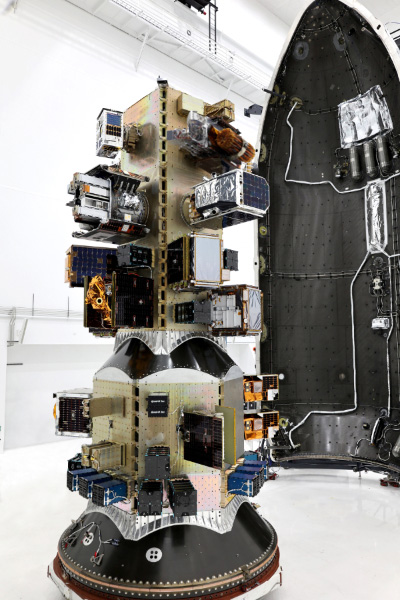
The first response to China’s quantum satellites came on August 16, 2024, when the German CubeSat, QUBE, weighing just 3.5 kg, was launched aboard a Falcon 9 rocket. It was developed by the German research institute Zentrum Für Telematik eV (ZFT), also known as the Center for Telematics.
QUBE’s primary mission is to organize quantum encryption by transmitting quantum states of photons, which the satellite generates in orbit using its miniaturized quantum random number generator (QRNG). The UNISEC-Europe standard, which the German satellite uses to transmit encoded photon beams, was patented in 2018, but it took almost six years to develop a fully functional CubeSat version. During its six months in orbit, QUBE conducted a series of studies, the primary one being the refinement of the technology for precise alignment with the receiving station, ensuring continuous transmission of quantum keys.
Source: SpaceX
The European Space Agency (ESA) is also interested in unlocking the space potential of QKD technology. A number of European countries and commercial companies are currently involved in the development of Eagle-1, the first European orbital platform for quantum key distribution. Its launch is planned for 2025-2026.
Currently, there is very little information about the new satellite. It is known that a consortium of over 20 European manufacturers is involved in its development. The satellite bus is being supplied by the Italian company Sitael, while the payload for creating entangled particles is being developed by the German company Tesat Spacecom. The ground infrastructure for receiving signals is being built by the German Aerospace Center (DLR).
The development of Eagle-1 is part of the ESA ScyLight program. The spacecraft will be placed in LEO, where it will serve as the first three-year demonstration before the full implementation of Europe’s quantum communication infrastructure, EuroQCI.
Another player that has taken interest in the advantages of satellite quantum communication is the American aerospace conglomerate Boeing. By 2026, it plans to demonstrate its own satellite, Q4S, which will use quantum data transmission protocols to spread the internet.
An additional application of the Q4S satellite may be the creation of an ultra-precise clock, based on the principle of quantum entanglement. Despite the ambitious nature of its project, Boeing assures that Q4S will be purely an experimental satellite for certain point demonstrations, emphasizing that the full implementation of quantum data transmission networks and global QKD satellite networks is still a long way off.
These statements are indeed accurate, since, despite the innovation of the technology, QKD has a number of weak points that physicists and computer scientists still need to address.
The future of technology: quantum cryptography or laser communications?
At the current moment, quantum cryptography, quantum key distribution (QKD), and quantum communication technologies, continue to face a number of technical challenges, which were recently highlighted by the National Security and Defense Council (NSDC) and the U.S. Central Security Service. Let’s review the main issues:
Authentication of the quantum key transmission source. While QKD technology ensures the generation of reliable, unique keys that guarantee protection from interception at the level of quantum physics, there remains the problem of authenticating the source of the transmission or the receiving signal. In other words, we need to be sure that the quantum transmission is coming from the intended sender and is being received by the required recipient. Currently, authentication is carried out using traditional data transfer protocols, which are still vulnerable to hacking. This results in a situation where the encrypted quantum communication channel, while protected from third-party interference, may still allow one of the parties involved in the transmission to be compromised by a malicious actor.
Technologically complex and expensive infrastructure. QKD systems require complex network infrastructure, which is difficult to integrate with existing network equipment or replicate in software. The use of reliable signal relays depends on large budgets. Ground-based quantum communication systems, relying on fiber-optic cables, require equipment to relay signals every 10 km. While space-based QKD seems to be a less costly technology, optical transmission of quantum flow faces classic issues such as signal absorption by Earth’s atmosphere, inability to transmit information through dense clouds, etc.
Complicated key protection and verification processes. The security offered by QKD also proves to be a weakness when it comes to verifying generated keys, as the margin for error is much smaller, complicating the verification process. Attacks on QC and QKD systems have already been recorded, including attacks using fake states or large impulse attacks, which could lead to optical eavesdropping.
Service denial due to the system’s high sensitivity. Another situation where the strong point of QC and QKD systems is a weakness. The high sensitivity to interception can lead to service denials of quantum keys, even in cases where there is no actual interference from third parties in the data exchange process.
As a result, in recent reports on the use of QC and QKD for encrypting critical national security communications, the U.S. has increasingly leaned toward the use of new types of optical (laser) data transmission systems, organized via satellite relay networks. Another solution being considered is the development of quantum-resistant, or post-quantum cryptography, as a more reliable and technically feasible alternative to QC and QKD. More information on post-quantum cryptography and its standards can be found here.
However, China’s experiments with these technologies and its desire to deploy a global satellite network for quantum cryptography and key distribution have raised serious concerns in the U.S. Warnings about China’s development of new types of QKD technologies appeared in the annual report of the U.S.-China Economic and Security Review Commission, published in November 2024.
Meanwhile, the U.S. Strategic Command and departments involved in national security matters continue to place their bets on space-to-space and space-to-ground laser satellite communication systems. Chinese experiments with quantum key distribution systems, however, remain a kind of “terra incognita” for the U.S. Nevertheless, the next decade seems unlikely to yield any major breakthroughs in quantum cryptography. Most likely, these years will be used to establish and strengthen optical-laser telecommunication systems.