On May 19, 2026, a landmark event took place for both heliophysics and geophysics: from Europe’s spaceport in French Guiana, the Solar wind Magnetosphere Ionosphere Link Explorer (SMILE) mission, a joint project of the European Space Agency (ESA) and the Chinese Academy of Sciences (CAS), was successfully launched.
SMILE will provide researchers with the first global images of Earth’s magnetosphere and conduct an in-depth investigation of its complex interaction with the relentless solar wind. What lies behind this fascinating connection, and what does it mean for space weather and the security of our technological infrastructure? Let’s find out.
Earth’s magnetic shield from destructive cosmic winds
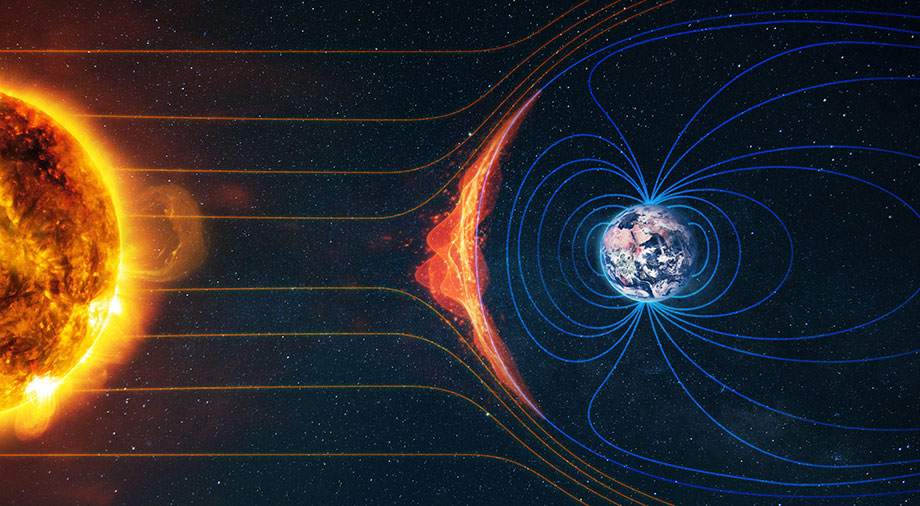
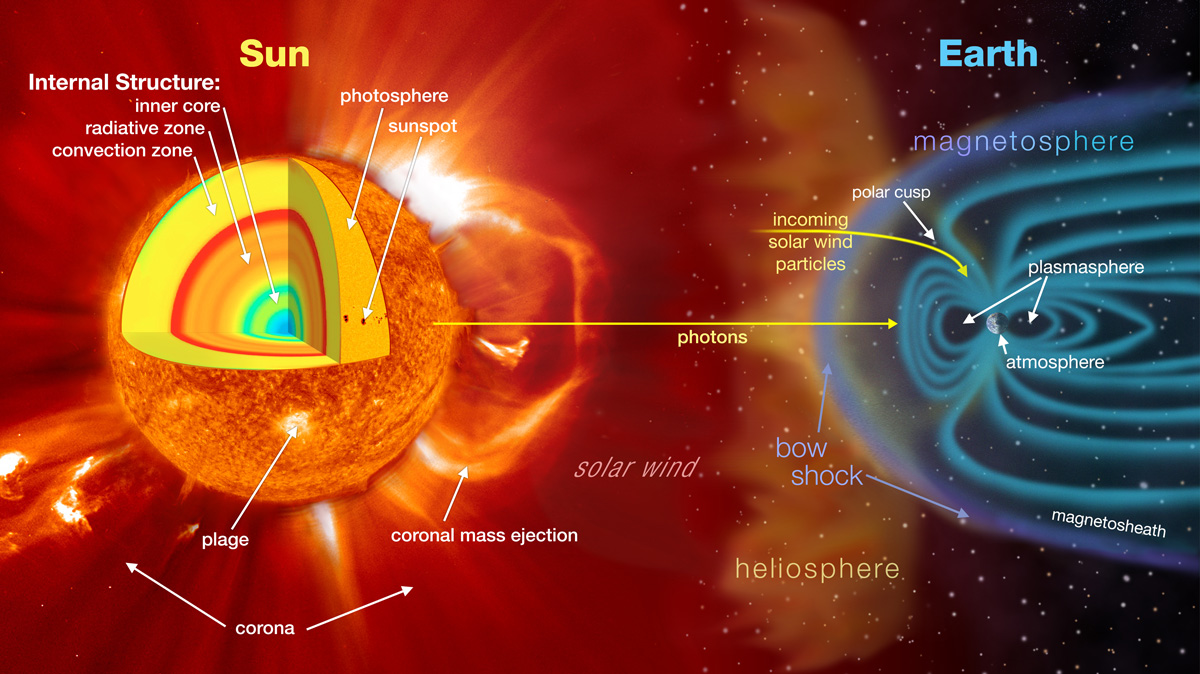
The solar wind is a continuous and extraordinarily powerful stream of charged particles, primarily electrons and protons. These plasma flows are constantly expelled from the Sun’s superheated outer atmosphere, known as the solar corona, and spread in all directions throughout our Solar System. The temperature of this plasma reaches roughly one million degrees Celsius, making it a highly dynamic and potentially hazardous environment.

Source: esa.int
The speed of this cosmic stream is remarkable: under normal conditions, it races through interplanetary space at velocities ranging from 300 to 800 kilometers per second. Along with its charged particles, the solar wind carries the interplanetary magnetic field, which governs the electromagnetic environment throughout the Solar System. Coronal mass ejections loaded with energetic particles constantly bombard every planet in their path: the more powerful the eruption, the greater the potential damage.
The solar wind is capable of literally stripping away the atmospheres of planets that lack strong magnetic fields, depriving them of water and other gases. Mars provides a striking example: billions of years ago, the Red Planet lost most of its dense atmosphere largely due to the long-term effects of the solar wind.
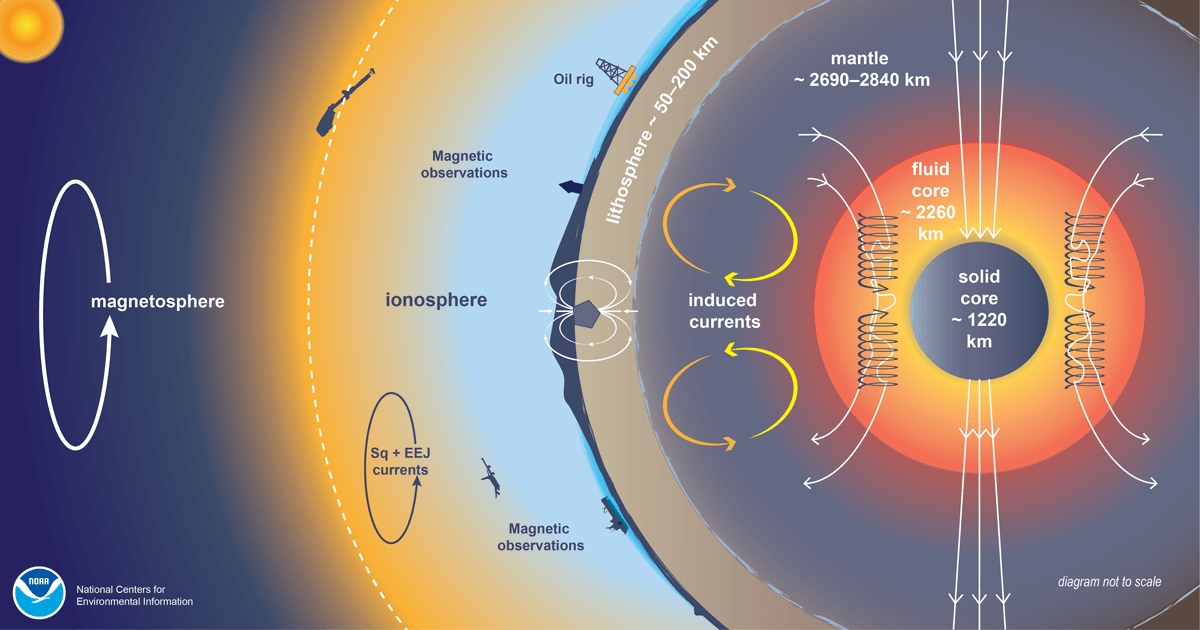
Fortunately, Earth is equipped with an effective internal “generator” that provides a reliable protective barrier: the magnetosphere. Our planet’s magnetic field is produced through a process known as the geodynamo. At a depth of roughly 3,000 kilometers beneath the surface lies Earth’s outer core, composed primarily of molten iron and nickel. The continuous motion and convection of this liquid metal generate electric currents, which, through the laws of electromagnetic induction, create a powerful magnetic field surrounding the entire planet.
Source: ncei.noaa.gov
Earth’s magnetosphere is not a perfect sphere. Under the constant pressure of the solar wind, it becomes distorted, taking on an aerodynamic, teardrop-like shape. On the dayside of Earth (the side facing the Sun), the magnetic field is compressed to a distance of about 65,000 kilometers, or roughly 10 Earth radii. On the nightside, it stretches into a long magnetotail that extends millions of kilometers into space, far beyond the orbit of the Moon.
The outermost boundary of Earth’s interaction with space is known as the “bow shock.” It forms at the frontier where the supersonic solar wind abruptly encounters the magnetosphere. The process is similar to the wave that forms at the bow of a ship moving rapidly through water (hence the name). At this collision region, the flow of charged solar particles suddenly slows from supersonic to subsonic speeds and heats up.
Source: svs.gsfc.nasa.gov
Immediately beyond the bow shock lies the magnetosheath. This is a region of extreme turbulence where solar wind plasma becomes chaotic, highly heated, and compressed. It is through this zone that the Sun’s magnetic and kinetic energy begins to transfer into Earth’s protective magnetic envelope, triggering complex electromagnetic disturbances.
Closer to the planet lies the magnetopause, the actual boundary of Earth’s magnetic shield. It is a region of relative equilibrium where the dynamic pressure of the solar wind plasma from the outside balances the pressure exerted by Earth’s magnetic field from within. The magnetopause, moreover, is not static: it constantly pulsates, compressing during intense solar storms and expanding during quieter periods.
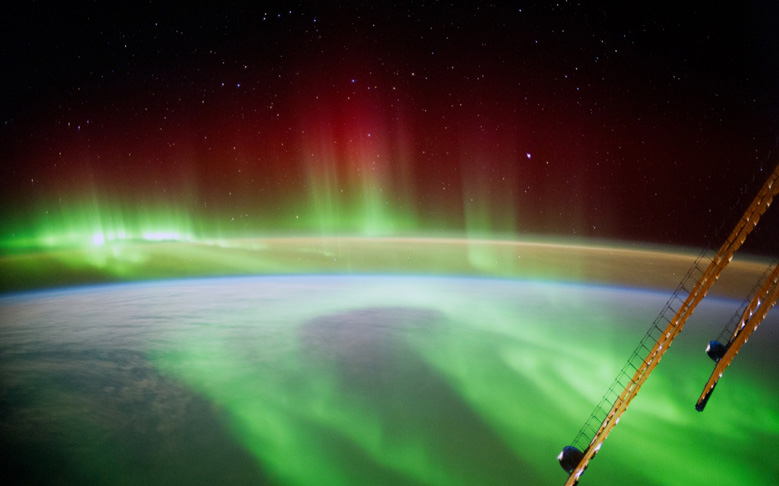
Within this protective structure are vulnerable regions known as the “polar magnetic cusps.” These are two funnel-shaped areas near Earth’s northern and southern magnetic poles where the planet’s magnetic field lines bend inward. Through these “funnels,” solar-wind particles can penetrate directly into Earth’s ionosphere. Their interaction with atmospheric gases produces one of nature’s most spectacular light displays, the aurora, also known as the Aurora Borealis in the Northern Hemisphere.
Source: pacificspacecenter.com (ESA/NASA)
Yet the incredible beauty of these interactions between the solar wind and Earth’s upper atmosphere conceals a significant danger: when solar activity intensifies, the Sun can eject enormous clouds of plasma into space, known as coronal mass ejections (CMEs). When these plasma clouds collide with Earth’s magnetosphere, they trigger powerful geomagnetic storms, the very phenomena that drive what we call “space weather.”
Needless to say, modern society is highly dependent on satellites and electronics. GPS navigation, radio communications, data transmission, and the Internet of Things all rely on space-based infrastructure. Extreme solar storms can disrupt these technologies and, in severe cases, even damage or destroy operational satellites.
This is precisely where the SMILE spacecraft comes into the picture. The mission is designed to provide the scientific community with a deeper understanding of Earth’s magnetosphere and the mechanisms governing its interaction with the solar wind, helping researchers better predict and mitigate the effects of hazardous space-weather events.
From concept to spacecraft
The story of SMILE began in 2015, when the European Space Agency (ESA) and the Chinese Academy of Sciences (CAS) took a significant step toward collaboration: together, the two organizations announced a competition to identify new scientific mission concepts that would be both valuable to space infrastructure and feasible to implement through a joint international effort. Among the 13 proposals submitted by various international teams, the SMILE concept was ultimately selected as the most promising.
Source: esa.int
The project was developed under the joint scientific leadership of University College London (UCL) and China’s National Space Science Center (NSSC). Even in 2015, a collaboration of this scale required both parties to overcome numerous geopolitical barriers, as well as comply with strict technology-transfer regulations, including restrictions similar to those imposed by U.S. export-control frameworks such as ITAR. As a result, SMILE became the first mission in which Europe and China jointly defined, designed, built, and planned the operation of a space mission from its inception through to its current operational status.
Between 2016 and 2018, the project remained in its preliminary study phase. During this period, engineers and scientists from both organizations worked to align the mission’s scientific objectives with the technical capabilities of the future spacecraft. They developed orbital models, calculated the probe’s mass and dimensional characteristics, and assessed the risks associated with the radiation environment in which SMILE would operate.
The decisive milestone came in March 2019, when ESA’s Science Programme Committee officially approved the SMILE mission and advanced it to the Mission Adoption phase. For Europe, this approval provided the green light to move from concept and design work to full-scale implementation. The mission’s total cost was estimated at approximately €250 million, with the funding shared almost equally between ESA and the Chinese Academy of Sciences. The European contribution exceeded €130 million, distributed through 25 major procurement contracts involving scientists and engineers from across the Eurasian continent.
Source: esa.int
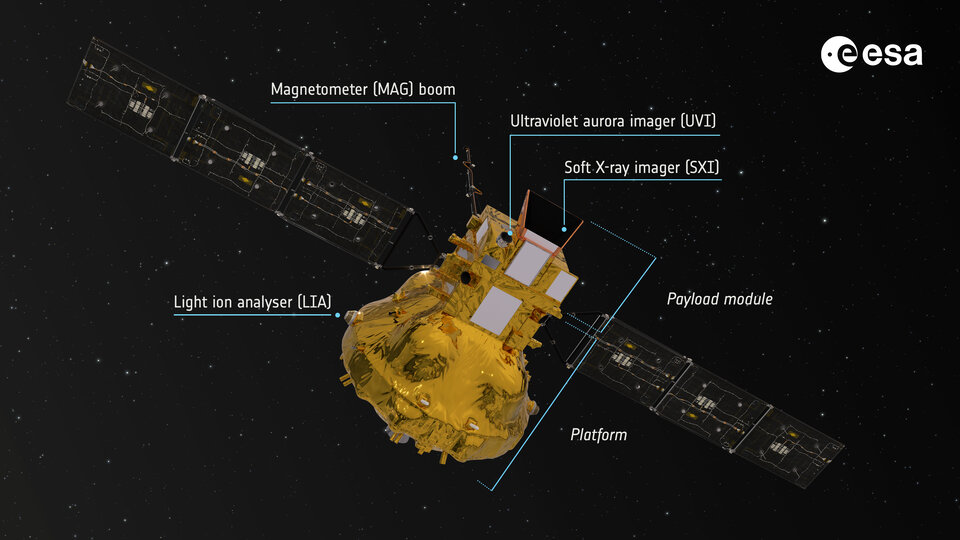
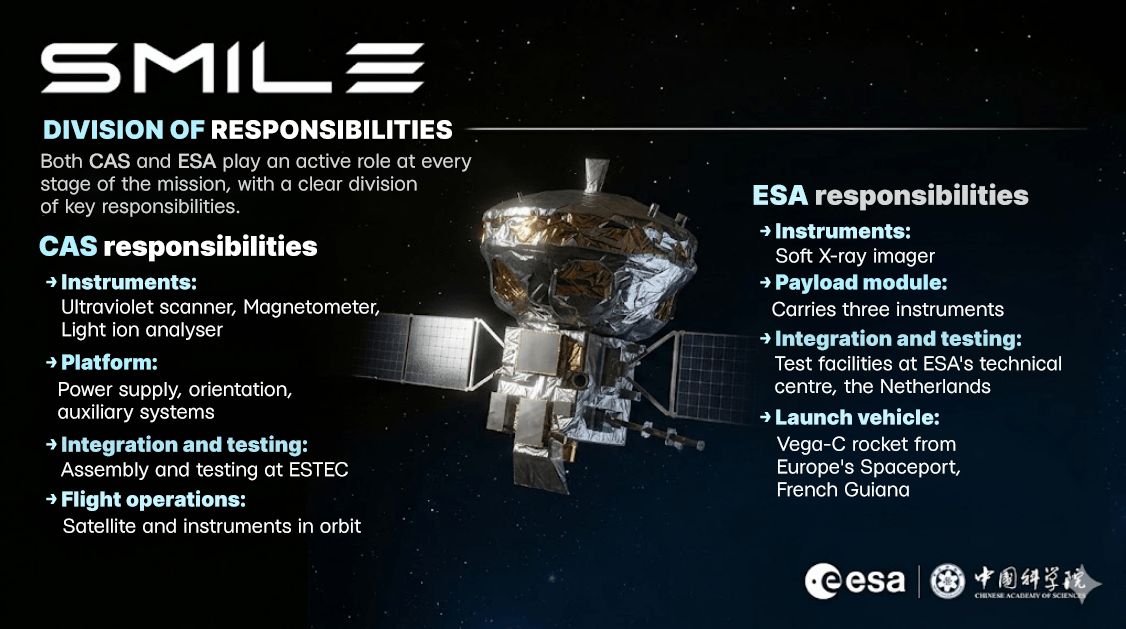
The division of responsibilities between Europe and China was clearly defined. ESA took charge of developing the payload module for the scientific instruments and provided its Vega-C launch vehicle (the possibility of using the new Ariane 6 rocket was also considered during the planning stages). Europe was additionally responsible for one of the mission’s key instruments, the Soft X-ray Imager (SXI), and for managing part of its scientific operations. The Chinese Academy of Sciences, together with its industrial partners, built the spacecraft’s bus, including the propulsion, power, and communications systems, and supplied SMILE with three scientific instruments: the Ultraviolet Imager (UVI), the Light Ion Analyzer (LIA), and the Magnetometer (MAG).
Development of the European payload module was assigned to the Spanish division of Airbus Defence and Space. Their task was to design a structure capable of securely supporting the mission’s highly sensitive cameras and analyzers while maintaining the stable thermal environment required for accurate data collection and transmission to the spacecraft’s main platform.
Meanwhile, in Shanghai, CAS engineers focused on developing the spacecraft bus, the technological “heart” of SMILE. This module incorporated the solar arrays, attitude-control systems, and high-gain antennas required for communication with ground stations. In June 2023, the Chinese segment of the project successfully passed its Critical Design Review (CDR), confirming its readiness to enter the pre-launch testing phase.
Source: news.cgtn.com & Nano Banana 2
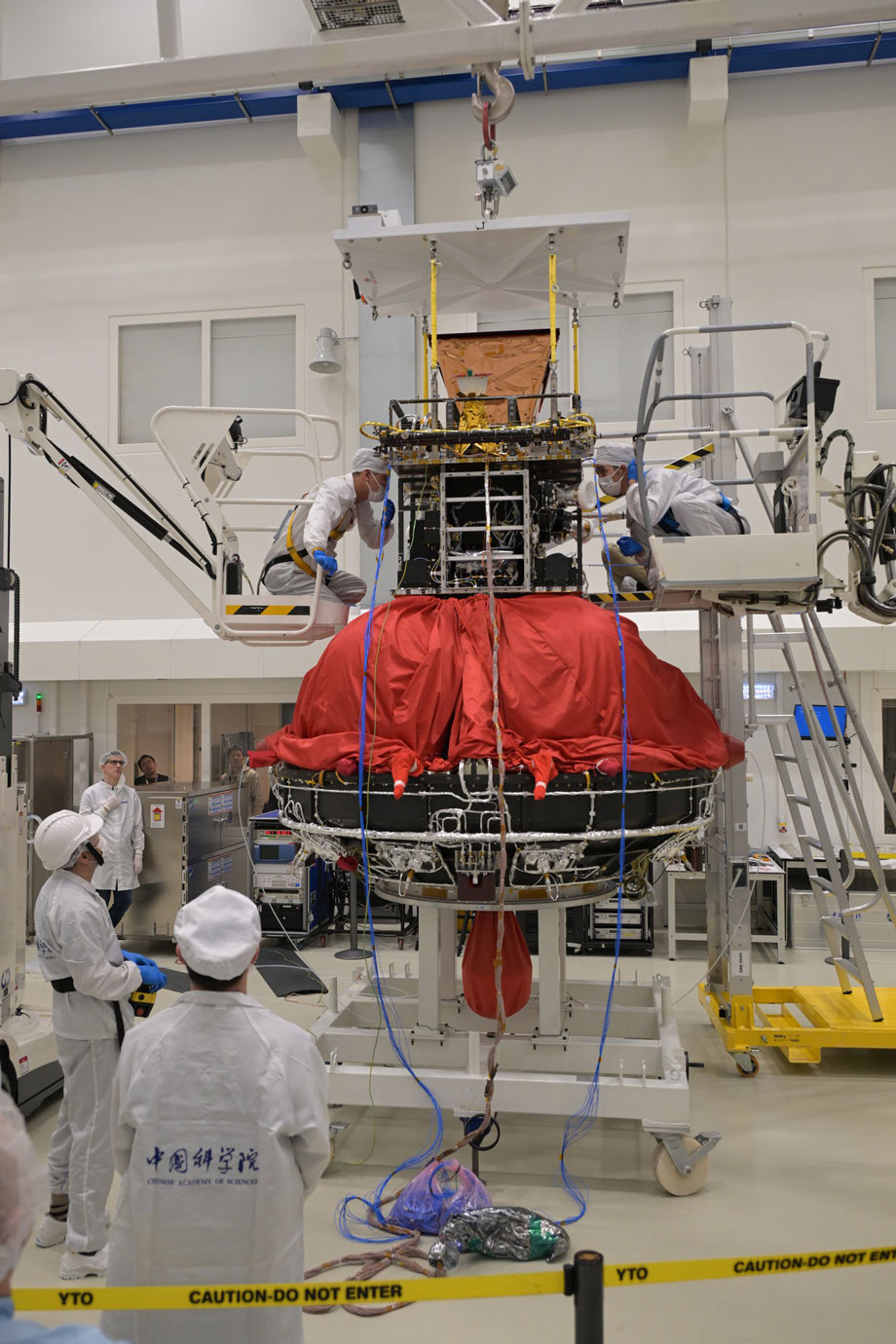
By the end of 2024, the two partners began the process of physically merging their technologies into a single spacecraft. In September, the European-built payload module developed by Airbus arrived at the European Space Research and Technology Centre (ESTEC) in the Netherlands. Then, in December 2024, the Chinese platform was flown in from Shanghai aboard a dedicated cargo flight.
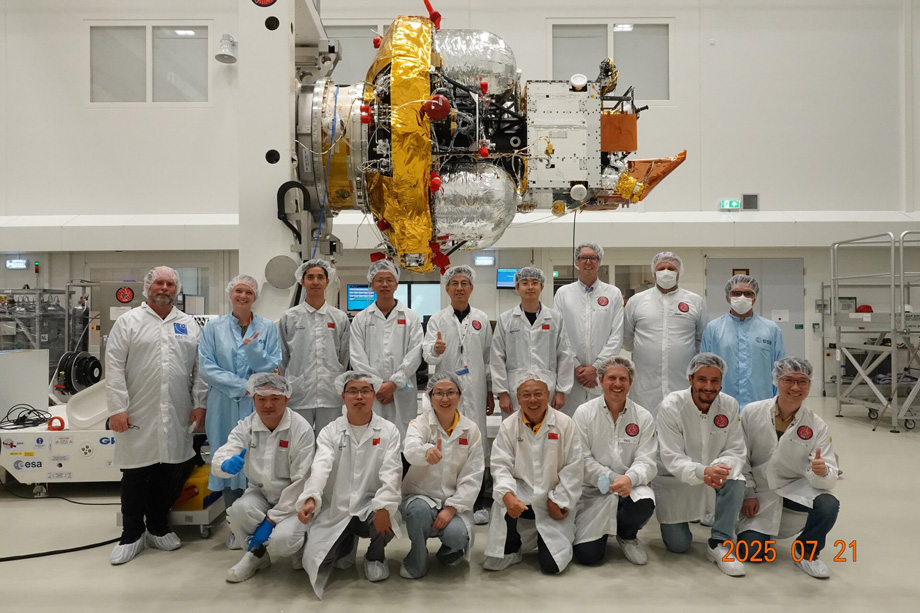
The historic milestone came on January 21, 2025, when these two large and highly sophisticated technological systems were successfully integrated into the fully assembled SMILE spacecraft.
Source: esa.int
The final hurdle was a series of exceptionally rigorous tests. In April 2025, the fully assembled SMILE spacecraft was moved into the Maxwell test chamber at ESTEC. There, it was subjected to extreme temperatures and a vacuum environment designed to replicate the conditions of deep space.
Following a series of demanding vibration tests in October 2025, which simulated the intense mechanical loads experienced during rocket launch, the spacecraft successfully passed its flight acceptance review, the final certification required to confirm its readiness for flight.
SMILE observation data and their importance for space weather forecasting
At last, the years of work carried out by thousands of specialists culminated in triumph: on May 19, 2026, at 05:52 Central European Summer Time (CEST), a Vega-C launch vehicle operated by the European company Arianespace lifted off from the Guiana Space Centre in Kourou, French Guiana, carrying the SMILE spacecraft into orbit.
By 06:48 CEST, ESA’s ground station in New Norcia, Australia, had received the satellite’s first telemetry signal. Just one minute later, the spacecraft successfully deployed its solar arrays, marking the climactic moment of the launch campaign.
The 2,250-kilogram spacecraft is now in the midst of a lengthy transfer phase. SMILE will require about a month of complex orbital maneuvers to reach its final highly inclined and elongated polar orbit. The spacecraft’s apogee, the farthest point from Earth, will be located at a distance of 20 Earth radii, or approximately 121,000 kilometers above the planet. From this vantage point, the satellite will be able to observe Earth’s magnetosphere from afar, capturing a global perspective much like a wide-angle camera lens. Its perigee, the closest point to Earth, will be about 5,000 kilometers above the surface.
Source: esa.int
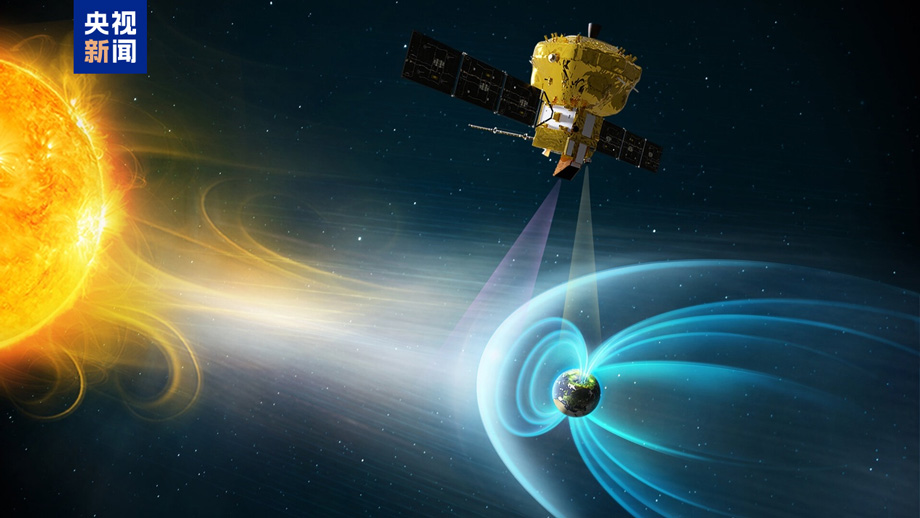
The spacecraft’s primary scientific eyes will be the European-built Soft X-ray Imager (SXI). It operates on an innovative principle: when highly charged ions carried by the solar wind collide with neutral hydrogen atoms in Earth’s exosphere, a process known as charge exchange occurs, producing soft X-ray photons. By detecting this emission, the SXI instrument will be able to create real-time movies of the motion of the magnetopause and polar cusps, allowing scientists to observe how the boundaries of Earth’s magnetic shield interact with the solar wind.
Complementing these X-ray observations will be the Chinese-built Ultraviolet Imager (UVI). Its primary mission is to continuously monitor the global distribution of auroras over Earth’s Northern Hemisphere. Working together, SXI and UVI will provide scientists with an unprecedented opportunity to observe two interconnected processes simultaneously: how the pressure of the solar wind deforms the outer boundaries of the magnetosphere in space, and how these changes are instantly reflected in Earth’s ionosphere through variations in auroral activity.
To connect these global images with local physical conditions in space, SMILE is equipped with two instruments designed for in-situ measurements. The first is the Light Ion Analyzer (LIA). This sensor will function as a cosmic speedometer and thermometer, continuously measuring the distribution of ions in the solar wind and the magnetosheath, precisely determining their density, velocity, and temperature.
The second in-situ instrument is the highly sensitive Magnetometer (MAG). Its primary purpose is to measure the orientation and strength of the magnetic field at the spacecraft’s exact location in space. Working in tandem, LIA and MAG will serve as an ultra-precise space weather station aboard SMILE, continuously recording the characteristics of the surrounding environment.
Source: news.cgtn.com
The spacecraft’s orbital cycle is designed to last 51 hours for each complete revolution around Earth. Of that time, SMILE will spend more than 40 hours at extremely high altitudes, beyond the Van Allen radiation belts. This is a strategically important aspect of the mission design, since the high-energy particles trapped within these radiation belts generate excessive noise that can interfere with the sensitive X-ray detectors of the SXI instrument. Far beyond this radiation environment, SMILE will be able to continuously produce high-quality, 40-hour observations of the changing dynamics of space weather.
According to the ESA and CAS mission schedule, once the spacecraft reaches its target orbit and completes a comprehensive testing campaign of all onboard systems, the official scientific data-collection phase, known as commissioning, is expected to begin in September 2026. This milestone marks the beginning of a new era in the study of Earth’s magnetosphere. Instead of relying on fragmented, point-by-point measurements from individual spacecraft, as researchers have done for decades, humanity will finally gain a comprehensive, global, and, most importantly, dynamic view of space weather.
The data returned by SMILE will also have direct practical applications. It will serve as the foundation for next-generation computer models and help calibrate and improve modern three-dimensional magnetohydrodynamic (MHD) simulations. With precise input from the mission’s advanced cameras and sensors, scientists will be able to significantly refine forecasting algorithms, moving space-weather prediction closer to the level of accurate and genuinely predictive forecasting of geomagnetic storms.
The nominal mission lifetime of SMILE is three years, but its legacy is already difficult to overstate. Equally important is the spirit of cooperation behind it. ESA and CAS are demonstrating that, when faced with global challenges such as protecting Earth’s technological infrastructure from space-based threats, science can transcend political differences and bring nations together in pursuit of shared knowledge and security.