Sending humans into space is an incredibly challenging endeavor. And it’s not just about the cost of launch vehicles, fuel expenses, or the production of complex navigation systems and communication technologies. The real challenge lies in sustaining organic life where it cannot naturally exist: in the deadly vacuum of outer space.
To tackle this challenge, orbital stations and spacecraft are equipped with advanced closed-loop life support systems that recreate an environment as close as possible to Earth’s, minimizing the need to deliver resources from our planet. These systems supply astronauts with fresh air and clean drinking water, maintain a livable temperature inside the orbital station, and process human waste. Today, we’ll take a closer look at how life support systems function aboard crewed spacecraft and orbital stations, enabling astronauts to remain in low Earth orbit for extended periods of time.
Recreating Earth’s environment: six survival conditions in space
Before entering the sealed compartments of orbital stations, let’s define the basic conditions that make life on Earth possible. Clean air, drinking water, food, and a comfortable climate — all of these seem obvious, and they form the core criteria for developing systems that support human life in space. Today’s systems must address six primary functions:
- Air supply with a composition close to Earth’s atmosphere. It’s not enough to simply pump oxygen into the spacecraft, since the carbon dioxide that astronauts exhale must also be removed. Moreover, the oxygen level cannot be 100% pure, since that would create a dangerous, fire-prone environment. Breathable air must therefore maintain a proper balance of oxygen, carbon dioxide, and other trace gases found in Earth’s atmosphere.
- Drinking and technical water. Water in space is necessary not only for drinking, but also for preparing food and maintaining personal hygiene. Almost all water used, as well as the moisture exhaled by astronauts, is retained inside the spacecraft and goes through filtration and purification processes that allow it to be reused.
- Temperature and humidity control in the living quarters. Temperature fluctuations in space can reach several hundred degrees Celsius in a single day. On the sunlit side, exterior temperatures can rise to +100°C, while on the dark side, when the spacecraft or orbital station is in Earth’s shadow, they can drop to -100°C. Excess heat is removed through a system of radiators, keeping the interior temperature within habitable limits. Humidity control is also critical to prevent the air from becoming too damp or dry.
- Waste management. Without proper handling, human waste in space poses a serious biological hazard. Solid and liquid waste is collected in special containers, frozen, and stored until it can be returned to Earth. Some waste (like urine) can be purified back into usable water. Other waste is collected by cargo spacecraft that arrive at the orbital station during resupply missions carrying food and equipment.
- Food supplies. While food provisioning is mainly handled through unmanned resupply missions, the station’s life support systems are responsible for operating cold storage for long-term food preservation and providing equipment for heating meals.
- Radiation protection. Space is saturated with harmful cosmic radiation. Although life support systems do not directly solve the problem of radiation shielding, they function in tandem with the spacecraft’s protective systems to create a safer environment for the crew.
From the dawn of the space age, it was clear that solving these six challenges was essential to ensuring relatively safe and prolonged human presence in orbit. However, before today’s astronauts could rely on technically advanced, autonomous closed-loop life support systems, a long path of development had to be followed.
Disposable Apollo and early open-loop systems
NASA didn’t always place such a high priority on life support. When Neil Armstrong, who would later become the first person on the Moon, visited NASA’s Flight Research Center (now the Armstrong Flight Research Center) in 1995, he was surprised to find that cadet regulations didn’t even establish standards for test equipment. Test pilots were expected to manage on their own, even for helmets, pressure suits, or emergency survival kits.
Recognizing the critical nature of this oversight, Armstrong insisted on forming a dedicated life support group as part of the test team for the X-15 experimental aircraft. This marked the beginning of NASA’s first life support research division. A small group of staff focused on ensuring flight safety, testing high-altitude suits, and refilling oxygen tanks. In the following decades, as astronauts returned from space on the first Space Shuttle missions, members of this team escorted them back to base and monitored their health.
But people alone were not enough: the spacecraft themselves needed fully functional life support systems.

Source: nasa.gov
Initially, spacecraft life support systems were designed as open-loop systems, meaning they were single-use. The supply of essential resources for sustaining human life (air, water, food) was finite and limited to the duration of the space mission. This was primarily due to the short length of early human spaceflights: missions lasting only a few hours or days simply didn’t require the recycling of air or water through closed-loop systems.
On the first crewed spacecraft, such as the American Mercury and the Soviet Vostok spacecraft, breathable oxygen was stored under pressure in special metal tanks, while carbon dioxide exhaled by astronauts was absorbed by chemical agents in cartridges or filters based on lithium hydroxide (LiOH). The substance in the cartridges would react chemically with the CO2 and absorb it, purifying the air to a safe level. These absorbent cartridges were replaceable — once their capacity was reached, the spacecraft crew had to manually swap them out.
The system for maintaining a comfortable temperature was implemented in a very rudimentary way. Part of the heat generated by the spacecraft’s electrical equipment was diverted to help maintain a stable interior temperature. Since the first spacecraft were relatively small, the food supply was strictly limited and was typically stored in the form of pre-packaged rations in tubes. Waste disposal was not even considered: early astronauts simply stored their waste in special sealed containers for the duration of the flight.
The first full-scale, integrated open-loop life support system appeared on the Mercury spacecraft. The Environmental Control System (ECS) was responsible for supplying oxygen to the crew compartment, removing CO2 using lithium hydroxide, and regulating pressure and temperature. Additional functions included smoke detection inside the spacecraft, fire suppression, and avionics cooling.
An improved version of the ECS was installed on the Gemini spacecraft, where it was capable of supporting a two-person crew for up to two weeks. It was aboard Gemini 4 that astronauts first donned space suits for extravehicular activity (EVA). A year earlier, similar individual life support suits had been tested during the launch of the Soviet Voskhod-2 spacecraft.

Source: airandspace.si.edu
However, the real test for life support systems came with the Apollo 11 mission. For the first time, a spacecraft traveled far beyond low Earth orbit (LEO), where such systems had previously been used. This meant that the astronauts inside the spacecraft had to entrust their lives entirely to the life support systems, since there was no possibility of receiving emergency help from Earth.
The life support systems in the Command Module (CM) and Lunar Module (LM) were composed of several similar blocks. Cryogenic tanks stored liquid oxygen and hydrogen, used for breathing, generating water, and producing electricity (in Apollo, electricity was generated by a special fuel cell running on the spacecraft’s chemical fuel). The CO2 removal system had changed little since the Mercury and Gemini missions and still relied on replaceable lithium hydroxide cartridges. However, temperature and humidity control systems were more advanced, now relying on complex radiator and sublimator structures. Waste disposal, meanwhile, remained almost unchanged: all human waste was stored in hermetically sealed bags until the crew returned to Earth.
The Apollo lunar missions, however, never lasted longer than two weeks. That meant that engineers could forgo closed-loop life support systems that would have recycled air and water onboard. The time for such systems came only in the 1970s–1980s, with the launch of the first inhabited orbital stations.
Steps toward closed-loop systems: Salyut, Skylab, and Mir
In 1971, the USSR launched the first crewed orbital station, Salyut. Over the 15 years of the program’s operation, six such platforms successfully reached orbit. While the earliest stations used life support systems very similar to those of Soviet spacecraft of the time, the later Salyuts introduced several innovative approaches to ensuring crew safety aboard.
In the initial deployment stages, oxygen was still supplied to living compartments from pressurized tanks. However, later modules (Salyut-6 and Salyut-7) were equipped with the Elektron system, which generated oxygen by electrolyzing water. It’s worth noting that Elektron was not a fully closed-loop system, since the water it used came from external supplies brought by the cosmonauts (though occasionally it utilized regenerated condensed moisture collected from the station’s atmosphere). Initially, the recycled water was suitable only for technical use, but with the introduction of new filtration systems, crews on the later Salyuts were able to drink it as well.
There was also a major improvement in carbon dioxide removal: although some station compartments still relied on lithium hydroxide cartridges, Salyut stations introduced the first hybrid cartridge systems based on amine sorbents. These had the advantage of being reusable, and, after manual cleaning, the cartridges could be purged of accumulated CO2 and used again.
The necessary microclimate parameters inside the station were maintained by a temperature and humidity control system that operated using condensers and heat exchangers. Crew waste was sent into space aboard Progress cargo ships, which regularly flew resupply missions to the sixth and seventh Salyuts, both of which were equipped with fully functional docking ports.
The Americans were quick to launch their own inhabited station. In 1973, Skylab reached space and, excluding American-produced ISS modules, remains the only fully American-made orbital station. Inside the station, a two-component atmosphere was created, consisting of 72% oxygen and 28% nitrogen, supplied at a reduced pressure of 34.5 kPa (5 psi). This design prevented the risk of fire, since 100% pure oxygen in an enclosed space is highly flammable.
In many ways, Skylab resembled the Apollo spacecraft. The orbital station still lacked systems for recycling air and water — these resources were delivered from Earth — and carbon dioxide was still absorbed using lithium hydroxide cartridges. However, Skylab did feature a few innovations. Most notably, it had a significantly improved toilet system, meaning astronauts no longer had to handle their waste manually. In addition, Skylab was equipped with a nearly full-functioning shower. Water was dispensed under pressure, and after bathing, it was vacuumed away by a suction system. While not a direct advancement in life support technology, Skylab was the first station where astronauts could experience a more comfortable standard of daily living.

Source: cdn.mos.cms.futurecdn.net
The last orbital station before the advent of the ISS was the Soviet Mir station, which remained in orbit for 15 years and 32 days. Its modular design allowed the gradual expansion of functionality by adding new technological modules. The station featured two systems for oxygen generation: the Elektron water electrolyzer, previously tested on Salyut 6 and 7, and solid-fuel oxygen generators that produced oxygen through chemical reactions.
Mir was equipped with automated systems to detect and remove harmful micro-contaminants in the air released by onboard equipment, a first for any spacecraft. A filtration system using activated carbon and other sorbents provided additional atmospheric purification inside the station. Complementing this was a new ventilation and air conditioning system, which collected condensation from the living quarters and delivered it to the station’s most technologically advanced module, the water recovery system. The collected condensate and crew urine went through several purification stages and were converted into technical water, which was then used to generate oxygen via electrolysis in the Elektron unit. However, drinking water still had to be delivered by Progress cargo spacecraft.
Mir brought humanity closer than ever to the development of fully closed-loop life support systems. For the first time, the crew was almost self-sufficient, even though not all essential needs were met exclusively by the onboard systems. Nevertheless, the experience gained from operating Mir laid the foundation for designing today’s autonomous space station: the ISS.
The marvel of the ISS: a quarter century of sustained survival
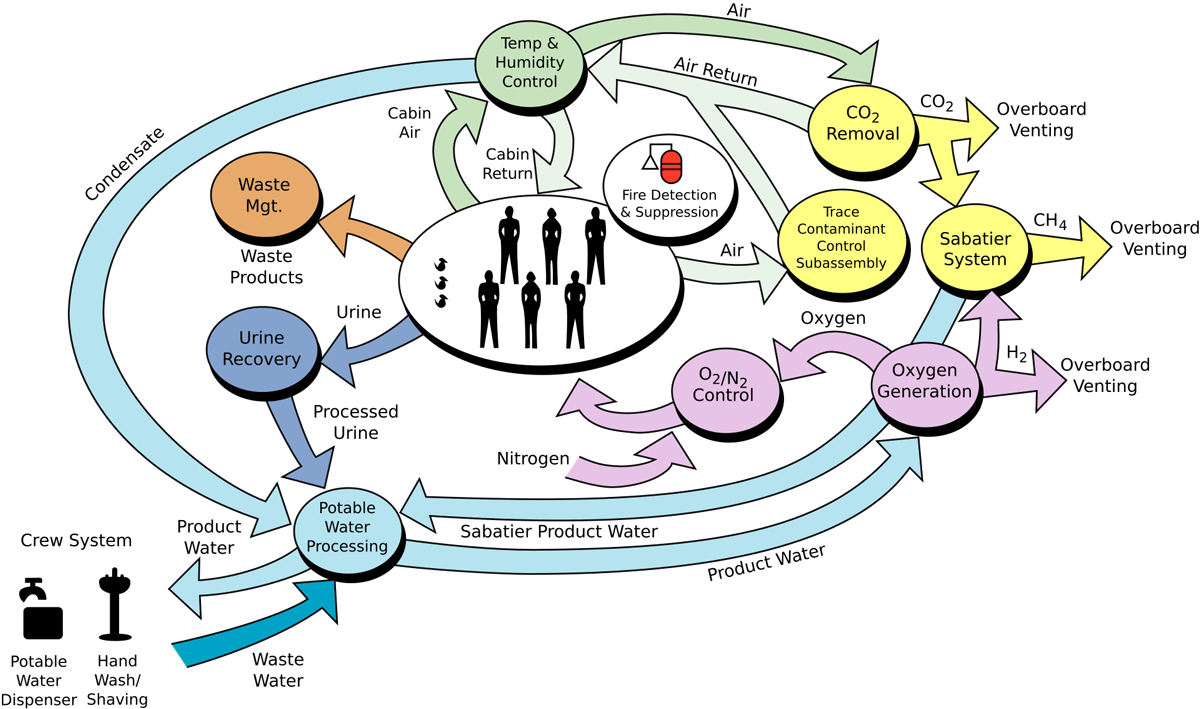
When the ISS finally became operational in the early 2000s and permanent crews began arriving, a true breakthrough in space life support technology was the Environmental Control and Life Support System (ECLSS), introduced on the U.S. segment of the station during mission STS-126. ECLSS is a fully closed-loop system that currently manages three key functions: water resource recovery, air purification (from both carbon dioxide and harmful contaminants), and oxygen generation.
Source: upload.wikimedia.org
ECLSS processes and recycles nearly all the water (98%) available on the ISS. The water filtration system collects and purifies not only wastewater but also produces drinking water from air condensate, using even astronauts’ own sweat and urine. This process is carried out using a complex system of purification filters and a catalytic reactor that breaks down any trace contaminants. The degree of purification is monitored by sensors at every stage: if the water does not meet safety standards or contains excess compounds, it is sent through another purification cycle. The final step before the water is deemed drinkable involves adding a small amount of iodine to prevent microbial growth. In this form, the water is stored until it is used and expelled, effectively closing the purification loop.

Source: s-bond.com
Another crucial component of ECLSS is the Oxygen Generation System (OGS), which produces the oxygen astronauts breathe. Technically, the OGS is a water electrolyzer, similar to the Elektron system installed in the Russian segment of the station. Water enters its compartments and, through electrolysis, is split into oxygen and hydrogen. Oxygen produced in this way is delivered to the station’s living quarters, some of the hydrogen is vented into space, and the rest is directed to the Carbon Dioxide Removal Assembly (CDRA), one of the three components of the Air Revitalization System (ARS), located in the Tranquility (Node 3) module. In addition to removing carbon dioxide, the ARS can also eliminate other harmful airborne substances. Monitoring the levels of these gases in the ISS atmosphere is the responsibility of the Major Constituent Analyzer (MCA), which measures the concentration of nitrogen, hydrogen, oxygen, carbon dioxide, water vapor, and methane.
Between 2010 and 2017, the ISS used the Sabatier process to recover oxygen and generate water. The NASA Sabatier system facilitated a chemical reaction between hydrogen (from the OGS) and carbon dioxide (from the CDRA), producing water (which later became an oxygen source for the OGS) and methane (which was vented into space through a dedicated ventilation system). In this way, the two key ECLSS systems involved in air regeneration complemented each other by supplying the chemical elements required for their respective functions.
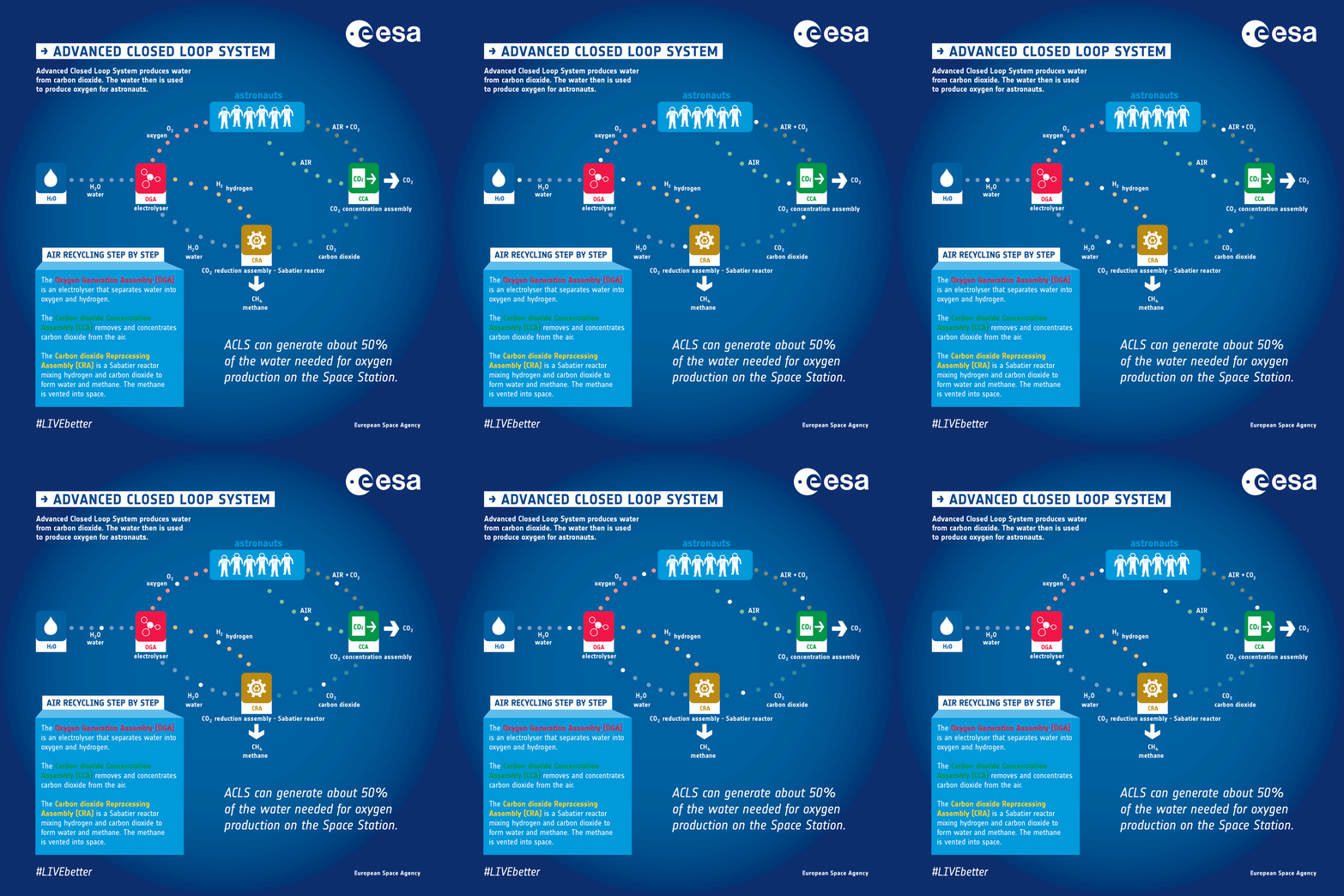
In 2018, the ECLSS was enhanced with a new system called the Advanced Closed Loop System (ACLS), developed by the European Space Agency. Compared to NASA’s oxygen regenerators, ACLS was significantly more advanced and comprehensive. It could also recover a much higher percentage of air from the carbon dioxide exhaled by astronauts. Specialized adsorbents remove CO2 from the station’s living quarters, after which it enters a Sabatier reactor and reacts with hydrogen (produced during water electrolysis). The result of this reaction is water and methane. The water derived from CO2 is sent to a water electrolyzer (similar to the OGS), where it is chemically converted into oxygen for the crew to breathe, thus closing the cycle.
Source: esa.int
Although the main functions of the ECLSS and ACLS are to supply purified water and provide fresh air, they also allow the implementation of bioregenerative systems. These systems allow astronauts to grow plants in space, providing a certain degree of food self-sufficiency.
Farming in orbit
By cultivating plants in space, the station’s crew gains a dual benefit: plants are not only edible but also serve as natural air purifiers. Additionally, through transpiration (the evaporation of water from plant surfaces), the crew acquires a supplementary source of drinking water.
Of course, space aboard the orbital station is far too limited to grow enough plants to absorb all the carbon dioxide exhaled by the crew or to generate sufficient oxygen. Therefore, plant cultivation remains largely experimental. One of the largest experiments in growing plants on the station was the Vegetable Production System (“Veggie”), which began operating in 2014.

Source: etstalkscience.ca, ESA/Alexander Gerst NASA
A small box about the size of a typical carry-on suitcase is divided into six plant compartments, which astronauts also refer to as “pillows.” Each “pillow” is filled with a special sticky clay mixed with organic fertilizers essential for healthy plant growth. Since traditional watering is impossible in microgravity, Veggie supplies moisture through passive capillary action from an internal reservoir built into the cultivation unit. The plants receive the necessary light from LED lamps consisting of red, blue, and green diodes that simulate sunlight.
In the more than ten years since Veggie was introduced on the ISS, a wide variety of Earth plants have been grown in this plant incubator, including red romaine lettuce, Tokyo Bekana Chinese cabbage, Mizuna mustard greens, green lettuce, and even real zinnia flowers, from which astronaut Scott Kelly once made an entire bouquet.

Source: universetoday.com
The successor to Veggie was an improved, semi-automated closed system known as the Advanced Plant Habitat (APH), which began operating on the ISS in April 2017. Unlike Veggie, APH is a full-fledged scientific research laboratory with a much broader spectrum of LEDs, precise control over lighting intensity, and a system for delivering water and nutrients through porous tubes, which provides better regulation of root-zone moisture. The fully sealed APH chamber allows control over internal temperature, CO2, oxygen, and other gas levels, as well as the relative humidity of the substrate. While Veggie operates with only a small number of sensors to monitor plant conditions, APH is equipped with 180 sensors for automatic monitoring of every system parameter.
The Advanced Plant Habitat has minimized the ISS crew’s involvement in growing plants and vegetables, since all necessary monitoring of the chamber is handled by a ground team at the Kennedy Space Center. Astronauts only carry out certain experimental tasks when needed and are responsible for overseeing water resource status. Read more about these and other experiments on growing plants in space in our recent review.

Source: sierraspace.com
Crews of China’s Tiangong orbital station are also implementing bioregenerative systems. For several years, research has been conducted on which plants can be sent on long-term space missions. Currently, green onions, cherry tomatoes, lettuce leaves, and other types of crops are being grown aboard Tiangong.
Besides providing plant-based food and a source of clean air, controlled artificial photosynthesis reactions on the station could supply visiting spacecraft with rocket fuel based on oxygen and hydrocarbons (primarily ethylene). This could potentially develop into an interesting technology for at least partial refueling in orbit.
Controlled experiments with a wide variety of plants on the ISS and Tiangong also help gain the necessary understanding of plant biology in space. In the future, this knowledge will form the basis for developing systems for long-duration space missions and will likely be used during the first colonizing expeditions to the Moon and Mars, providing personnel at those bases with access to fresh plant fiber, similar to that on Earth.
Next-generation life support systems
With the evolution of spacecraft and plans for further colonizing missions to the Moon and Mars, the need arose to improve life support systems. NASA has already launched the Next Generation Life Support (NGLS) program, which is aimed at developing new technologies for environmental control and life support systems (ECLS), as well as spacesuits for extravehicular activity. The agency states that the main goal of NGLS is to change the existing rules of the game by developing new life support system standards that will ensure human presence in the Solar System in the future.
Today, NGLS is concerned with four key areas:
- High Performance EVA Glove (HPEG): High-performance extravehicular activity gloves that provide astronauts with previously unavailable freedom of movement — especially important for precise repairs or equipment replacement on orbital stations and spacecraft. Current spacesuits used on the ISS were designed during the Space Shuttle era and were intended mainly for vacuum and microgravity use in low Earth orbit. These bulky suits have rather limited flexibility, especially the gloves, which need to be made suitable for use on planetary surfaces.
- SpaceCraft Oxygen Recovery (SCOR): Oxygen regeneration systems for spacecraft. This is another cornerstone of NGLS, focused on developing new air supply and closed-loop purification systems.
- Bioregenerative Life Support Systems (BRLSS): Artificial ecosystems that replicate natural cycles similar to those on Earth. Their goal is to sustain human life in the isolated environment of a spacecraft or on other planets. Unlike traditional physico-chemical systems that mainly recycle air and water, BRLSS also integrates organic components (plants, microbes, and sometimes aquaponic systems for fish farming) to produce food, regenerate air and water, and recycle organic waste into fertilizers for new plants, thus closing the loop.
- In Situ Resource Utilization (ISRU): Utilizing local resources will play a key role in colonizing missions. This includes not only finding construction materials but also extracting potable and technical water, producing oxygen, and even fuel for spacecraft (based on oxygen and hydrogen extracted locally at the planetary base). The main goal of ISRU is to create a “living off local resources” paradigm, significantly reducing the cost and logistical complexity of space missions.
Projects like NASA’s MOXIE (Mars Oxygen In-Situ Resource Utilization Experiment) or ESA’s MELiSSA initiative offer new approaches for future deep space exploration. They focus primarily on improving recycling technologies, integrating ISRU principles, and enhancing energy efficiency and system closure. These next-generation life support systems will support human space travel, paving the way for possible colonization of other planets in the Solar System.