We recently learned that the American company, Starfish Space, and Italy’s D-Orbit are planning a joint space mission. According to the plan, two spacecraft, Otter Pup 2, developed by Starfish Space, and D-Orbit’s ION, will demonstrate an orbital rendezvous maneuver that is expected to end in docking. This news might have gone unnoticed among many other planned space missions if not for the radically new technological approach to docking that the companies have chosen for this demonstration: for the first time, a special electrostatic mechanism will be used instead of the conventional mechanical docking port that has been in use since the last century.
While orbital rendezvous and docking are often considered to be basic elements of space operations and all the “real” hi-tech achievements have already been claimed by SpaceX’s mechanical “Mechazilla” arms, which catch the reusable SuperHeavy booster in an upright position, we have news for you. We guarantee you’ll be amazed at just how colossal the effort is behind what might seem like ordinary orbital maneuvers.
Meeting at first cosmic velocity: the importance of orbital rendezvous
Orbital rendezvous and docking maneuvers are sequential operations that form the foundation of any activity requiring the connection of two or more spacecraft in orbit. No logistical space mission, whether crew delivery, servicing, construction, refueling, or repair, can occur without these maneuvers.
Orbital rendezvous is the process by which two or more spacecraft move closer to one another. But this is not just a “meeting” in space: it is a precise, controlled maneuver that requires calculating trajectories, velocities, and timing, since at low orbital altitudes everything moves at first cosmic velocity (7.8 km/s, also known as orbital velocity), while at medium and geostationary orbits, spacecraft accelerate to 3–4 km/s.
The necessity of orbital rendezvous became evident as soon as humans began contemplating space activity. Wernher von Braun, the father of ballistic missile technology, highlighted the importance of this maneuver in his works on orbital stations in the mid-1950s. Even then, it was clear to him that even the most powerful launch vehicles would be unable to carry monolithic structures like space stations into orbit, and that their modular assembly would have to occur in space.
Later, in the mid-1960s, when spaceflight became a reality, NASA implemented the Gemini space program, a kind of preparatory stage for manned lunar missions under the Apollo program. Aside from testing the capabilities of the spacecraft, one of the main reasons for the Gemini missions in 1965–1966 was to master the key techniques of orbital rendezvous.
The first successful orbital approach occurred in December 1965, when the Gemini 6A spacecraft, piloted by Frank Borman and Jim Lovell, managed to catch up with Gemini 7, which was crewed by Wally Schirra and Thomas Stafford. The spacecraft performed a controlled approach, reaching a minimum distance of less than one meter, which they were able to maintain for several hours. The viability of the concept was officially proven.

Source: wikimedia.org
Any orbital rendezvous begins with the planning phase. Most often, the spacecraft to be docked with, such as the ISS, is already in a near-Earth orbit. The most difficult part of the process is the phasing and approach stage, when the approaching spacecraft performs a series of what are called “impulse burns” with its maneuvering engines to enter the designated orbit. Continuous monitoring of the relative speed and position of the approaching spacecraft is of utmost importance at this stage, since any mistake in calculations or maneuver execution could lead to a collision or a missed target.
To catch up with the target, the spacecraft uses the counterintuitive principle of orbital mechanics. This is one of the fascinating paradoxes of orbital rendezvous: in order to catch up with an object in a higher orbit, the pursuing spacecraft must perform a braking maneuver called “braking impulse.” A sudden decrease in speed leads to a lower orbit, and, as is well known, objects in lower orbits move faster due to Earth’s gravitational pull. That means the chasing spacecraft can complete more revolutions around Earth in the same amount of time as a target in a higher orbit.
So, according to this principle, in order to catch up with the docking target, a spacecraft must approach it from a lower orbit. This is why orbital approaches always happen from below rather than above: not only because launches originate from Earth, but also due to the basic principles of orbital dynamics. A similar logic applies to controlled “falling behind”: if, for any reason, a spacecraft overtakes the docking target, it must increase its speed via an impulse burn. This will raise it to a higher orbit relative to the target, allowing the target to overtake it, after which it can “fall” back to a lower orbit and repeat the previous approach.
When only tens or hundreds of kilometers remain between a spacecraft and its docking target, the chaser begins preparation for the terminal approach phase, called terminal phase initiation. This is the final major maneuver, during which the spacecraft selects a final orbital trajectory that will bring it to the same orbital altitude as the target.
The terminal approach phase is accompanied by a synchronization of the spacecrafts’ orbits. For precise navigation during this phase, satellite navigation systems (such as GPS, Galileo, Beidou, or GLONASS) are often used, and are further supported by radar systems and laser rangefinders. In the later stages, visual data from external optical observation cameras on the spacecraft are also useful.
The final stages of orbital rendezvous also involve aligning the relative velocities of the spacecraft. In an ideal scenario, the relative velocity should approach zero. Once the target distance is reached, the station-keeping phase begins, during which time it is crucial to maintain a constant relative distance and orientation between the spacecraft. After this, the spacecraft prepare for docking.
Safe and not-so-safe connections
There are several main types of docking, including soft docking, when one spacecraft is captured by a robotic arm and pulled toward another, and hard docking, in which the spacecraft mechanically join and seal together using specialized mechanisms. Recent developments have focused on new technological approaches and docking standards, including those based on electromagnetic phenomena.
The first orbital docking of a crewed spacecraft with an automated vehicle took place in March 1966 during the Gemini 8 mission. The spacecraft, piloted by Neil Armstrong and David Scott, successfully performed a controlled rendezvous and executed the first docking in history with the unmanned Agena target vehicle.
However, shortly after the initial euphoria from this achievement, the astronauts noticed an anomaly: due to a malfunctioning thruster, the Gemini-Agena assembly began an uncontrollable spin. A violent centrifuge effect emerged, prompting the crew to initiate an emergency separation from Agena. This process was carried out manually via the spacecraft’s attitude control system. Once detached, Gemini 8 conducted an emergency landing. Fortunately, the crew emerged unharmed, though the taste of the first successful orbital docking was bittersweet.

Source: nasa.gov
In October 1967, the Soviet Union also demonstrated its successes in orbital docking, with the automatic docking of two spacecraft, Kosmos-186 and Kosmos-188. Just a year and a half later, the USSR built on this achievement with the first-ever orbital docking of two crewed spacecraft in history.
On January 14, 1969, Soyuz 4, piloted by cosmonaut Vladimir Shatalov, was launched into space. A day later, Soyuz 5 went into orbit carrying a crew of three: commander Boris Volynov, flight engineer Aleksei Yeliseyev, and research engineer Yevgeny Khrunov. Soyuz 4 was the active vehicle responsible for the docking maneuver, while Soyuz 5 played the passive role.
On January 16, 1969, Soyuz 4 performed its automated approach to Soyuz 5. When the spacecraft were just 100 meters apart, Shatalov switched to manual control, completed the final approach, and executed the docking. In the end, this one maneuver created the world’s first inhabited orbital station.
Video of Soyuz 4 and Soyuz 5 docking and undocking:
The spacecraft remained docked for 4 hours and 35 minutes. During this time, a dramatic and highly risky part of the mission took place: the transfer of cosmonauts from one spacecraft to the other. One might ask: what is so difficult about moving through a hatch between two vehicles? This would be a fair question… if such a transfer hatch had existed on those early Soviet Soyuz spacecraft. But such a hatch didn’t exist… so the cosmonauts had to move from one spacecraft to another through open space!
To accomplish this feat, Aleksei Yeliseyev and Yevgeny Khrunov, wearing “Yastreb” spacesuits, spent 37 minutes slowly moving along the exterior of their spaceship, gripping the handrails that were thoughtfully installed by engineers. In the end, the spacewalk was a success.
Astonishingly, to complete what was then among the most complex space missions ever attempted (Apollo 11 was still about six months away), the Soviet Union chose to risk two cosmonauts’ lives instead of bothering to design an internal transfer hatch. Then again, it’s crucial to remember the context: the space race between the USSR and the USA was, above all, a competition, and crew safety was often a secondary concern. Indeed, it is likely that the development of a proper docking hatch would have delayed the mission and cost the Soviet Union the chance to be first to dock two crewed spacecraft. Every such demonstration at the time carried its own risk and cost, and both space powers were willing to pay that price with little hesitation.
Tight embrace: types of docking mechanisms and the future development of the technology
Next, let’s talk about what ensures the reliability of orbital docking, since the safety of both the crew and the cargo depends on such mechanisms. There are several primary systems used for hard docking, which we’ll list in the chronological order of their implementation:
- The probe-and-drogue mechanism was the first system developed for orbital docking and was used on early crewed spacecraft, including the Soviet Soyuz and the American Apollo missions. The probe-and-drogue design is based on the interaction of just two components: the active side features a probe with a special rod at the tip that functions as the capture device, along with a cone, while the passive side is equipped with a cone-shaped recess into which the probe must enter to form a connection. During the initial capture, the active probe enters the passive cone, and its latches engage with protrusions inside the recess, securing the connection. After that, a special winch (sometimes aided by maneuvering thrusters) gently aligns the spacecraft and pulls them together. At the moment of closest approach, a hard lock occurs, and special mechanisms (latches, hooks, and locks) secure the docking ports of both spacecraft, creating a mechanical connection. Finally, pressurization equalizes the pressure within the docking tunnel, allowing safe crew transfer or cargo movement.

Source: i.sstatic.net
- The Androgynous Peripheral Attach System (APAS) is a modern and flexible type of docking mechanism. The term “androgynous” in this case means that both docking ports are identical and can perform either the active or passive role. There is no separate probe or cone; each port can either connect or be connected to. “Peripheral” refers to the fact that the locking mechanisms are positioned around the outer edge of the docking port. During the final approach phase, one port extends its “petals,” which interlock with the corresponding petals or ring of the other port. This is followed by the automated alignment of the spacecraft using servomechanisms or hydraulic systems. Once the modules are firmly pressed together, the hard docking phase begins: the perimeter locks are activated, securely fixing the ports together. After that, the system is pressurized.
Thus far, APAS has proven to be the most versatile docking system, since any spacecraft equipped with such a port can dock with any other spacecraft with the same type of port. This greatly simplifies mission planning and gives space agencies and companies greater flexibility. The peripheral placement of the locking mechanisms also allows for a larger hatch, which is especially important for crew operations in space and enables the transfer of bulky cargo through the airlock. The peak period of APAS usage was in the 1980s and 1990s, when it was installed on American space shuttles. Since 2000, similar mechanisms have been used to connect the modular components of the International Space Station (specifically, APAS-89/95).

Source: wikimedia.org
- Docking mechanisms based on the NDS/IDSS standards (International Docking System Standard) represent the newest international standard for docking systems, designed to ensure compatibility between spacecraft from different countries and companies in the future. This is a direct evolution of the androgynous peripheral systems, incorporating new technological approaches, enhanced safety, and connection reliability. The NDS/IDSS-compatible docking standard is used on spacecraft like SpaceX Crew Dragon and the long-delayed Boeing Starliner. NASA’s lunar spacecraft will also have a docking port compatible with NDS/IDSS.
- Magnetic and electromagnetic systems are currently the most innovative approach in orbital docking. As the name suggests, they involve the use of controlled magnetic fields to connect two spacecraft. This approach may utilize permanent magnetic plates, electromagnetic plates, or eddy currents, and it is the first non-mechanical type of orbital docking proposed. Importantly, electromagnetic docking systems will not be subject to mechanical wear like the mechanisms described above. With such systems, the initial approach phase will still be conducted using conventional thrusters. However, when the spacecraft come within a few meters of one another, electromagnets will activate, creating a controlled magnetic field between them. Initially, this field will align and synchronize the rotation of the spacecraft relative to one another and then facilitate their gentle docking.
The key advantage, which guarantees a smoother docking, lies in the physics of electromagnetism — if the approach speed is too high, the electromagnets create a damping effect using eddy currents to “brake” the approach. Although the approach is assisted by magnetic interaction, the final locking will still be ensured by mechanical locks similar to those used in APAS or NDS. Currently, electromagnetic docking systems are in the final stages of development, but they are expected to be demonstrated by private space companies. The joint mission of D-Orbit and Starfish Space mentioned earlier may go down in history as the first demonstration of this type of docking.

Source: spacenews.com
The use of electromagnetic forces in future space missions will help significantly reduce the cost of manufacturing docking ports and provide a gentler capture of spacecraft, with the possibility of remote control over the process. Currently, this technology offers many advantages but is also expected to face a number of challenges. The key ones include high energy consumption, complexity of implementation, and shielding electrical systems onboard spacecraft, since prolonged exposure to strong magnetic fields could damage electronic equipment. Soon, it will be clear whether D-Orbit and Starfish Space have managed to overcome these challenges.
A cosmic helping hand: robotic manipulators for soft docking
The docking mechanisms described above, as well as the new types of electromagnetic docking systems, were designed for hard docking, wherein two spacecraft are firmly connected by locks and the pressure is sealed, making the interior safe for crew movement. However, there are spacecraft without docking ports, making soft docking methods involving robotic manipulators optimal for capturing them.
An external robotic arm manipulator, most often seen on orbital stations, grabs the spacecraft and moves it to a special docking port. Unlike hard docking, where both spacecraft constantly maneuver, this type of soft attachment is mostly called orbital berthing. This process is inherently less dynamic because the spacecraft being attached is passive and entirely dependent on the external robotic arm.
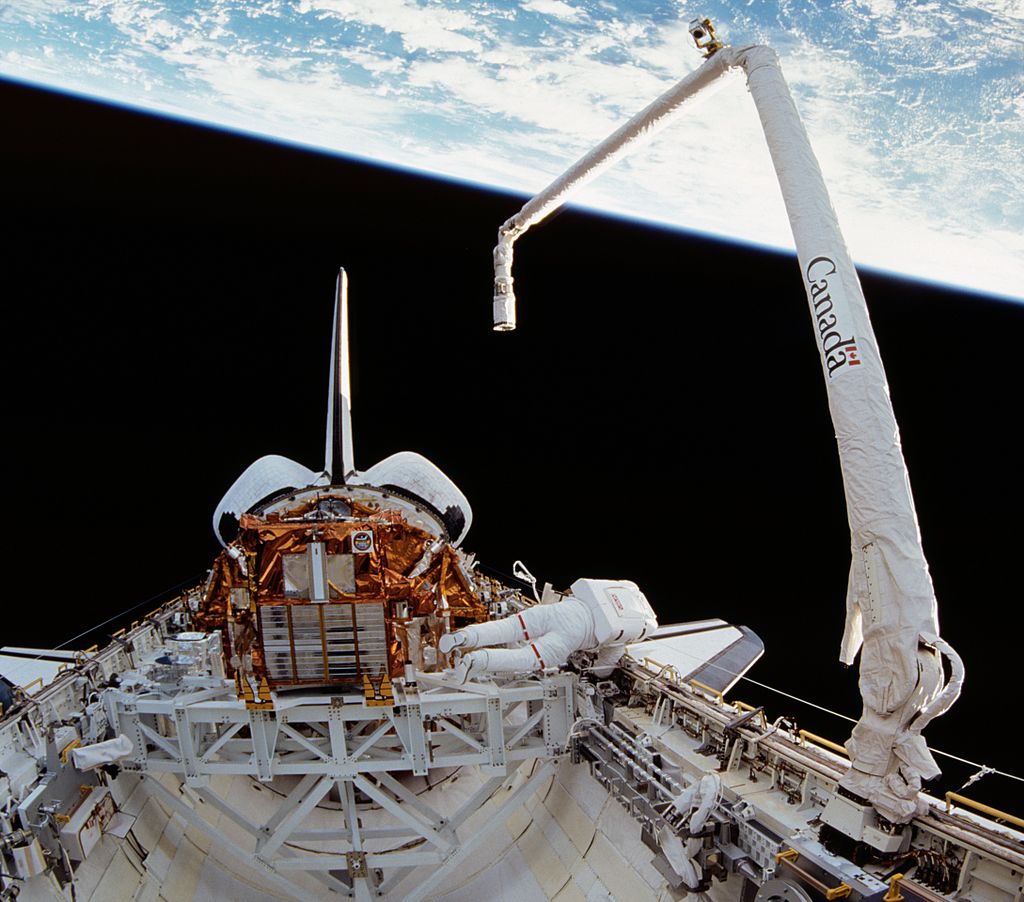
The first robotic arm manipulator was the Canadarm (Shuttle Remote Manipulator System, SRMS), developed by Canada. Canadarm was first tested in space aboard the shuttle Columbia during the STS-2 mission in November 1981. The arm was about 15.2 meters long and consisted of six joints, providing six degrees of freedom. At its tip, the manipulator had an end effector, a mechanism capable of grasping payloads specially equipped with fixtures for this purpose.
In the early stages of development, the manipulator was controlled manually by an astronaut operator who relied on cameras on the arm and visual cues to capture objects. After capture, Canadarm either deployed the spacecraft from the shuttle’s cargo bay (in case of deployment) or returned it there. Canadarm played a crucial role in the initial stage of the ISS construction. It was used to move large modules and trusses from the shuttle’s cargo bay. Sometimes, two robotic arms (Canadarm and Canadarm2) even worked simultaneously.
Source: wikimedia.org
Since its delivery to the ISS in April 2001, Canadarm2, a new, longer (17.6 m) modification of the first manipulator with seven movable joints, has helped capture unmanned spacecraft, including the Japanese HTV (H-II Transfer Vehicle), the first-generation American SpaceX Dragon, and the Northrop Grumman Cygnus. After being captured by the manipulator, the cargo ships were transferred to a special area called the Common Berthing Mechanism (CBM), where 16 automatic motorized bolts firmly secured them to the station’s outer hull, ensuring rigid, airtight berthing. Later, the Canadarm series was supplemented by a third modification with similar functionality.
In 2008, Japan also deployed its own robotic arm manipulator on the ISS, the JEMRMS (Japanese Experiment Module Remote Manipulator System). Installed on the Japanese experimental module Kibo, unlike its predecessors, the JEMRMS system consisted of two robotic arms: the main arm was 9.9 m long, and the smaller one was 1.7 m long. The larger arm was used for capturing and handling large objects, while the smaller one had higher precision and was used for working with small objects requiring fine accuracy.

Source: picryl.com
The JEMRMS arms have never berthed large spacecraft to the ISS; instead, they have been used to move experimental platforms and individual experiments from the pressurized Kibo module to its external platform, called the Exposed Facility.
The latest robotic arm installed on the ISS was deployed in July 2021. The ERA (European Robotic Arm), which measures 11.3 meters long and features seven movable joints, remains the only arm capable of servicing the Russian segment of the orbital station. ERA’s innovation lies in the fact that it is the only robotic manipulator able to actually move along the station’s exterior surface, attaching itself to 11 base fixation points. ERA is also a versatile arm because both of its “wrists,” which are on different sides, have identical functionality and can serve either as end effectors or as attachment points to the ISS surface.
It is worth noting that new types of robotic manipulators are being developed today, and aim at a higher level of autonomy by incorporating machine learning algorithms into their operation. AI will enable robots to make real-time decisions about the sequence of actions, tool selection, and responding to unforeseen situations. Currently, such developments are being advanced by the Japanese startup GITAI, which is already testing autonomous two-armed systems (S2 on the ISS). It is expected that this functionality will extend far beyond the ISS and may even be installed on service spacecraft tasked with maintenance, refueling, and modification of satellites in orbit.
Within the expansion of robotic manipulators’ functionality, there are proposals to create new manipulators with enhanced dexterity, the ability to work with small parts, and the production of modular and reconfigurable arms similar to ERA on the ISS. There are also developments in the field of “soft robotics,” which refers to new types of robots made from flexible materials and structures, as well as the design of small robotic assistant manipulators known as collaborative robots, or “cobots.” Such cobots will be indispensable in colonization missions to other planets, where robotic arms will work directly alongside human astronauts to assist in construction and other routine tasks.
Proba-3: a two-year orbital rendezvous
As mentioned above, orbital rendezvous usually concludes with the docking of two spacecraft. However, there are specific missions that require spacecraft to remain continuously in a state of rendezvous, thus maintaining a fixed distance from each other.
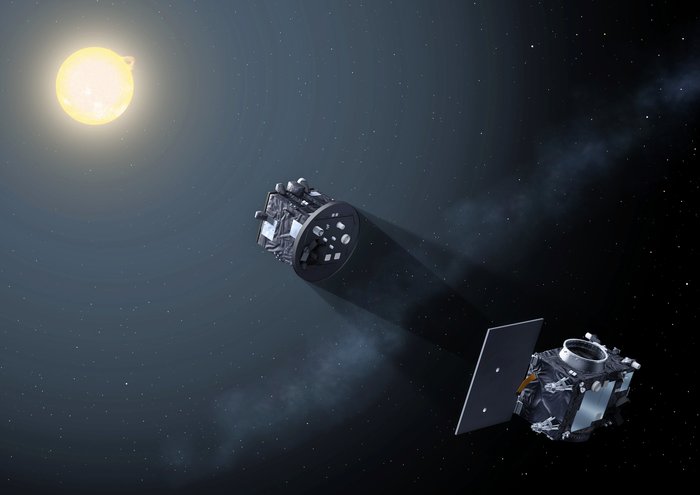
This is exactly how the Proba-3 solar observatory operates. Organized and launched by the European Space Agency (ESA) in May 2024, this mission consists of two spacecraft in a high elliptical orbit (HEO). One of them, the coronagraph spacecraft, is equipped with the mission’s primary scientific instrument, a coronagraph for studying the Sun. The other, called the occulter spacecraft, creates a constant artificial eclipse so that the coronagraph is not blinded by direct sunlight. To do this, the occulter spacecraft has a special disk that blocks the Sun’s light, simulating a solar eclipse.
Source: spaceflightnow.com
To ensure the eclipse is always complete, the satellites must maintain a constant distance of 144 meters from one another. Maintaining a continuous orbital rendezvous requires the Proba-3 mission team to use extremely sensitive space navigation, positioning, and timing instruments. The nominal duration of the Proba-3 experiment is two years, but as often happens with successful space missions, it may be extended.
Although other missions use internal coronagraphs, and while other missions are using multiple spacecraft observing the Sun from different angles (such as SOHO and STEREO), Proba-3 remains unique precisely because of its use of two separate spacecraft in continuous precision rendezvous. The mission thus demonstrates how orbital rendezvous is one of the most important aspects of space activity, not only in orbital construction and logistics but also in scientific research.