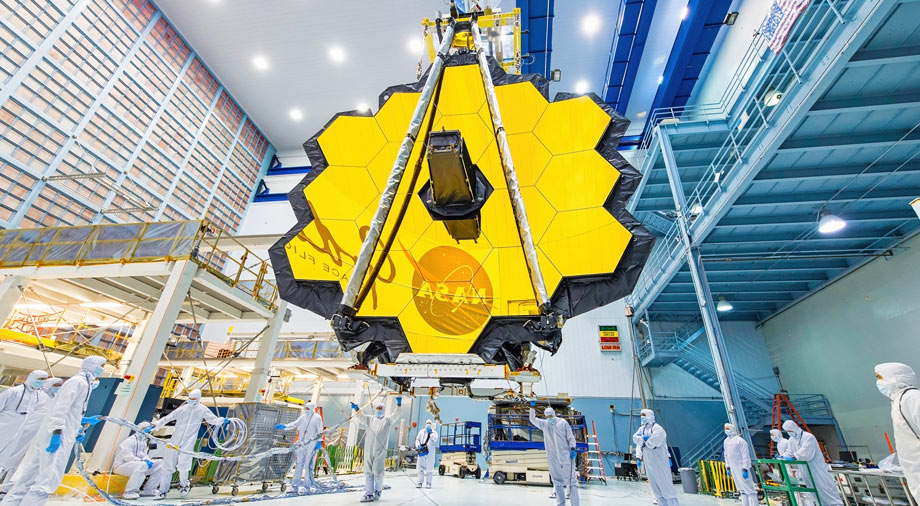
On Christmas Day, December 25, 2021, humans were able, for a brief moment, to witness what appeared to be a new star in the Western Hemisphere. But it wasn’t the Star of Bethlehem we saw: it was the brilliant glow of Ariane 5 rocket engines igniting in the morning sky above the Kourou launch site in French Guiana. Thus began the ascent of the most advanced and powerful space telescope ever built: the James Webb Space Telescope (JWST). Its journey to the Lagrange Point L2, located 1.5 million kilometers from Earth, took about a month. Finally, on January 24, 2022, Webb began the first adjustments of its ultra-sensitive instruments, and by the summer of that year, we saw the first full-color images of the most distant galaxies and other cosmological structures in the Universe.
As we approach the fourth anniversary of the James Webb mission, we’ve decided to revisit its most significant astronomical discoveries and once again marvel at the unearthly beauty of its extraterrestrial images.
A window into the deep universe: SMACS 0723
Immediately after James Webb began its observation mission, many astronomy enthusiasts held their breath when, on July 12, 2022, NASA presented the first full-color image captured by the space telescope. That image depicted the galaxy cluster SMACS 0723, often called “Webb’s First Deep Field.” The photograph revealed thousands of galaxies in the depths of space. Many of the cosmological structures visible in the SMACS 0723 image had either never been seen before or had been captured by JWST’s predecessors in much lower quality.
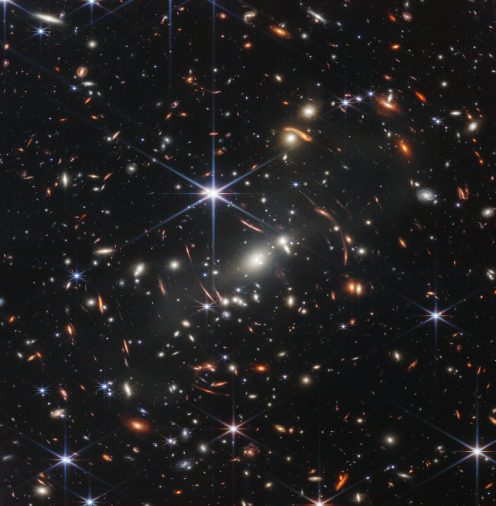
Image courtesy of NASA, ESA, CSA, and STScI
Source: esawebb.org
The uniqueness of the SMACS 0723 galaxy cluster lies in the fact that it is a natural gravitational lens, meaning that the mass of the cluster is so great that its gravity actually warps space itself. The effect of gravitational lensing acts as a kind of cosmic “magnifying glass,” amplifying light from extremely distant objects located behind the massive cluster. Thanks to this effect, JWST was able to see galaxies that existed only 600–800 million years after the Big Bang.
The image of the SMACS 0723 galaxy cluster was taken using the telescope’s Near-Infrared Camera (NIRCam). JWST captured these images at different wavelengths, primarily in the infrared range. For 12.5 hours, the telescope was focused on a single region of space, recording individual sections of galaxy clusters. The light from the SMACS 0723 galaxies traveled for 4.7 billion years before finally reaching JWST’s lens.
That first image from JWST revealed that galaxies in the early Universe were much brighter and more structured than previously believed. Moreover, even at that time, galaxies already displayed spiral and elliptical shapes, indicating a surprisingly rapid process of formation. What JWST revealed about the speed of galaxy formation would continue to astonish scientists in the coming years, but it was the SMACS 0723 image that first pushed astronomers to rethink theories of galactic evolution. The assumption that star formation in the early Universe occurred far more intensely than first believed began to be confirmed by observational data.
Thus, one of JWST’s very first images was a scientific breakthrough in and of itself, transporting us billions of years back in time in an instant. For the first time, the telescope’s unparalleled ability to see the tiniest details through cosmic dust was demonstrated. The SMACS 0723 image marked a triumphant beginning for a mission that would soon provide even more important discoveries.
The mystery of exoplanets and the search for biosignatures
About 60% of JWST’s observations are not “images” in the usual sense of the word, but rather spectrographic studies. This methodology is used to search for organic compounds in protoplanetary disks, measure the redshift of the most distant galaxies, and so forth. One of the first spectra obtained by JWST on July 12 was the spectrogram of the exoplanet WASP-96b, located approximately 1,150 light-years from Earth.
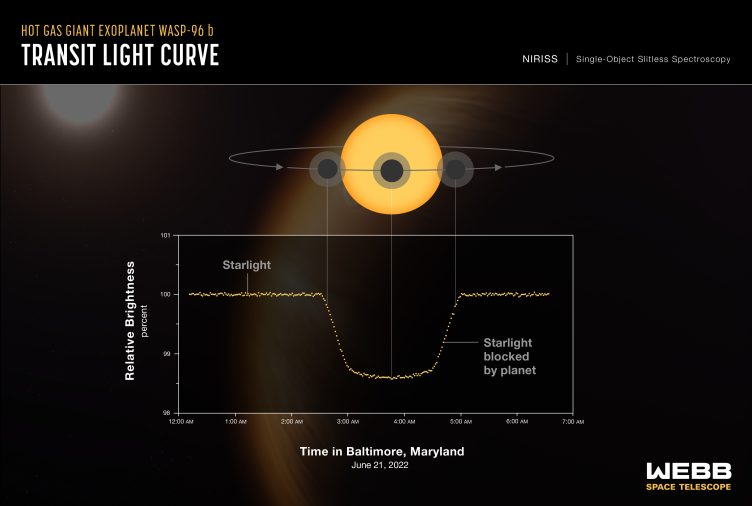
This planet belongs to the class of hot Jupiters and orbits a Sun-like G-type star, WASP-96, every 3.4 days. The mass of the exoplanet was measured quite precisely: 0.48 times that of Jupiter. Although previous assessments indicated that the planet itself was uninhabitable and unsuitable for colonization, it still drew scientists’ attention. The JWST research team decided to study the planet in more detail using the Near-Infrared Imager and Slitless Spectrograph (NIRISS), one of the telescope’s four main scientific instruments. These tools made it possible to obtain the light curve of WASP-96b, a graph confirming the planet’s transit (orbit) around its star.
Source: en.wikipedia.org
The discovery of WASP-96b itself happened in 2013, nine years before JWST began its observations using a network of robotic observatories that were part of the international WASP (Wide Angle Search for Planets) project. However, JWST provided the most comprehensive information about this Jupiter-like world, as the planet’s atmosphere proved to be an ideal target for the telescope’s scientific instruments.
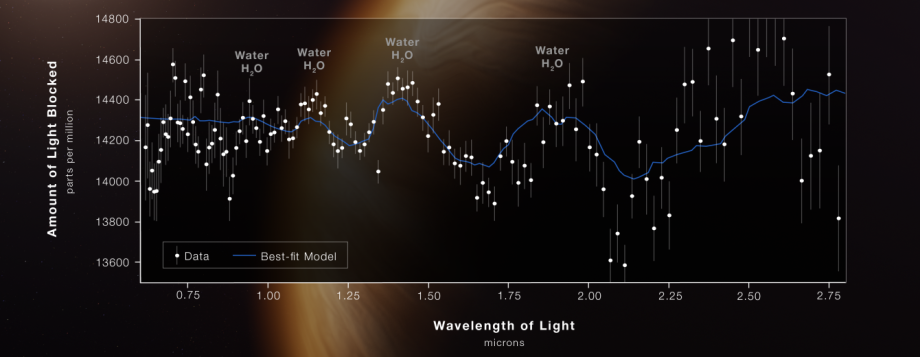
Using the transit spectroscopy methodology, which measures when starlight passes through a planet’s atmosphere during its transit, JWST was able to “split” this light into its components. As a result, it obtained the most detailed spectrum of an exoplanet’s atmosphere in the history of astronomical observation. Among other things, the presence of water vapor was detected in the atmosphere of a planet beyond our Solar System for the first time.
Courtesy: NASA, ESA, CSA, STScI, and the Webb ERO Production Group
Source: en.wikipedia.org
The spectrography revealed not only the presence of water vapor but also provided relatively accurate data on its quantity. The spectrum also showed signs of clouds and haze that had previously been impossible to observe. The discovery of water vapor in WASP-96b’s atmosphere was revolutionary because it clearly demonstrated that JWST indeed possesses instruments capable of precisely determining the chemical composition of distant planetary atmospheres.
This finding sparked hope that, in the future, we might discover an atmosphere rich in biosignatures. Henceforth, in addition to observing distant galaxies, stars, and nebulae, JWST would be frequently used to search for signs of life on other exoplanet candidates.
As of 2025, the telescope has analyzed the chemical composition of more than 100 atmospheres among the most promising of the 6,000 known exoplanets. So far, the telescope has detected water vapor, methane, carbon dioxide, and carbon monoxide in the atmospheres of dozens of exoplanets. However, the process of definitively confirming their biosignatures will take much longer, as it requires not merely the detection of life-forming molecules but also ruling out all possible non-biological sources of their origin.
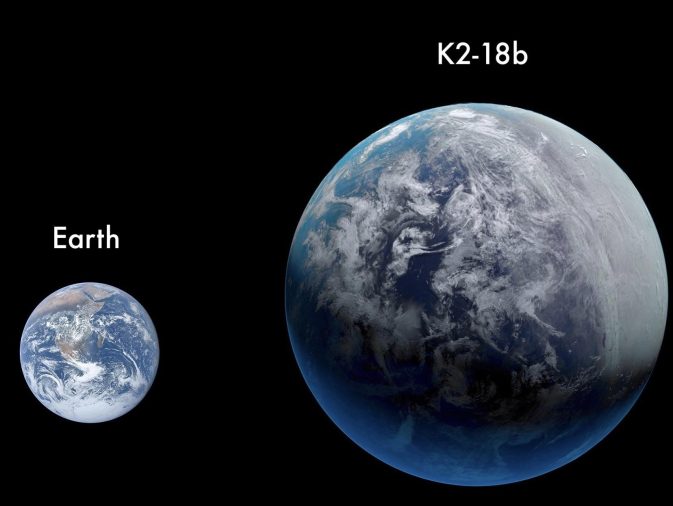
One of the most promising candidates was the exoplanet K2-18b. In September 2023, JWST detected the presence of methane and carbon dioxide in its atmosphere. The most intriguing result was the possible detection of the molecule dimethyl sulfide (DMS), which on Earth is produced almost exclusively by biological organisms called phytoplankton. However, no definitive evidence of DMS on K2-18b has been confirmed thus far.
Source: www.reddit.com/r/spaceporn
JWST continues its search for a habitable world that could sustain organic life. The sensitivity of the telescope’s instruments allows for the detection of even trace amounts of complex molecules. The beginning of the biosignature study on K2-18b, which started in September 2023, may become an important step toward solving one of humanity’s greatest mysteries: are we alone in the Universe?
A new look at the Pillars of Creation
In October 2022, JWST turned its infrared eyes toward one of the most famous cosmic structures in our Universe: the Pillars of Creation. This cosmological structure consists of enormous columns of interstellar gas and dust located within the vast Eagle Nebula (M16), which is approximately 6,500–7,000 light-years from Earth. The Pillars of Creation serve as a cradle of star formation, as within these massive and extremely dense clouds of gas (primarily molecular hydrogen) and dust, protostars are born.
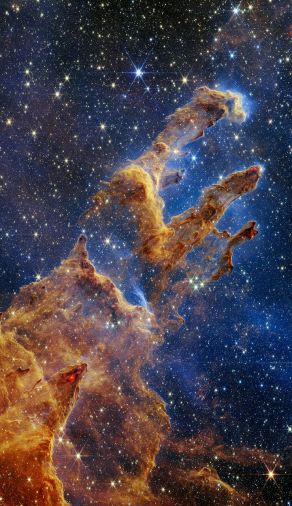
Image processing: Joseph DePasquale (STScI), Anton Koekemoer (STScI), Alyssa Pagan (STScI)
Source: science.nasa.gov
The first image of these majestic gas-and-dust “pillars” within the Eagle Nebula was captured by the Hubble Telescope on April 1, 1995, and has since become an icon of modern astronomy. However, because Hubble operated only in the visible spectrum, it could not capture the structure in detail through the thick layers of cosmic dust. Only JWST’s infrared images could allow astronomers to see inside the Pillars of Creation and observe thousands of newborn stars.
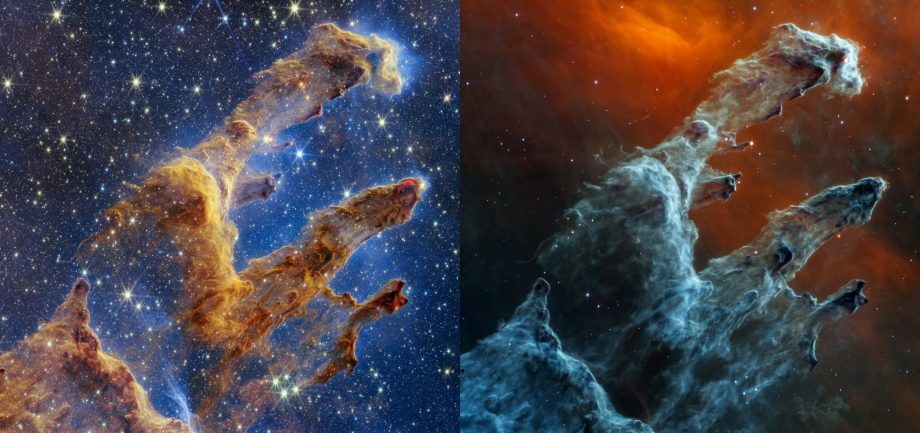
Two main cameras were used for the study: one operating in the near-infrared range (NIRCam) and the other in the mid-infrared (MIRI). Using NIRCam, the telescope was able to pierce through most of the dust and view the young stars forming within the structure. The principle of observation using MIRI was somewhat different: this instrument allowed JWST’s sensors to directly observe the dense clouds of gas and dust and study the colder matter that makes up the Pillars of Creation. This gave scientists insights into the molecular composition of the pillars and helped identify the regions where the material remained cold enough to form new stars.
Source: scitechdaily.com
The results of this study were truly stunning. In these images, astronomers saw not only the familiar shapes from earlier Hubble photographs but also countless new bright red dots, which were actually newborn stars. Previously hidden behind dense layers of gas and dust, they now shone like precious gems. But the greatest treasure was not the image of the stars themselves, but the fact that each one could potentially reveal in detail how the process of star formation unfolds.
Observations of the Pillars of Creation thus provided insight into how protostars form in dense clouds of gas and dust. For the first time, there was clear visual confirmation that the main processes of star formation occur inside these giant “towers of dust.” JWST also captured thin, needle-like structures that looked like diffuse red glows emerging from some of the pillars. This confirmed the hypothesis of active jets or outflows of matter from stars in the early stages of their formation.
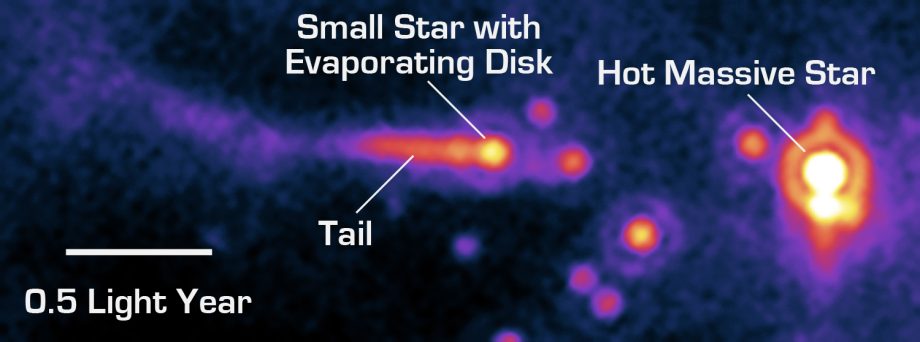
The MIRI image also demonstrated that dust was most densely concentrated near the “tops” of the pillars, indirectly supporting the idea of destructive influence from massive, fully formed stars located outside the image frame. Their powerful ultraviolet radiation and stellar winds gradually erode and evaporate the dust columns. JWST was able to capture this process, known as photoevaporation, in which newborn stars destroy their own “building material” to complete their formation.
Source: en.wikipedia.org
Careful work with infrared light coming from deep space allowed the James Webb team to detect flows of energy and matter being ejected from young stars, shaping the Pillars of Creation. This discovery complemented and expanded knowledge gained from the Hubble telescope, demonstrating how two telescopes operating in different spectra (infrared and visible light) can together create a more complete picture of the universe.
The oldest known black hole in the universe
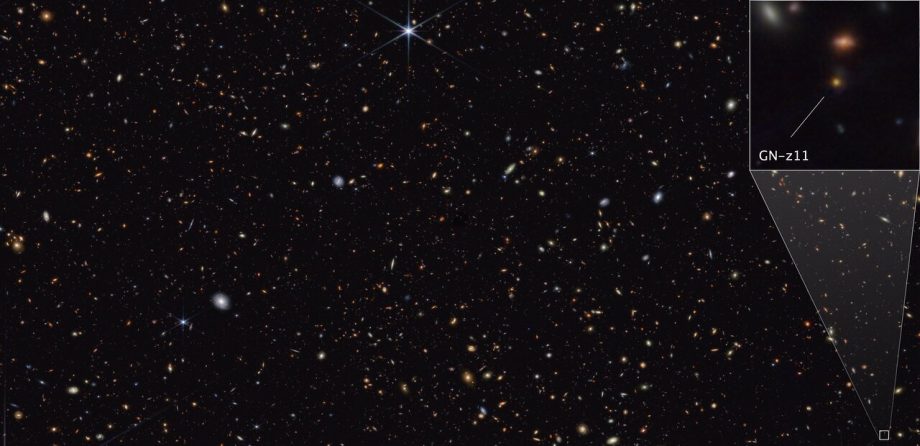
In December 2022, the JWST team announced the discovery of the oldest known actively feeding black hole to date. According to estimates, this object came into existence only 430–570 million years after the Big Bang. The black hole is located at the center of the galaxy GN-z11, whose light took roughly 13.4 billion years to reach the Milky Way.
GN-z11 was originally discovered in 2016 through analysis of data from the Hubble and Spitzer space telescopes, as well as the ground-based Subaru telescope. However, in December 2022, using its NIRSpec (Near-InfraRed Spectrograph) and NIRCam instruments, JWST detected strong and broad emission lines of ionized gas, primarily He-II and N-V, which indicated extremely high gas velocities in the accretion disk around the black hole. This data provided direct evidence that the object was actively and rapidly accreting surrounding matter while emitting enormous amounts of energy, confirming that a supermassive black hole resided at the center of GN-z11.
Source: esawebb.org
The black hole was identified as an active galactic nucleus (AGN) powered by a supermassive black hole. The active region of emission, directly caused by the black hole accreting matter, was designated GN-z11-ID. Further studies showed that this black hole was significantly more massive than existing cosmological models had predicted. Its mass was estimated at roughly 2 million solar masses.
Although not the largest mass ever observed in the universe, this value was extremely high for a black hole that had formed so early. Once its age and mass were confirmed, scientists were faced with numerous questions about the nature of GN-z11-ID. For example, according to conventional theories, to reach such a mass in fewer than 600 million years, a black hole would need to grow at an extraordinary rate. However, the required growth rate would far exceed the theoretical Eddington limit, or the maximum accretion rate at which radiation pressure does not repel incoming gas.
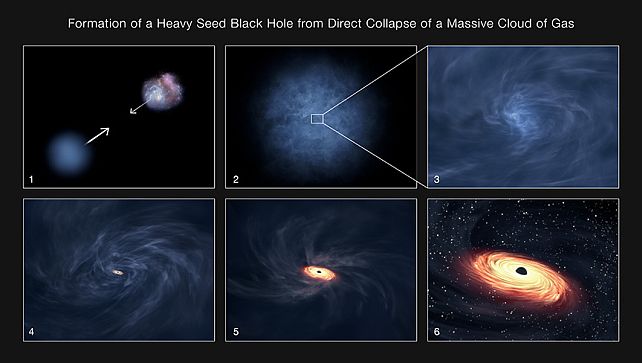
This discovery prompted reconsideration of the models describing the formation of “seed” black holes, which serve as the starting point for supermassive objects. The traditional “light seed” model proposes that the first black holes formed from the collapse of the first massive stars–so-called Population III stars–with around 10–100 solar masses. To reach 2 million solar masses so quickly, such black holes would have needed ideal conditions for continuous growth at rates above those predicted by the Eddington limit.
Another model, known as the “heavy seed” scenario, supports the theory of so-called “direct collapse black holes.” This model suggests that enormous primordial gas clouds weighing approximately 10^5 solar masses could collapse directly into a black hole, bypassing the star formation stage entirely. Theoretically, this could give early black holes the powerful head start necessary to achieve the enormous mass observed in GN-z11.
Source: sciencealert.com
The supermassive black hole observed in the galaxy GN-z11, discovered with JWST, thus became the first “missing link” between theories of early formation and actual observations, demonstrating that the largest black holes in the early universe formed through unusually rapid growth mechanisms.
As for galaxy GN-z11 itself: it held the record as the most distant known galaxy only briefly.
“And everything became clear”: the discovery of JADES-GS-z14-0
At the turn of 2023/2024, JWST broke its own record again by discovering an even more distant galaxy: JADES-GS-z14-0. Preliminary redshift analysis indicated that this galaxy formed just 290 million years after the Big Bang, meaning it was the oldest and most distant object ever observed by astronomers. The existence of a fully formed galaxy in such a young universe provided a significant boost to theories about how quickly such cosmological objects could form.
JWST, of course, did not randomly focus on that part of the sky: the discovery of JADES-GS-z14-0 happened within the framework of the JWST Advanced Deep Extragalactic Survey mission (JADES), a deep study of early galaxies in sky regions previously photographed by the Hubble Telescope and identified as potential areas of interest for further research.
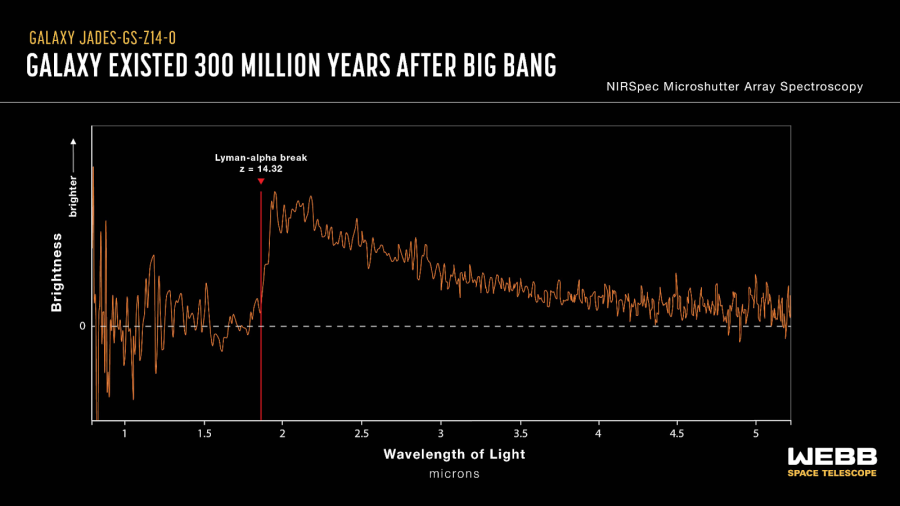
The redshift (z) of galaxy JADES-GS-z14-0, measured at approximately 14.32, was later stereoscopically confirmed using the NIRSpec instrument. The spectrum clearly showed the Lyman break (high redshift galaxies actively forming new stars) and distinct hydrogen and oxygen emission lines, allowing astronomers to determine the galaxy’s distance with high accuracy. This meant that scientists were observing a part of the universe from when it had existed for only 2% of its current age.
Source: esa.int
One of the main paradoxes associated with this new galaxy lies not only in its record-breaking distance but also in its extraordinary luminosity and size. In NIRCam images, it does not appear as a point source but as an elongated object, allowing astronomers to estimate its approximate diameter at around 1,600 light-years. JADES-GS-z14-0 clearly indicated that even just 290 million years after the Big Bang, the galaxy had already formed a significant number of stars, implying an extremely high star formation rate.
Spectral analysis also confirmed the presence of a distinct emission line of ionized oxygen (O III). This finding indicated that several cycles of star formation and stellar death had already occurred, since ionized oxygen was produced only inside the first massive stars and released into interstellar space when these stars exploded as supernovae at the end of their life cycles. Observations indicated that JADES-GS-z14-0 was a young, star-forming galaxy and did not have an active galactic nucleus with a supermassive black hole, as was the case with GN-z11. Most of the galaxy’s bright emission was classified as having originated from young, hot stars.
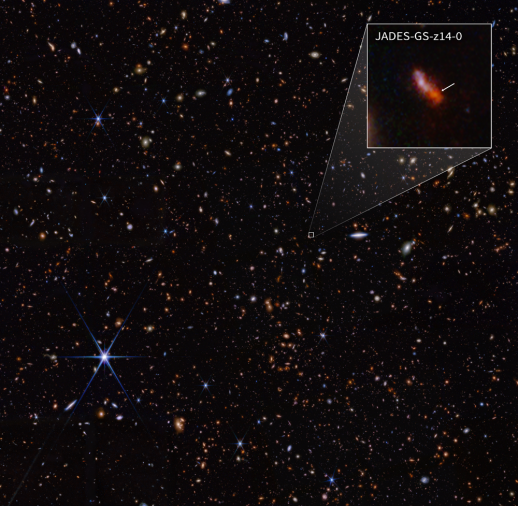
Source: en.wikipedia.org
JADES-GS-z14-0 is considered a very unique galaxy. The confirmation of its existence in the form we observe it just 290 million years after the Big Bang indicates that the galaxy existed during the so-called “epoch of reionization,” a period when the Universe transformed from a neutral (or opaque) state into an ionized (or transparent) one. It is possible that light emitted by bright early galaxies like JADES-GS-z14-0 may have been a primary “source of energy” that permeated space and drove this fundamental change.
The “building blocks of life” around young stars
Another significant JWST discovery occurred very recently. In March 2025, the JWST team announced the detection of complex organic molecules and water vapor in a protoplanetary disk named d216-0939, which orbits a young T Tauri-type star on the outskirts of the Orion Nebula Cluster. Structurally, this star closely resembles our Sun during its early formation stages. This observation provided the first direct evidence that the so-called “building blocks of life” may actually be widespread in young stellar systems.
The molecules that were detected included methane, methanol, and other organic compounds, which are considered key for the formation of amino acids and other more complex molecules that form the basis of biological life. JWST was able to detect the thermal signatures of these molecules in the cold cosmic dust. Using spectroscopy with NIRSpec and MIRI, scientists were able to precisely identify a unique complex organic molecule, ammonium carbamate (NH4+NH2COO−). In addition to complex organics, the protoplanetary disk also contained H2O ice (water vapor), carbon dioxide (CO2), carbon monoxide (CO), and the cyanate ion (OCN−).
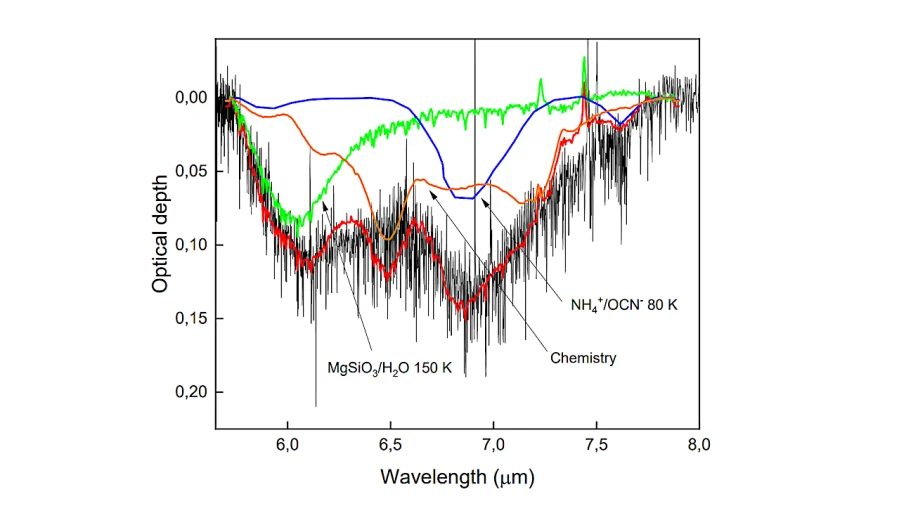
Source: astrobiology.com
This discovery is of enormous significance for the field of astrobiology, as it indirectly confirms the theory that the chemical components necessary for life are not unique to our Solar System. In the long term, this could mean that there may be countless other stellar systems in the universe where life similar to that on Earth is emerging.
Although the James Webb Space Telescope is only approaching its fourth anniversary, it has already provided the scientific community with over 100 terabytes of data, about 200,000 images, and conducted thousands of spectroscopic observations. Based on this data, the astronomical community is advancing bold hypotheses that often force scientists to look at the structure of the universe from a completely different perspective. The planned duration of JWST’s space mission is 10 years, but the telescope’s actual fuel reserves may actually allow it to remain active for closer to 20 years. Our hope is that, however long it operates, JWST’s most astonishing discoveries remain ahead.