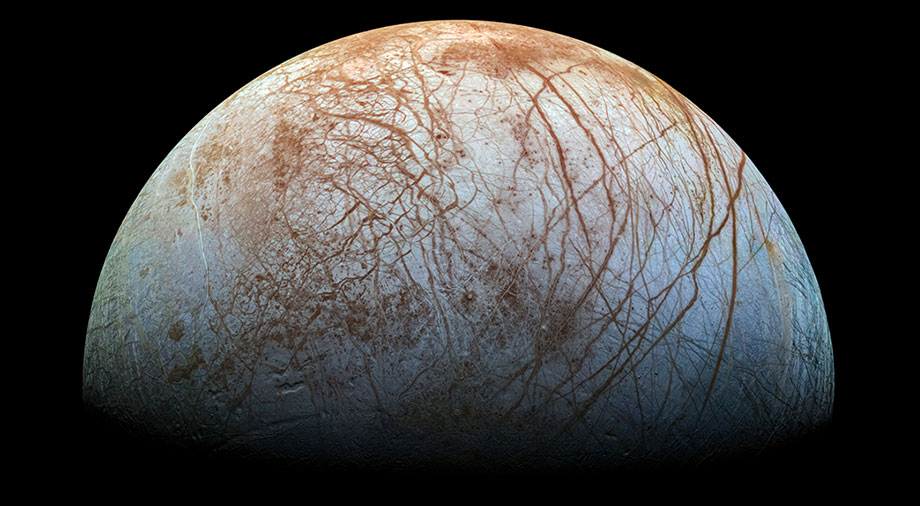
More than 400 years ago, while observing the stars through a telescope, Galileo Galilei discovered four of Jupiter’s moons, now known as the Galilean moons. Until then, no one believed that other planets could have their own satellites. Then, almost 250 years ago, William Herschel discovered Uranus while studying stars and comets in the constellation Taurus. Although other astronomers were already aware of this celestial body, they had long mistaken it for a star. It was only thanks to Herschel’s observations that Uranus was finally recognized as a planet, the first to be discovered using a telescope instead of with the naked eye.
In the 21st century, such discoveries no longer seem particularly incredible, since we now know much more about the Universe. And yet, unexpected discoveries still happen even today, with hundreds of observatories, tens of thousands of scientists, and amateur astronomers closely watching the sky. Inspired by the book Our Accidental Universe by Oxford astrophysics professor Chris Lintott, we aim to share just a few of the amazing accidental discoveries of past decades.
The Big Bang
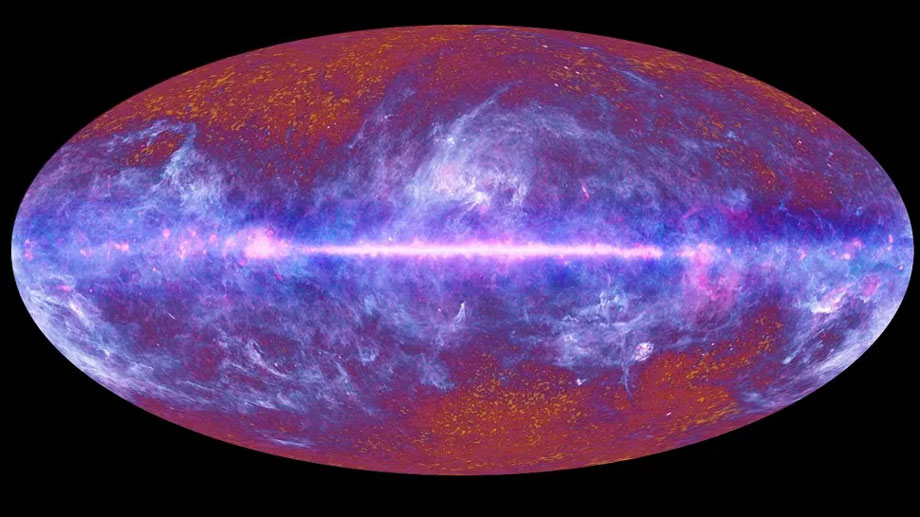
The theorization of the Big Bang in 1964 was not a story of a brilliant flash of insight, but rather one of circumstance. When Arno Penzias and Robert Wilson were working with a radio telescope, they consistently picked up a mysterious “noise.” The researchers even tried to clean the antenna of possible contamination, believing that particles of unknown origin were interfering with their measurements. Much later, scientists realized that this “noise” was not interference at all, but the oldest light in the Universe: so-called cosmic microwave background radiation, which is also known as relic radiation. Penzias and Wilson’s “failure” thus confirmed that the Universe was once incredibly dense and hot and has been expanding ever since.
The faint light in question is from the time after the Big Bang, when the Universe had cooled enough to allow photons to move freely through space. Since then, these photons have traveled across the cosmos until being detected by the world’s first radio telescope, which was built by Bell Labs. Although relic radiation cannot be seen without a telescope, it nevertheless fills the entire Universe. Most importantly, this radiation helps scientists understand how the Universe formed and what it was like in its earliest stages.
Source: space.com
Gamma-ray bursts
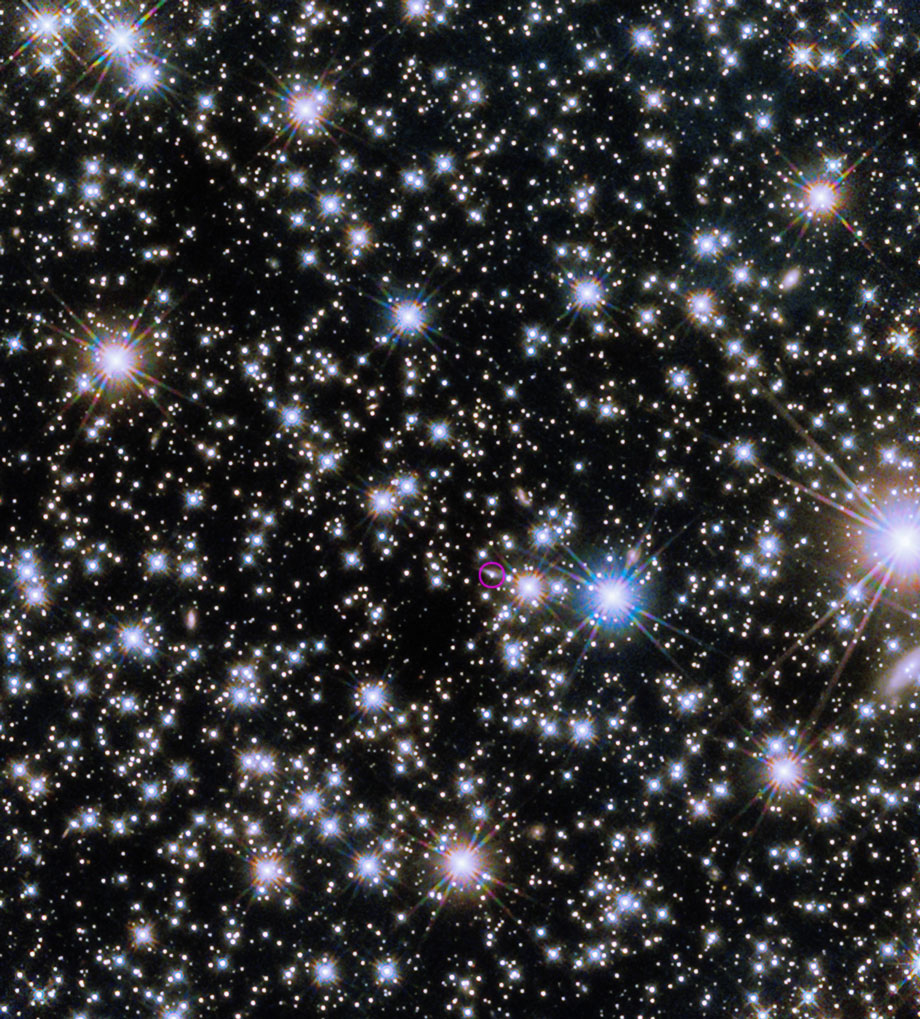
The discovery of gamma-ray bursts (GRBs), which are bright and powerful explosions, happened during the space race between the USA and the USSR. Astronomers believe that these bursts happen in distant galaxies and result from the formation of black holes tens of millions of light-years away from us. In 1967, gamma-ray bursts were unexpectedly detected by the Vela satellites, which had been developed to monitor for secret nuclear weapons tests. Four years earlier, the USSR had signed the Treaty on the Prohibition of Nuclear Weapons Tests in the Atmosphere, in Outer Space, and Under Water, but the United States suspected that the Soviets were not complying with the treaty and were conducting nuclear tests covertly.
Source: nasa.gov
The Vela satellites were positioned much higher than other satellites and carried detectors that recorded X-ray and gamma radiation characteristic of nuclear explosions. Their placement allowed them to detect blasts even on the far side of the Moon, and four satellites operating in parallel could monitor several locations simultaneously. One day, they detected events that were not related to nuclear tests.
However, the information about and classification of gamma-ray bursts only happened in the 1990s, when NASA launched the Compton Gamma-Ray Observatory with the BATSE instrument designed specifically to study GRBs. Within a year, scientists concluded that these bursts are distributed across the entire sky, originate from distant galaxies, and release even more energy than previously thought.
Unexpected Andromeda
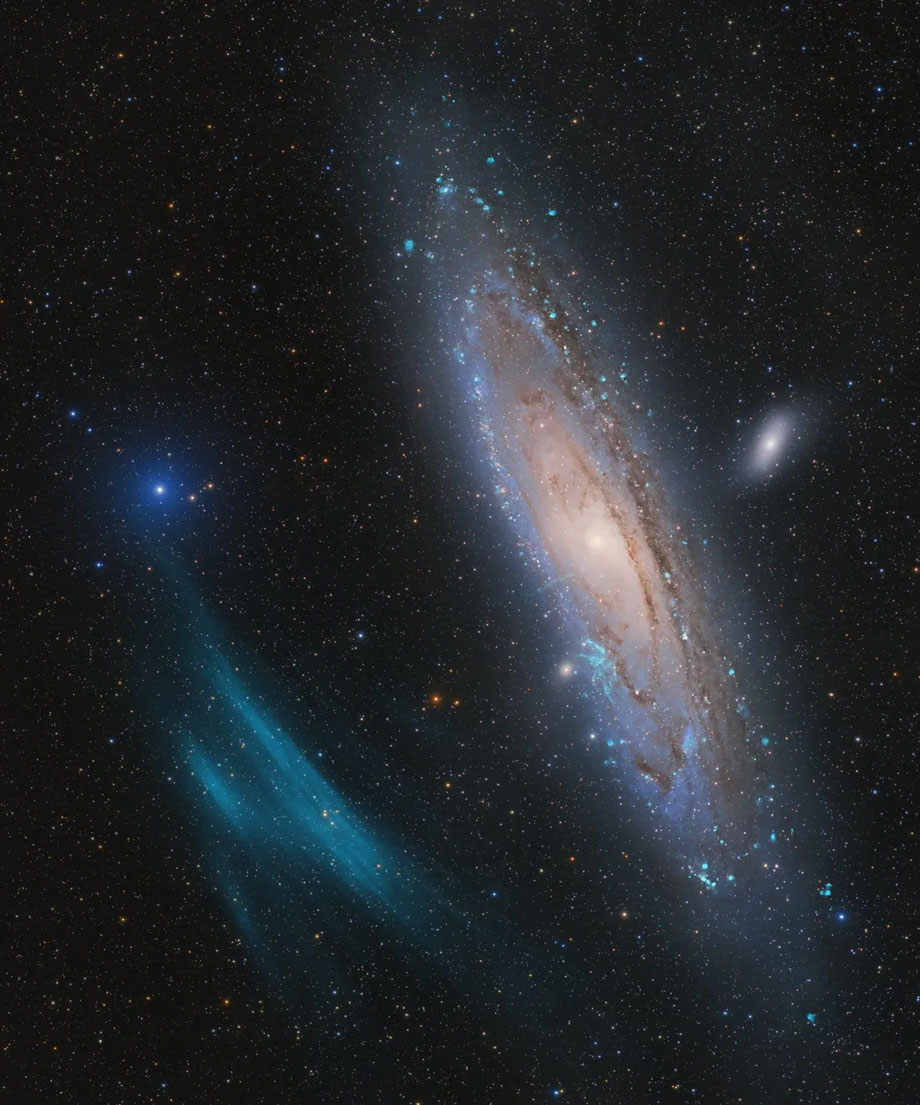
This is an incredible story of how three amateur astronomers and astrophotographers changed our view of the universe. And they did it recently! In 2022, they discovered and photographed a previously unseen oxygen arc near our closest spiral galaxy, Andromeda. Thanks to Marcel Drechsler, Xavier Strotner, and Jan Sainte, we now know about the existence of this oxygen arc.
In 2023, the photograph, “Andromeda Unexpected,” earned its creators the Astronomer-Photographer of the Year award, held annually by the Royal Observatory in Greenwich. The jury noted at the time that “the result [of this discovery] could be the largest and closest structure of its kind in the universe.”
Source: rmg.co.uk
Why had no one seen this bluish arc before? The reason is that it emits a very faint glow only in the spectral line of doubly ionized oxygen. That means that it can only be captured using special filters or a spectrograph tuned to specific spectral lines. However, only a few astrophotographers use such techniques because photos taken in this way contain a lot of noise, making it incredibly difficult to obtain a high-quality image.
“Hanny’s Object”
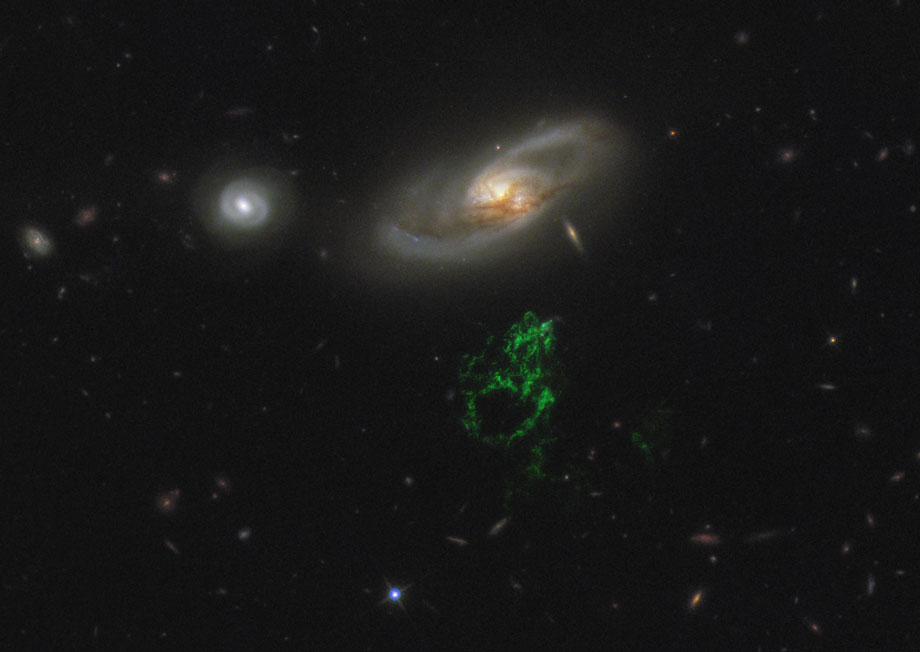
Volunteer projects span a wide range of human activities. For example, within the global Galaxy Zoo online project, volunteers from around the world help scientists classify galaxies by analyzing images provided by several powerful telescopes. It was in this way that Dutch teacher Hanny van Arkel discovered a mysterious green spot near the spiral galaxy IC2497. Two years later, scientists at Yale University were finally able to explain that the image had captured a cloud of glowing gas illuminated by a quasar, a highly active galaxy with a massive black hole at its center. Although the quasar itself has already faded, the remnants of its light continue to travel through space, creating the effect of a light echo.
“Hanny’s Object,” named after the researcher, drew attention to the galaxy, which is located 650 million light-years from Earth. Radio observations showed that new stars are actively forming at the interface between this object and the neighboring galaxy, with the youngest of them being “only” a few million years old.
Source: wikipedia.org
The brown dwarf called “The Accident”
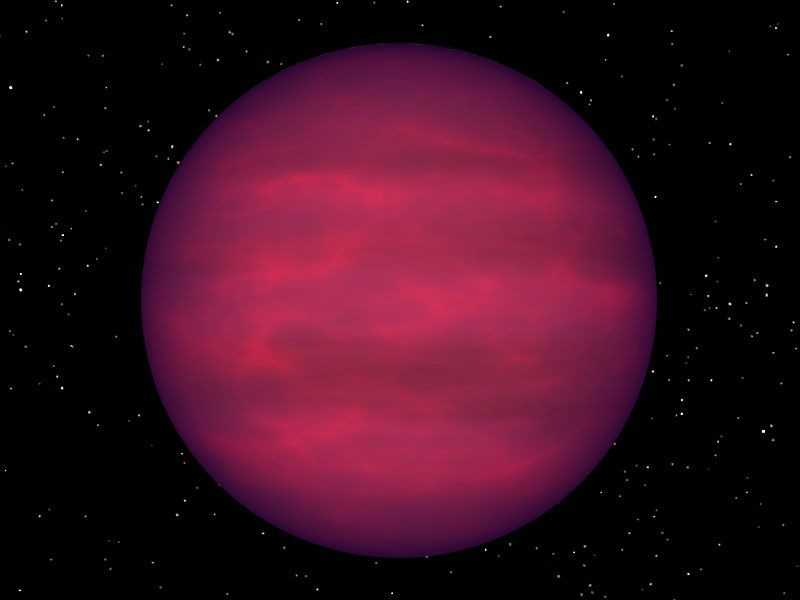
The peculiarity of brown dwarfs is that they are no longer planets, but not quite stars. On one hand, they undergo processes similar to those of planets, yet they are more massive. Meanwhile, they are too small to become stars. One such brown dwarf was accidentally discovered in 2021 by amateur astronomer Dan Caselden, using an online service to search for them in datasets collected during the NEOWISE mission. Today, this discovery is known as “The Accident,” although the object’s official designation is WISEA J153429.75-104303.
In 2021, more than 2,000 brown dwarfs had already been identified in our galaxy, but no one knew about “The Accident,” which is located 50 light-years from the Sun. It attracted attention because of its unusual properties: in different parts of the spectrum, it appeared either very dim or very bright. This indicated seemingly opposite characteristics: low temperature and great age in the first case, and the exact opposite in the second. In the end, scientists managed to estimate its approximate age as being between 10 and 13 billion years and concluded that objects like it may be more common in the universe than previously thought.
Source: wikipedia.org
The existence of pulsars
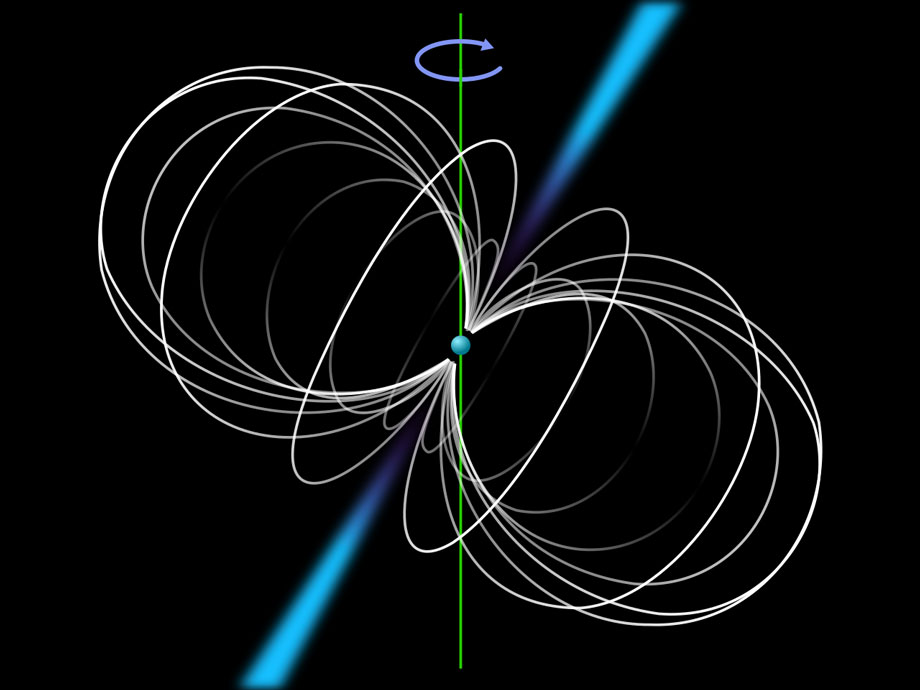
Pulsars are rotating neutron stars with a strong magnetic field tilted relative to their rotation axis. This causes radiation reaching Earth to be modulated, appearing like the periodic flashing of a lighthouse. The discovery of pulsars in 1967 was sensational: at first, they were thought to be possible signals from extraterrestrial civilizations and were even jokingly called LGM, for “little green men.” Soon, however, scientists realized they were dealing with a previously unknown type of astrophysical object.
Source: uk.wikipedia.org
The first pulsar was discovered in 1967 by astronomers at the University of Cambridge: graduate student Jocelyn Bell and her supervisor, Professor Antony Hewish. They were testing a new radio telescope equipped to record variable cosmic radiation. They initially thought the variability was caused by flickering radio signals from distant galaxies and quasars passing through interstellar and interplanetary plasma, similar to how starlight “twinkles” when observed through Earth’s uneven atmosphere. But instead of chaotic signals, the scientists unexpectedly detected periodically repeating sequences of pulses. It turned out that the source of these pulses was rapidly rotating neutron stars, the existence of which some scientists had suspected nearly thirty years earlier.
Today, pulsars are considered some of the most precise “cosmic clocks.” Additionally, their pulses, arriving with perfect regularity, help astronomers detect gravitational waves and map the structure of our galaxy.
Charon, Pluto’s Moon
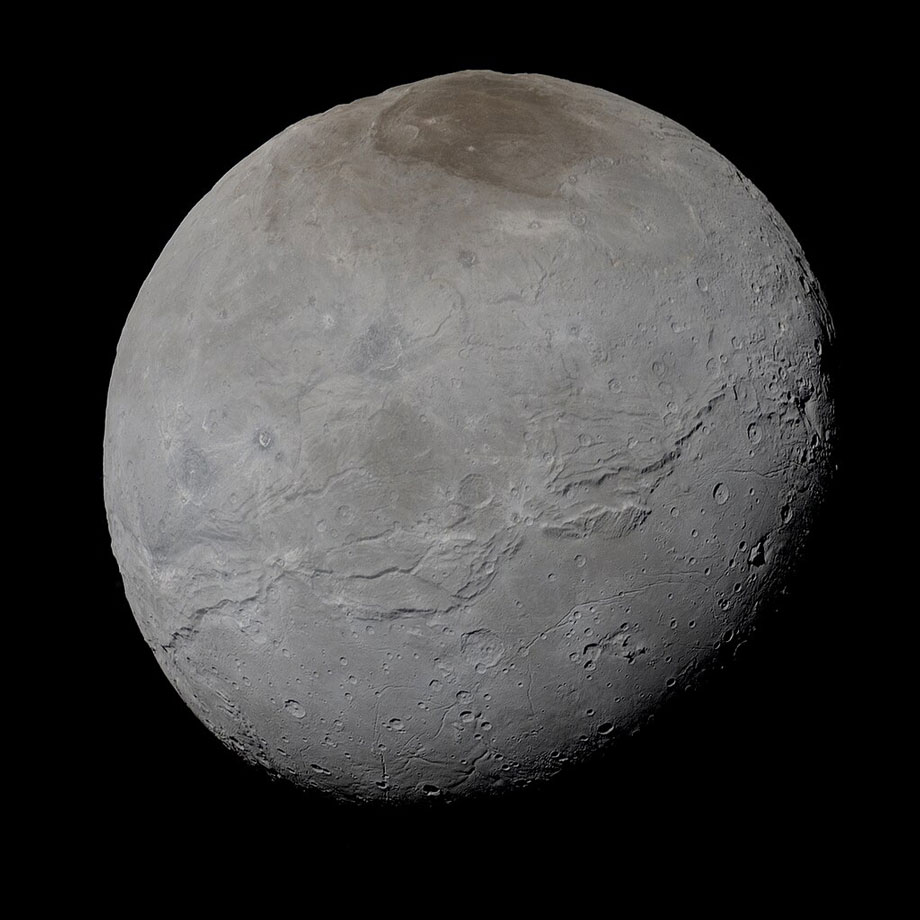
Scientists first became aware of Pluto in 1930. Even then, the planet behaved somewhat unusually, moving along an elongated and highly inclined orbit, occasionally approaching the Sun. But it wasn’t until 1973 that American astronomer James Christy, who was studying Pluto’s orbit, noticed a strange spot on its side. At first, he and his team attributed it to faulty equipment. However, they later realized that this “fault” appeared in the exact same place on a strict schedule: every 6.39 days. This is how one of Pluto’s five moons was discovered.
Source: wikipedia.org
As the discoverer, James Christy had the right to choose a name for the moon himself. He took the first letters of his wife Charlene’s name and added the suffix “-on,” as in the words “electron” and “neutron.” Today, we know this moon as Charon, the name officially approved by the International Astronomical Union.
The “Einstein Ring”
One very recent discovery is the giant “Einstein Ring.” Scientists found it in February 2025 while testing the powerful new Euclid space telescope. This rare phenomenon was noticed in test images of a galaxy relatively close to us. Researchers were intrigued by the glowing ring, formed by a gravitational lens around the galaxy NGC 6505, located 500 million light-years from Earth. As Thomas Collett of the University of Portsmouth noted in a press release, it is effectively “in our cosmic backyard.”
But why is it called an “Einstein Ring”? The answer is that this object is an example of strong gravitational lensing. Strong lenses are special and, among other things, help confirm the General Theory of Relativity on astronomical scales.
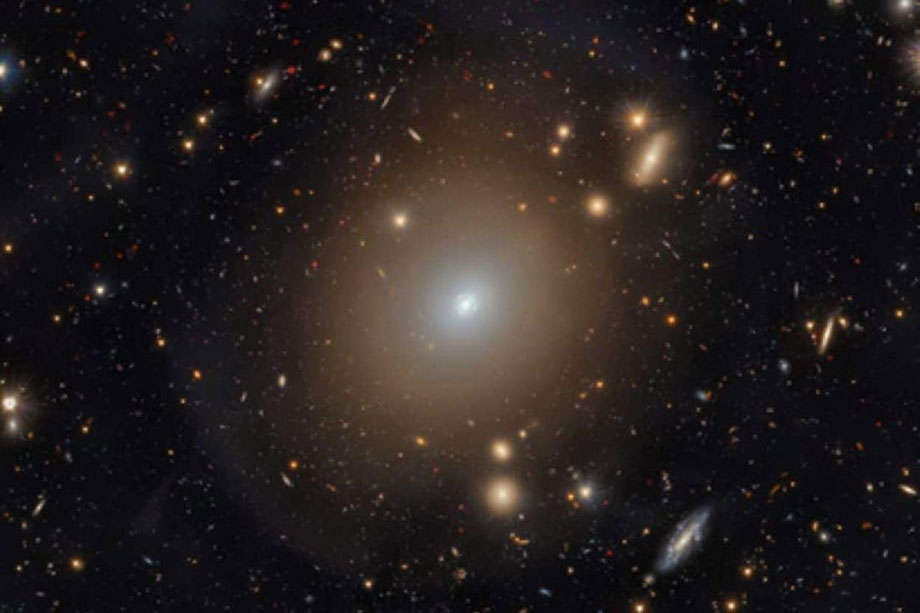
Source: independent.co.uk
Oort Cloud spiral
In this case, we’re not talking about the discovery of the Oort Cloud itself, but rather something that could change our understanding of one of the most mysterious structures in our Solar System. The Oort Cloud is a vast region filled with icy celestial bodies orbiting the Sun. While preparing an upcoming “Encounters in the Milky Way” show for the Hayden Planetarium in New York, event curators suddenly noticed a model of a spiral structure within the Oort Cloud. At first, this was dismissed as an artifact. But after investigation and modeling on NASA’s Pleiades supercomputer, it turned out to be a genuine spiral in the Oort Cloud, formed by small bodies and comets.
As Malena Rice, Associate Professor of Astronomy at Yale University, told CNN in June 2025, “The discovery of this spiral is a wonderful example of what we can learn about the Universe through visualization.” She also added that the results of this visualization are changing our understanding of the Solar System and helping us imagine what Oort Clouds in other systems might look like.
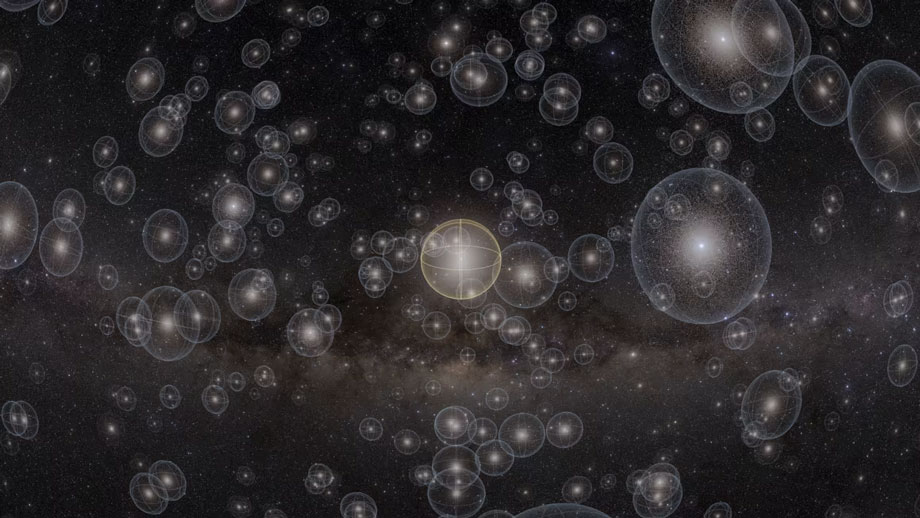
Source: edition.cnn.com
How many more unpredictable discoveries await us?
Discoveries about the Universe, as we can see, are often made by chance, but this in no way diminishes their significance. Anthony Hewish received the Nobel Prize in Physics in 1974 for the discovery of radio pulsars. His student, Jocelyn Bell, who first noticed the mysterious pulses, was not included among the laureates, but in 1973 she was awarded the Albert A. Michelson Medal alongside Hewish. The discovery of the cosmic microwave background earned Arno Penzias and Robert Wilson the Nobel Prize in Physics in 1978.
Kenneth Lang, an astronomer at Tufts University, noted in a January 2010 comment for SPACE.com that “the trend of serendipitous discoveries will continue in the future, especially as new telescopes are installed on Earth or in space, opening up new ways to observe the Universe.” In the 1990s, astronomer John Bahcall similarly observed that “the most astonishing discoveries happen when we are looking for something completely different.” In his view, humanity is likely to unravel the major cosmic mysteries related to dark matter and dark energy, but “not through traditional means, rather through entirely unexpected observations.”
So, it is clear that much excitement lies ahead, thanks to next-generation space telescopes, ultra-sensitive spectrographs, massive data arrays, and of course, enthusiasts striving for something beyond routine research.