The Artemis program’s plan to return humanity to the Moon and explore it could be an important step towards the exploration of Mars. In terms of complexity, however, going to Mars is not just “another Moon mission”: it’s an entirely new universe. That’s why intermediate steps like returning to the Moon are necessary, and why missions to Mars have not yet happened, even though today’s spacecraft are significantly more reliable, safer, and more powerful than those used in the Apollo missions. Among the main obstacles are the need for a soft landing, life support in conditions of limited oxygen and water, and high levels of radiation. But there is good news: some of the challenges related to Mars exploration may be solved soon. Read on to find out which solutions are on the horizon and why flights to Mars have not yet become routine for the space industry.
Problem 1: Radiation
Mars has no global magnetic field and only a thin atmosphere, which means its surface is exposed to high amounts of radiation that pose a serious threat to astronauts’ health. Streams of high-energy particles can easily penetrate the skin, damaging cells and DNA and potentially causing radiation sickness during the mission. Scientists have calculated that, throughout a 2.5-year journey, astronauts would receive a radiation dose that increases the risk of cancer by about 1%. On Earth and in low Earth orbit, where the ISS is located, these risks are minimal thanks to the planet’s natural protective mechanisms, the magnetosphere and atmosphere, which block most of the energetic particles.
“There’s a lot of good science to be done on Mars, but a trip to interplanetary space carries more radiation risk than working in low-Earth orbit,” notes Jonathan Pellish, a space radiation engineer at NASA’s Goddard Space Flight Center.

Source: nasa.gov
In reality, astronauts will need protection from two radiation sources that will affect the crew both during the journey and after landing. Naturally, the primary source is the Sun, with its constant particle streams and occasional powerful flares accompanied by coronal mass ejections. But galactic cosmic rays, which travel at near-light speeds, may also contain heavier elements in addition to protons. These rays break apart atoms in the materials that make up spacesuits, spacecraft walls, and other equipment. This results in so-called secondary radiation, which is extremely dangerous to all forms of life.
How can the problem be addressed?
There are at least two main strategies for protecting against energetic particle flows and secondary radiation. The first is to build massive structures using traditional materials. The second is to use more advanced protective materials. Scientists previously explored using thick metal shields, but later found that such solutions were costly and not always effective. Currently, NASA is developing hydrogenated boron nitride nanotubes (BNNTs), which retain their strength even at high temperatures.
In addition to physical barriers, researchers are also considering the use of force fields that could shield the Martian surface in a way similar to Earth’s magnetic field. However, this type of project is extremely difficult to implement, due to the enormous energy demands.
Finally, exposure to radiation on Mars can be reduced through operational measures. For example, minimizing the time astronauts spend outside the spacecraft, taking rapid shelter during solar storms, and avoiding spacewalks during daytime hours.
Problem 2: Food, Water, and Oxygen
Mars has 99% less air than Earth, and its atmosphere is composed mostly of carbon dioxide (95%). The share of oxygen is vanishingly small at just 0.174%. But the extremity of Martian conditions isn’t just about air composition: the atmospheric pressure is low, nighttime temperatures are extremely cold, and water is scarce. There is currently no life on the planet, but it may have existed billions of years ago. Evidence of this, specifically, the remains of an ancient lake, was discovered by the Perseverance rover, which is continuing its search for signs of life on Mars:
Unfortunately, carrying large reserves of oxygen and water to Mars would make the mission far more complex: the size and weight of the capsule would increase, which would in turn demand a more powerful launch vehicle, triggering a chain reaction of new requirements. This becomes even more complicated when one considers the duration of the journey. A trip to the Moon and back takes just three days, and the world record for time spent in space is nearly 438 days, but a mission to Mars could last at least 2.5 years.
How can the problem be addressed?
One of the seven instruments aboard the Perseverance rover is MOXIE, a device that extracts carbon dioxide from the Martian atmosphere and converts it into oxygen. Scientists hope that in the future, this technology can supply astronauts with oxygen for breathing and for rocket fuel needed to complete the mission. However, spacesuits would still be necessary.
The first experiments with MOXIE have been successful, achieving stable oxygen generation at a rate of 10 grams per hour. For context: just to launch four crew members from the surface of Mars, it would take up to seven metric tons of rocket fuel and 25 metric tons of oxygen.

Source: nasa.gov
Local oxygen production is part of the ISRU (in-situ resource utilization) strategy. Its implementation became possible thanks to low-temperature plasma, which is used to convert electrical energy. A chemical reaction may require as little as 25 watts, an acceptable power level even for the small solar panels that power the Perseverance rover.
In addition to oxygen, water and food are also pressing challenges. Plants could be a solution: they produce oxygen and are edible. However, plants also require specific (non-extreme) conditions for growth, which are difficult to maintain on Mars. Moreover, if they all fail at once, it would be a major problem for the astronauts. That’s why one current approach is to send essential supplies to Mars in advance, before the crew arrives, along with the development of a robust food program for long-duration crewed missions.
NASA’s prior experience may help with this. The agency already delivers a wide range of ready-to-eat meals, fresh fruits, and vegetables to the ISS via specialized cargo ships. For Mars missions, such deliveries will be far less frequent, so NASA’s labs are already developing long-shelf-life foods that retain their structure longer, while still being nutritious, varied, and palatable.
In search of other ideas for providing food during long-term missions, NASA launched the Deep Space Food Challenge. Through this initiative, the agency is looking for new contractors and technologies capable of providing astronauts with high-quality nutrition. Among the options are alternative food production methods in space, which are not limited to plant-based solutions and have minimal waste.

Source: nasa.gov
Problem 3: Food, Water, and Oxygen
“The distance between Earth and the Moon allows us to talk, troubleshoot, and resolve anomalies almost in real time,” says Dina Elzey, director of the Mars Campaign Office in NASA’s Exploration Systems Development Mission Directorate. “Due to the distance to Mars, the delay is much longer, anywhere from 4 to 24 minutes one way, so it can take over 40 minutes round trip just to ask a question and receive a response.”
Mars is “only” the fourth planet from the Sun, but the distance between it and Earth is vast even by space standards: from 55 to 401 million kilometers. This leads to significant communication delays, reaching up to two weeks during periods when the Sun is positioned between Earth and Mars (which occurs every 26 months). During these periods, radio signals are unable to pass through the Sun’s interference, and charged solar particles further distort the signal.
This presents a danger for astronauts: in a critical situation, they would be left to face the problem alone and would have to make decisions on the spot, without support from ground control. Moreover, the lack of real-time communication with Earth could cause psychological distress, as pointed out in a study titled “Affective Health and Countermeasures During Long-Duration Space Exploration” published on ScienceDirect.
How can the problem be addressed?
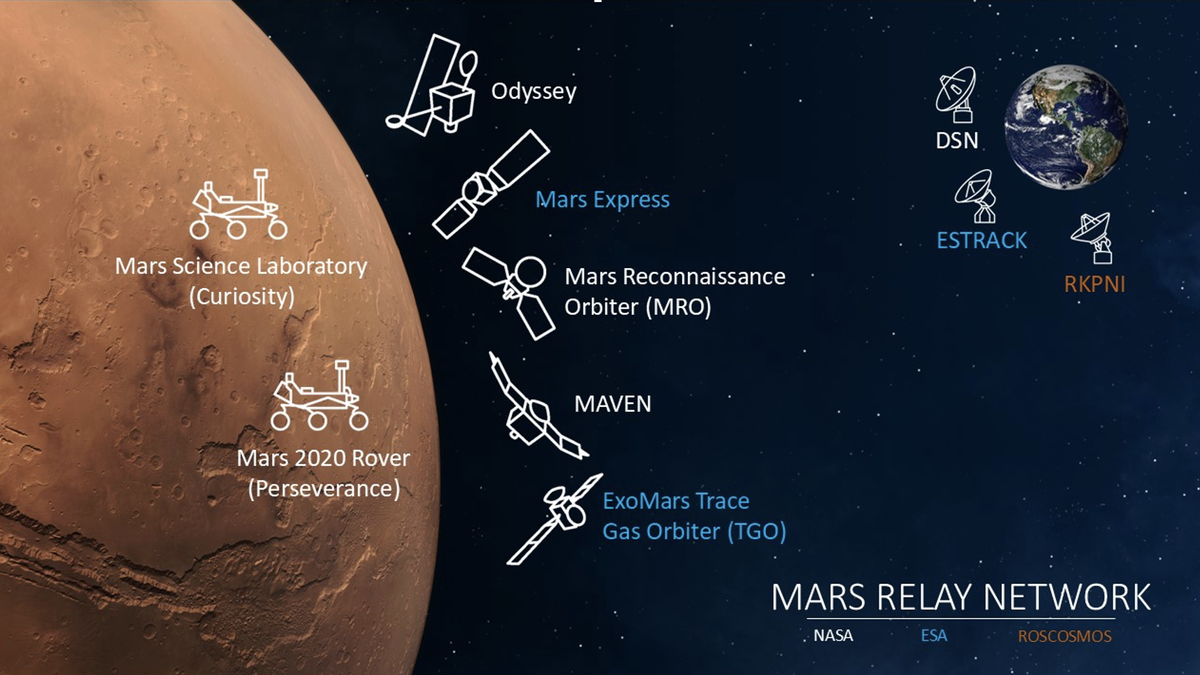
Engineers are working on the idea of developing a satellite relay communication system to keep Mars connected with Earth while minimizing delays, potentially even reducing the two-week communication blackout to just a few hours. Currently, the Mars Relay Network (MRN) is in operation, consisting of five spacecraft used for data relay. Instead of sending information directly to Earth, orbiters collect large amounts of scientific data during their missions and periodically transmit it to powerful relay stations. This speeds up communication with Earth and frees Mars rovers from the need to carry heavy and energy-intensive radio equipment.
Source: science.nasa.gov
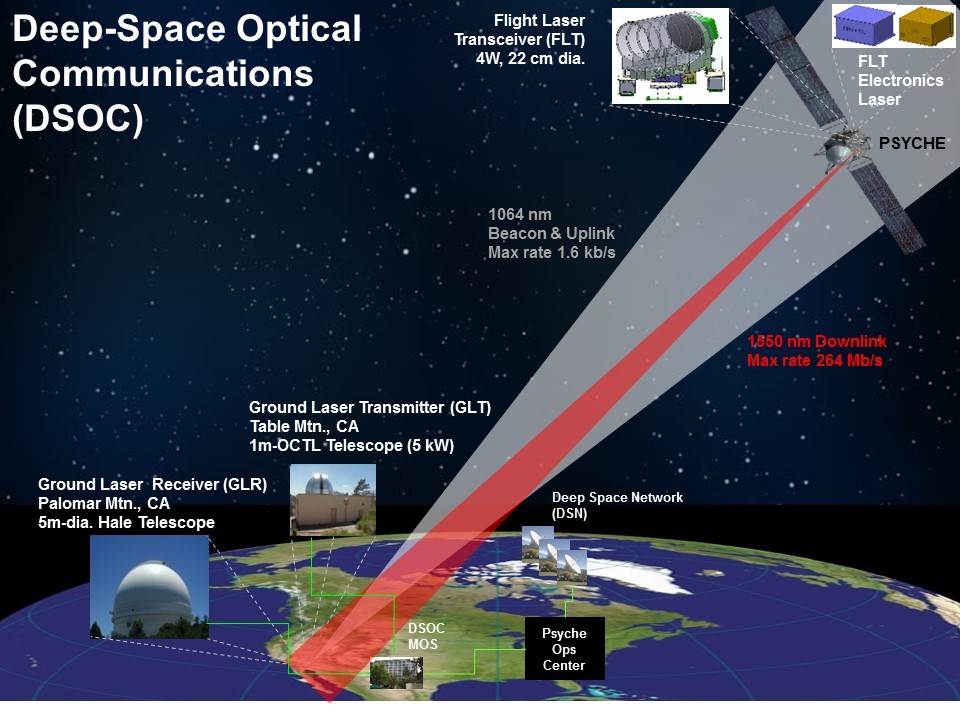
NASA’s second approach to addressing the signal delay problem is laser communication. This technology can also be used to implement a hybrid architecture, where data is first transmitted to relay satellites and then sent to Earth. Currently, a laser communication system is being tested as part of NASA’s Psyche mission, which is studying a unique asteroid of the same name. In this mission, the Deep Space Optical Communications (DSOC) laser system allows for data transmission at rates 10 to 100 times higher than traditional systems without adding significant weight to the payload.
Source: nasa.gov
Problem 4: Landing Challenges
A soft landing on Mars requires precisely calculated deceleration. NASA has only landed relatively small spacecraft weighing just under 1 ton, or roughly the weight of the Perseverance rover, which was lowered onto the Martian surface using high-strength cables. NASA rated the challenge of landing Curiosity softly at “20 out of 10,” as it required meeting hundreds of conditions: withstanding friction and intense heat, firing engines at just the right time, entering the atmosphere at the correct angle, and many others. To get a sense of how complex it is to land even a small rover smoothly, watch this video:
How can the problem be addressed?
Landing a large spacecraft softly on Mars remains a challenging task. While several scenarios have been developed, none have yet been adopted as a working solution. For instance, in 2022, NASA tested an inflatable decelerator in low-Earth orbit (Low-Earth Orbit Flight Test of an Inflatable Decelerator, or LOFTID). This technology could potentially enable safe arrivals not only on Mars, but also on Venus and Titan.
LOFTID is a circular inflatable structure several meters in diameter, equipped with a flexible heat shield that functions like a giant air brake. Its large surface area creates enough drag to slow down a spacecraft at higher altitudes, reducing the heat it experiences as it approaches Mars. This type of decelerator could be used in both crewed missions and large robotic missions, with its diameter scalable from 3 to 6 meters.

Source: nasa.gov
Another option involves using Supersonic Retropropulsion (SRP) engines to decelerate spacecraft as they enter Mars’s atmosphere. These engines were first tested over a decade ago during a Falcon 9 rocket landing. Although the rocket ultimately broke apart and fell into the ocean, the engines themselves performed their intended function. However, many questions remain unanswered: for example, how might space debris interfere with these engines, how might they behave when reused, or how well they could perform during a Martian dust storm.
Problem 5: Fuel Challenges
Due to the great distance between Earth and Mars, supplying missions with fuel presents another major hurdle. The problem is straightforward and cyclical: the more fuel you need, the heavier the spacecraft and its launch vehicle must be, meaning they, in turn, consume even more fuel on a round trip.
How can the problem be addressed?
In theory, the fuel issue can be addressed in the same way as oxygen and food: by delivering it to Mars in advance. Another option is in-situ fuel production, achieved by splitting water into oxygen and hydrogen, the latter being a key ingredient in rocket fuel. In addition to electrolysis, NASA scientists have explored creating rocket fuel from hydrogen trapped in Martian regolith (residual soil) and carbon from the Martian atmosphere. When these react, they produce methane, one of the main components of rocket fuel.

Source: bigthink.com
And That’s Not All (Being First is Always Hardest)
A crewed mission to Mars will be the first mission in which astronauts will only be able to rely on systems, food, and oxygen that were either delivered in advance or produced on-site. Extravehicular activity (EVA) will also have to be conducted without real-time support from the rest of the team if the issue of communication delays with Mission Control hasn’t been resolved by then. This means that all equipment and spacesuits must meet strict standards, and the crew must be thoroughly prepared for the most challenging tasks and emergencies.
In addition, the team must be ready, both emotionally and operationally, for the possibility that one of the astronauts could become seriously ill or injured and be unable to carry out their duties. In that case, the rest of the crew would need to adapt their workflows to the new circumstances and redistribute responsibilities in order to achieve the mission’s objectives.
This marks a fundamental difference from all previous space missions, no matter how complex or dangerous they may have been.

Source: thoughtco.com
It’s possible that, by the time of the first crewed flight to Mars, scientists will have overcome some of the challenges outlined above. But doing so will require immense coordination across many different teams. Moreover, there is never a single solution to a specific problem: it’s always a combination of tools and methods that complement one another. As Vijay Ramani, a chemical engineer from Washington University in St. Louis, puts it: “When we’re talking about exploring space or the surface of the moon or Mars, it’s never just one technology that’s used — it’s never just one silver bullet that solves all issues.”
(Source: https://www.space.com/mars-colonists-fuel-oxygen-production)
NASA’s current funding woes may slow the progress of government-led programs related to Mars exploration and space development as a whole. On the other hand, it could also spur innovation from private companies, ultimately increasing readiness for the mission.