Space is too far for direct measurements: we cannot even physically reach even the closest star to the Sun, Proxima Centauri. Although it was difficult to detect through observations, and was only finally observed in 1915, scientists later determined its distance from Earth: 4.24 light-years away, or over 40 trillion kilometers. This was done with the ESA Gaia space telescope, which creates a detailed map of the distribution of stars in our galaxy. However, even without modern telescopes, people in the past had already found ways to measure distances in space.
The first attempts to measure the Earth and space
The ancient Greek scientist, Aristarchus of Samos, is known for proposing the heliocentric system of the universe, with the Sun at the center and the Earth revolving around it. As early as 270 BC, he was the first to estimate the distance from our planet to the Moon. According to various sources, he obtained an average of about 60 Earth radii. Modern science calculates this distance as 60.3 Earth radii, or 384,400 km. He was mistaken in his assumption that the Earth’s shadow forms a perfect cone.
Today, the distance to the Moon is measured much more precisely: the Apollo 11 astronauts installed special reflectors, called retroreflectors, on its surface. Laser pulses are sent from Earth toward them, and the time it takes for the beam to return is used to calculate the distance with an accuracy of a few centimeters.
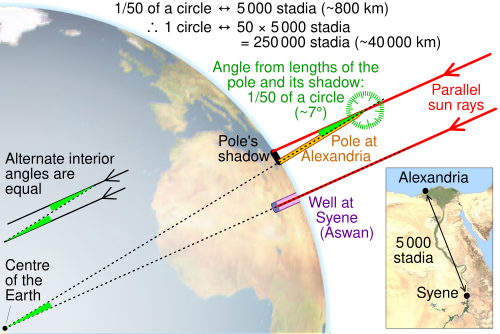
Aristarchus was not the only one making early cosmic measurements. Other ancient scientists also engaged in astronomical calculations before our era. Eratosthenes, a Greek scholar, mathematician, and chief librarian of the Library of Alexandria, determined the circumference of the Earth in 240 BC. According to his calculations, it was just over 40,200 km. Remarkably, he did this using only the shadow of a stick at midday on the summer solstice in two different cities, Alexandria and Syene. Estimates suggest his error was only 1.4–2.0%, made possible by measuring an arc. The original description of his method has not survived, but a simplified version is known from the works of another scientist, Cleomedes.
Source: wikipedia.org
Later, the Greco-Egyptian astronomer Claudius Ptolemy proposed his geocentric model of the universe, in which the Earth was stationary at the center, and all other celestial bodies revolved around it. He described his understanding of the motion of celestial bodies in his 13-volume work, the Almagest. The mathematical tables in these books, written in the 150s AD, already allowed for the calculation of planetary positions and other celestial phenomena for arbitrary dates, exerting a strong influence on medieval astronomy.
Johannes Kepler, working in the early 17th century, generalized the observations of the astronomer Tycho Brahe and formulated three laws of planetary motion, describing their elliptical orbits and the relationship between orbital period and distance from the Sun. Later, these laws enabled astronomers to calculate planetary orbits and predict positions in time far more accurately, even without telescopes or electronic sensors, laying the foundation for Newtonian celestial mechanics.
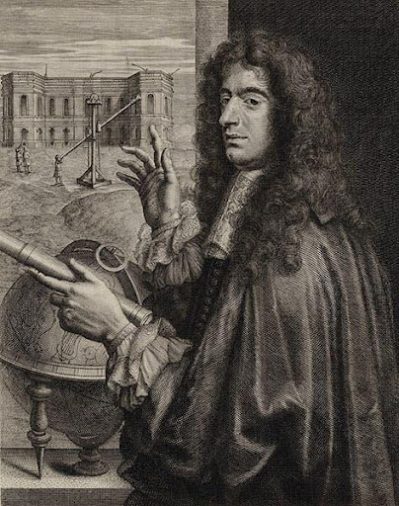
Later in the 17th century, the French astronomer Giovanni Domenico Cassini, in collaboration with Jean Richer, applied the parallax method to Mars. Cassini compared Mars’s position against the background of stars by observing it from two distant points, Paris and Cayenne. From different viewpoints, the planet appears to shift by a tiny angle: this is the parallax. Using this method, Cassini obtained the first reasonably accurate value of the astronomical unit (AU), or the distance from the Earth to the Sun.
The parallax method allows the measurement of the distance to an object based on the change in its apparent position when observed from different points. Armed with one of the first telescopes, invented in 1609 by Galileo Galilei, Cassini used trigonometric formulas to determine that the distance to the Sun was about 140–150 million km, which was very close to the value we know today: 149.6 million km.
Source: lindahall.org
The 18th century was a turning point for cosmic measurements, thanks to the transits of Venus across the Sun in 1761 and 1769. These relatively rare astronomical events, which only occur once every few decades, had also been observed by ancient astronomers. However, at that time, they did not yet understand how to properly use them to calculate distances in space. Cassini was the first to predict such transits in 1631 and 1761, and the idea of using them for measurements was proposed by Edmund Halley in 1716. Halley suggested that, when Venus passes between the Earth and the Sun as a black dot, one can measure the time it takes for it to move across the edges of the solar disk from different points on Earth. The difference in timing reveals the solar parallax, the angle from which Venus’s apparent shift is seen. Using this angle and trigonometric formulas, it is then possible to determine the Earth–Sun distance and calculate the absolute value of the astronomical unit.
All the scientists mentioned above made significant contributions to astrometry, the science of measuring the positions and motions of celestial bodies: the Sun, Moon, planets, and stars. Although its foundations were laid in the second century BC, the term itself only came into use much later, in the 19th century. It was then that astrometry was recognized as a separate scientific discipline.
The cosmic distance ladder
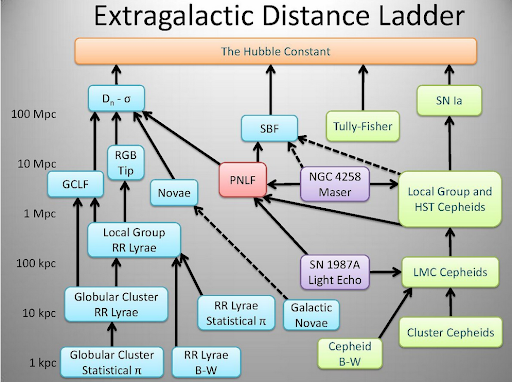
To calculate how far objects are from each other in the Universe, scientists use what is called the “cosmic distance ladder,” which combines several methods of measurement in which each previous step serves as the foundation for the next. This allows distances to be measured even in deep space, but if an error occurs at the early steps, it affects all subsequent measurements. The term “cosmic distance ladder” appeared only in the second half of the 20th century, although the system began forming long before the Common Era, and modern scientists have added new levels to it.
Step 1: Earth’s parameters. These became the starting point, and from there ancient scientists measured other cosmic quantities in Earth radii, such as the distance to the Moon or the Sun (recall Eratosthenes’ calculations).
Step 2: Distance to the Moon. For these calculations, the ancient Greeks used trigonometry and observations of lunar eclipses (here, Aristarchus obtained data close to modern values).
Step 3: Distance to the Sun (astronomical unit). Today, we know it corresponds to 149,597,870.7 km. Aristarchus attempted to measure it using the geometry of the Moon’s phases, but miscalculated, although he confirmed that the Sun is far larger than the Earth.
Step 4: Distance to the planets. At this level, we work in kilometers and can discuss distances to Mars and the other planets of the Solar System. Copernicus, in his time, accounted for the cyclical apparent motion of Mars and, based on the heliocentric model, estimated that its distance from the Sun was 1.5 AU. These calculations were later refined through the work of Tycho Brahe and Kepler, and later with the help of radar and interplanetary spacecraft.
Source: esahubble.org
Step 5: The speed of light. This value was determined thanks to the delay in observing the eclipses of Io, Jupiter’s moon. This played a significant role in the further development of physics and astronomy and became the basis for new calculation methods that use the travel time of light and electromagnetic measurements.
Step 6: Distance to the nearest stars. This was first measured by Friedrich Bessel in 1838, and the results were later confirmed using conventional optical telescopes.
Step 7: The size of the Milky Way and other galaxies. Stellar physics comes into play here: spectroscopy allows astronomers to determine the color and temperature of celestial objects, while photometry measures their apparent brightness. Knowing the distances to nearby stars makes it possible to determine their absolute luminosity, and conversely, color and brightness can be used to calculate distances. Today, it is known that the Milky Way has a diameter of 30,000 parsecs, or 97,000 light-years.
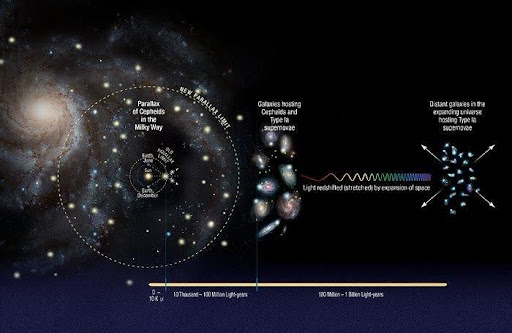
Step 8: Distance to other galaxies. Astronomer Henrietta Leavitt noticed that the pulsation period of Cepheid stars (which vary in brightness) is related to their intrinsic luminosity. Using this relationship, distances to galaxies containing such stars can be determined, up to about 100 million light-years.
Step 9: Estimating the scale of the Universe. At extremely large distances, it is impossible to see individual objects, so scientists measure the redshift in galaxy spectra and apply Hubble’s law: the greater the redshift, the farther away the object. This allows astronomers to map the distribution of galaxies and study large-scale structures of the Universe.
Source: wikipedia.org
Three units for measuring distance in space
This text already mentions several units of measurement: parsec, astronomical unit, and light-year. Why are different distances expressed in different units? Doesn’t this cause confusion?
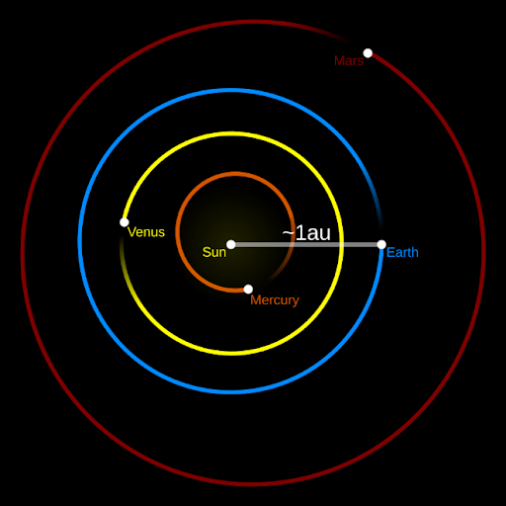
Astronomical units (remember, 1 AU is the distance from the Earth to the Sun) are used when it’s necessary to record a very large, truly astronomical number in a compact form. For example, the distance from the Sun to Saturn’s orbit is “only” 9.5 AU, or 886 million miles, or 1.4 billion km. In other words, astronomical units not only simplify notation but also make it easier to understand the differences between distances. For instance, Saturn is twice as far from the Sun as Jupiter, and this is clear when comparing 9.58 AU and 5.2 AU (1.4 billion km and 778 million km, respectively).
For a long time, the astronomical unit did not have a fixed value in meters for two reasons. First, it depended on the constant motion of celestial bodies, and second, there was no precise way to directly tie the scale of the Solar System to the metric system. Everything changed in 2012, when the astronomical unit was redefined and fixed at 149,597,870,700 meters. Now it is not an approximate distance between the Earth and the Sun but a constant.
Source: wikipedia.org
When astronomical units become inconvenient to use, light-years are employed. One light-year equals 63,000 astronomical units, or 9 trillion km, the distance a photon of light travels in one year. In other words, a light-year is the distance that can be covered in a year if moving at the speed of light (300,000 km/s). The distance to the Alpha Centauri system is 4.3 light-years. That’s the same as 25 trillion miles, 40 trillion km, or 272,000 astronomical units.
Light-years are perfect for describing distances to nearby stars. But when assessing the scale of the Universe, parsecs are needed. One parsec equals 3.26 light-years, or 206,265 astronomical units. The word “parsec” comes from “parallax of one arcsecond,” the distance from which a segment of 1 astronomical unit subtends an angle of 1 arcsecond (1″). The distance to the Pleiades, a star cluster in the constellation Taurus visible to the naked eye in the Northern Hemisphere, is 135–136 parsecs, or 440–444 light-years.
The most amazing thing about these colossal distances in the Universe is that they allow us to see objects in the past. For stars, this past ends the moment their light leaves them and travels toward Earth. When we look at the Pleiades, we see them as they were about 440 years ago: that’s how long their light takes to reach us. At greater distances, this is even more striking: the farther a galaxy is, the earlier its version we observe through a telescope.
This NASA educational video helps explain that a light-year is a unit of distance (not time!) and that when we look at distant objects, we are seeing them in the past.
Telescopes have improved the accuracy of space measurements
Telescopes can see much farther than more primitive optical instruments, and far beyond the unaided eye, thanks to two key characteristics: strong magnification and the ability to collect more light. This allows for more precise measurements of angles and brightness, enabling us to observe even very distant and faint celestial bodies.
Today, hundreds of ground-based observatories and dozens of space telescopes provide continuous astronomical observations. Let’s focus on four key systems that have made enormous contributions to measuring the cosmos: Hipparcos, the James Webb Space Telescope (JWST), the Global Astrometric Interferometer for Astrophysics (Gaia), and the Hubble Space Telescope (HST).
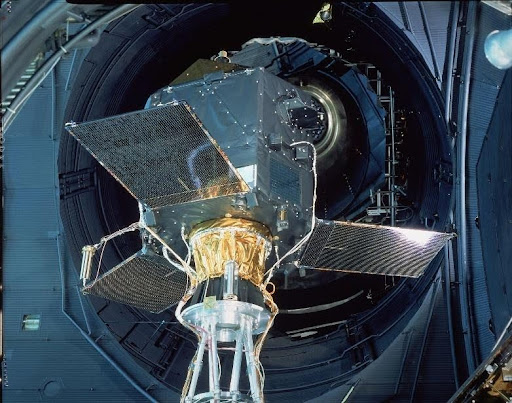
In 1989, Hipparcos, the first space mission specifically designed for precise measurements of star positions, parallaxes, and motions, was launched. At the time, it was a pioneering mapping project with ambitious goals: to study over 120,000 primary stars and 400,000 additional stars over 2.5 years. The plan was carried out almost perfectly: scientists studied about 100,000 stars, determining their locations 200 times more accurately than ever before. In addition, Hipparcos collected data that later helped refine other distance-measuring methods. Among other things, it revealed that many objects were actually farther away in the Universe than previously thought. Its observations also allowed astronomers to synchronize the age of the Universe with the ages of the oldest stars.
Source: esa.int
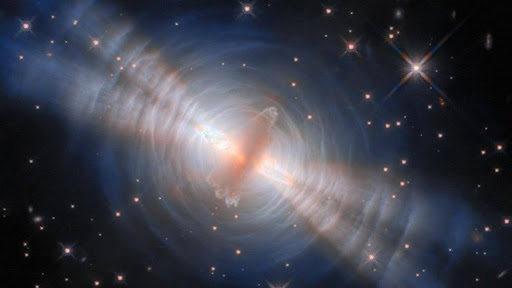
Since 1990, the Hubble Space Telescope has been performing the main work of collecting precise astronomical data, and it continues to do so even now, as you read this article. Its key task, as part of a joint NASA–ESA project, is to refine the expansion rate of the Universe (called the Hubble constant) and, consequently, to better estimate its age. To achieve this, the telescope searched for and measured Cepheid variable stars in nearby spiral galaxies, including M81, determining their true luminosity and distance to the galaxy itself, and then compared these distances with their redshifts.
Thanks to these observations, Hubble helped narrow the estimate of the Universe’s age to approximately 13–14 billion years and refine the distances to dozens of galaxies tens of millions of light-years away. This level of precision became possible because the telescope operates above Earth’s atmosphere, in space: its 2.4-meter mirror provides a diffraction-limited resolution of about 0.05 arcseconds, roughly 10–20 times better than that of ground-based telescopes. You can read more about Hubble’s role in exploring space in our article dedicated to the history of its creation and its major achievements.
Source: space.com
From 2013 to 2025, astrometric data were collected by Hipparcos’s successor, the orbital observatory Gaia. It has measured the parallaxes and proper motions of over 1.5 billion stars, built a multidimensional model of the Milky Way, and refined the cosmic distance scale, directly contributing to the cosmic distance ladder.
Among the main discoveries of the James Webb Space Telescope, the fourth observatory on our list, are new records for measuring distances to the oldest galaxies. Launched at the end of December 2021, it now continues to operate near the second Lagrange point (L2), 1.5 million kilometers from Earth. Its infrared instruments, NIRCam and NIRSpec, allow it to see galaxies as they were just 300–400 million years after the Big Bang.
This is important for cosmic measurements for two reasons. First, James Webb refines the upper rungs of the cosmic distance ladder: from the spectra of distant galaxies, astronomers can determine their redshift, distance, and the depth of cosmic time we are observing with high precision. Second, its exceptional sensitivity and infrared capabilities allow it to measure the light and chemical composition of very distant and therefore faint objects.
In the coming years, another key mission will join this measurement team: the Nancy Grace Roman Space Telescope. Its launch is planned for no later than May 2027, after which it will take over part of the work currently performed by existing systems. Roman will provide an ultra-wide infrared survey of the sky: its camera’s field of view will be roughly 100 times larger than Hubble’s infrared instruments, enabling it to measure the light distribution of more than a billion galaxies and detect thousands of supernovae during its primary mission. This will allow humanity to better track changes in the Universe’s expansion rate and assess the structure of large-scale galaxy clusters. In other words, we will gain an even more advanced tool for measuring cosmic distances.

Source: space.com
The cosmic distance ladder continues to improve as new measurement methods emerge. For example, gravitational lensing uses the bending of light by massive objects to estimate distances, the Tully–Fisher relation links the rotation speed of spiral galaxies to their luminosity, and the Sunyaev–Zeldovich effect identifies galaxy clusters through distortions in the cosmic microwave background. Together with telescopes like Hubble and JWST, these methods will continue refining the Universe’s expansion rate and age, ultimately helping us measure the cosmos with even greater precision in the future.