Life beyond Earth’s atmosphere is not only the romance of starry skies, but also a daily struggle for the human body to survive under conditions for which evolution has not prepared us. The absence of gravity, cosmic radiation, and confined space all turn ordinary biological processes into complex puzzles. But medicine in orbit has already gone beyond simply providing first aid to crew members. It has become a vast laboratory where methods are being developed to treat diseases that on Earth were once considered unbeatable.
Today, the International Space Station (ISS), China’s Tiangong orbital station, and new types of private stations to be deployed in the coming years are increasingly taking on the features of full-fledged biotechnology hubs, where microgravity is used as a unique tool to study cellular aging, protein crystallization, and to test next-generation pharmaceuticals. In a certain sense, the future of the Earth’s pharmaceutical industry today partly depends on the results of research conducted at an altitude of about 400 km above our planet.
Your orbital intensive care specialist: the role of the CMO
On an orbital station, every astronaut must not only perform the functions of a pilot and engineer, but also be a fully trained, certified paramedic. According to the protocols of most of the world’s leading space agencies, including NASA, the European Space Agency, and the Japan Aerospace Exploration Agency, a Crew Medical Officer (CMO) system is in place. This represents a key element of crew autonomy, providing basic medical training as part of astronauts’ operational duties.
All astronaut candidates, regardless of their primary specialization (pilots or flight engineers), must undergo basic medical training. According to updated NASA regulations, each space crew must include at least two CMO specialists. Their training involves about 40–60 hours of intensive practice, ranging from mastering tracheal intubation and venous catheterization to providing dental care and performing ultrasound screening. The main goal of this training is to turn an astronaut into a qualified practitioner capable of stabilizing a patient in any condition, no matter how severe.
The CMO system operates on the principle of advanced telemedicine: the onboard medical officer becomes the “hands” of ground-based specialists. Since not every crew includes a fully qualified medical doctor (MD), the CMO relies on specialized onboard checklists and video communication with Mission Control.
In practice, the CMO system has proven capable of enabling complex procedures even under critical conditions. During Expedition 57 (June to December 2018), astronaut Serena Auñón-Chancellor, who holds a medical degree, used onboard ultrasound equipment to detect an asymptomatic thrombosis of the internal jugular vein in another crew member (whose identity remains undisclosed for ethical reasons).

Source: fr.wikipedia.org
This was the first documented case of such a thrombus forming in space, so the situation required the immediate development of a treatment protocol. Over the following 90 days, Auñón-Chancellor administered therapy using injections of enoxaparin and oral anticoagulants, which made it possible to stabilize her colleague’s condition and successfully complete the mission without an emergency evacuation. After the astronaut returned to Earth, further medical examination confirmed the complete disappearance of the thrombosis.
This happened almost eight years ago. Today, the development of machine learning algorithms may eliminate the need for constant ground control, as the number of specialized diagnostic devices with AI-assisted consultation functions aboard the International Space Station continues to grow.
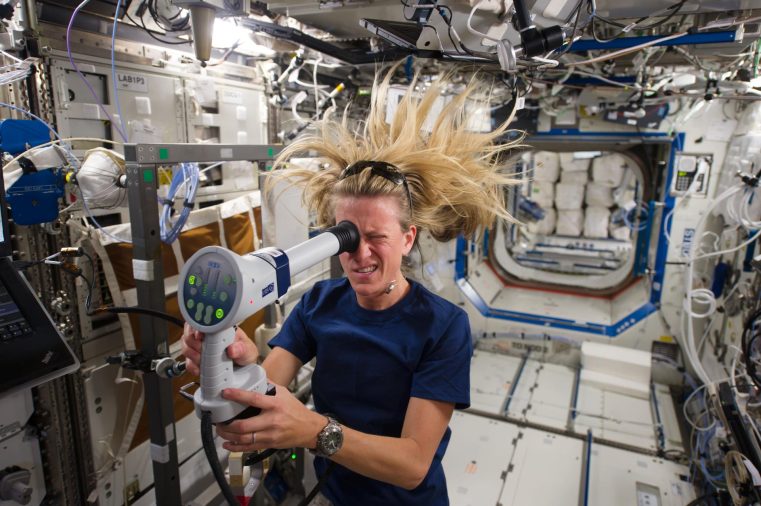
An important part of CMO training is adapting to the physiological anomalies of microgravity. In space, the heart takes on a more spherical shape, and fluid redistribution to the upper body alters acoustic windows for ultrasound. Even astronauts’ eyes undergo changes, as reduced gravity leads to fluid shifts in the body, potentially causing alterations in the eyes and blood vessels.
Medical officers are trained to recognize specific pathologies such as Spaceflight Associated Neuro-ocular Syndrome, a swelling of the optic nerve caused by increased intracranial pressure. Official NASA reports confirm that regular medical examinations conducted by CMOs make it possible to detect problems at early stages, which is crucial for preserving astronauts’ vision during long-duration missions.
Source: nasa.gov
In addition to diagnostics, CMOs are responsible for pharmaceutical logistics aboard an orbital station. The onboard medical kits of the International Space Station, known as the Health Maintenance System (HMS), contain more than 190 types of medications. However, in space, chemical substances degrade more rapidly under the influence of cosmic radiation. It is the medical officer’s duty to monitor expiration dates and storage conditions of these drugs.
Another major challenge for CMOs is the provision of surgical care. Due to the impossibility of ensuring full sterility of an open wound and the difficulty of containing biological fluids in microgravity, priority is always given to minimally invasive procedures that do not require surgical incisions. Nevertheless, CMO training necessarily includes skills such as controlling massive bleeding and stabilizing complex fractures using splints specially designed for orbital conditions. Each such scenario is practiced on Earth during parabolic flights (so-called “Vomit Comet” missions) where future CMOs learn to work with weightless instruments.

Source: smithsonianmag.com
It is also worth mentioning another particularly significant factor in conditions of weightlessness: the crew’s psychological resilience. This, too, falls under the purview of medical officers. They are trained to recognize symptoms of depression, cognitive decline, and fatigue in their colleagues. In the event of conflicts or psychological crises, the CMO acts as the first line of support, using protocols for confidential communication with psychologists on Earth. This helps maintain the operational effectiveness of the team during 6–12 months spent in the confined environment of an orbital station.
In the future, the importance of CMOs will only grow along with the development of the commercial space sector. As tourists begin traveling to orbit, medical risks will only increase due to a lack of professional training and the likelihood of chronic conditions. Such individuals will not have undergone the rigorous selection process of their more experienced astronaut counterparts, making the emergency care skills even more essential. However, even the most experienced CMOs cannot guarantee that every injury will fall within the capabilities of orbital paramedics. That is why, when the risk to a crew member’s life exceeds the station’s resources, the most drastic and complex protocol is activated: emergency medical evacuation. This procedure, too, has been practiced down to the second aboard the International Space Station.
Emergency descent: the ISS medical evacuation protocol
Medical evacuation from orbit, a procedure known at NASA as the Emergency Return protocol, is considered a last resort, used when it is no longer possible to stabilize a patient using the station’s available resources. Unlike terrestrial emergency services, space evacuation does not mean an immediate departure. It is a complex, multi-stage process that begins with the suspension of scientific experiments and the transition of the station into an autonomous mode of operation until such time as new crewed missions can arrive.
The main challenge here is not so much the speed of undocking as the patient’s physical survival during reentry into the dense layers of the atmosphere, when the strain on the body increases dramatically. In critical conditions, this can pose extremely serious risks to the patient’s health. The evacuation process begins with an immediate consultation with a ground-based flight surgeon. If the decision to descend is approved, the crew must prepare the transport spacecraft within hours. It is important to understand that each astronaut is assigned to the specific spacecraft in which they arrived. This vehicle effectively serves as a lifeboat, permanently docked to the station and maintained in a state of constant readiness.

Source: bbc.com
On January 14, 2026, the first full-scale medical evacuation of an International Space Station crew in more than a quarter-century of the station’s operation took place. The SpaceX Crew-11 mission, which included Zena Cardman and Mike Fincke, Japanese astronaut Kimiya Yui, and Russian cosmonaut Oleg Platonov, was forced to leave the station early. The reason was a serious deterioration in the health of one of the crew members, first detected on January 7 after preparations for a spacewalk. Although the patient’s condition remained stable for a week, NASA decided to return to Earth a month ahead of schedule for full diagnostics in a terrestrial clinical setting.
The evacuation proceeded in a controlled but accelerated manner: on January 15, the SpaceX Dragon Endeavour capsule successfully splashed down in the Pacific Ocean near San Diego. During the incident, the station’s advanced equipment played a key role, particularly a portable ultrasound device, which enabled doctors on Earth to assess the patient’s condition in real time.

Source: bbc.com
The January incident demonstrated the effectiveness of established safety protocols and became a real test of the autonomous medical monitoring system. Although the identity of the ill astronaut and the exact diagnosis remain undisclosed for confidentiality reasons, the successful return of SpaceX Crew-11 confirmed that modern space medicine is capable of responding rapidly to complex challenges, even during long-duration expeditions.
The evacuation of Crew-11 became the first such operation of the new century. Previously, the only example of an emergency medical evacuation from an orbital station remained the case of Salyut 7 in 1985. At that time, due to the acute illness of cosmonaut Vladimir Vasyutin, the mission was terminated 64 days after launch. In that case, the Soviet officer fell victim to his own secret, a chronic prostatitis that had been concealed during the astronaut selection process. Under microgravity, the illness rapidly progressed into an acute phase, accompanied by a fever of up to 40°C, severe pain, and psychological exhaustion, rendering the commander completely incapacitated. Since the onboard medical kit and remote medical advice proved ineffective, and the risk of sepsis and death in orbit became real, mission control made an unprecedented decision: to terminate the costly scientific program and urgently return the entire three-member crew to Earth.

Source: www.gw2ru.com
Today, ISS crews regularly conduct Medical Emergency Drill training sessions. During these exercises, the crew rehearses a scenario in which one astronaut plays the role of an unconscious patient. Their colleagues must deploy resuscitation equipment within minutes and secure the “patient” on a medical table.
The main challenge during such training is performing cardiopulmonary resuscitation (CPR) in microgravity. Since the standard method of applying pressure using one’s body weight does not work, the medic must either strap themselves to the patient or use a handstand technique that involves bracing their feet against the opposite wall of the module to generate sufficient force on the chest. Each simulation concludes with a detailed analysis of how quickly the defibrillator was deployed and how properly the patient was secured.

Source: spaceref.com
A special role in evacuation operations is played by the SpaceX Crew Dragon spacecraft, the primary vehicle for transporting people to the International Space Station. Unlike the Russian Soyuz, it has a more spacious cabin, allowing the medical officer to assist a patient while remaining in their seat. However, the main challenge remains the same: the ultra-fast ballistic descent of the spacecraft. During atmospheric braking, the crew experiences overloads of 4–5 G’s, a phenomenon that negatively affects resuscitation efforts and has not yet been fully mitigated. Technically, evacuation from the ISS using Crew Dragon takes between 3 and 6 hours (depending on protocol requirements) from hatch closure to landing.
The logistics of rescue operations after landing are also carefully refined. At the landing site, the capsule crew and the patient are met by a Search and Rescue (SAR) team. The first minutes on Earth after exposure to microgravity are critical for the cardiovascular system, so the patient is not immediately removed from their seat liner. Instead, they are transported together with it to avoid sudden pressure changes and loss of consciousness.

Source: nasa.gov
Although NASA has not disclosed the financial costs of the Crew-11 evacuation, the expense of such a rescue operation can run into the tens of millions of dollars. For this reason, each individual case of astronaut illness aboard the station is always evaluated through a “risk versus cost of return” criterion.
Medical evacuation is always an acknowledgment of our defeat in the struggle with space, and to keep such cases exceptional, space agencies spend years preparing astronauts. It all begins long before launch, in the sterile rooms of medical centers where each candidate passes through a medical filter that screens out even the slightest signs of illness.
Screening systems and medical selection
Selection for the NASA astronaut corps is an exhausting marathon that eliminates the vast majority of those who aspire to become astronauts. Candidates undergo extensive genetic testing, hours-long MRI scans of all organs, and centrifuge stress tests simulating launch loads. NASA places particular emphasis on detecting hidden pathologies: even a microscopic kidney stone or a barely noticeable tendency toward arrhythmia automatically disqualifies a candidate.
Psychological screening is no less rigorous than the physiological one. Physicians are not merely looking for stress-resistant individuals, but for people with an ideal level of social compatibility. Candidates are tested for their ability to make balanced decisions under conditions of sensory deprivation and prolonged isolation, and any sign of impulsivity or depressive tendencies identified at this stage also closes the path to orbit.

Source: colorado.edu
Directly aboard the International Space Station, the health of astronauts is monitored by an integrated monitoring system that has been refined over decades of station operations. The primary diagnostic tool remains the expert-class GE Vivid q device, which resembles an ordinary laptop but has the functionality of a full clinical workstation for detailed cardiac and deep vascular scanning.
Alongside it is the HRF Ultrasound system, intended for long-term scientific studies of physiological changes in the human body. A newer stage in this evolution is the portable Butterfly iQ, which uses semiconductor “ultrasound-on-a-chip” technology. The device allows the medical officer to begin an examination within seconds using a standard onboard tablet.
The crew’s blood is analyzed by the compact Abbott i-STAT Portable Clinical Analyzer (i-STAT), which first appeared on the station during the initial astronaut rotation in 1999. The system works on a cartridge principle: a person places a drop of their own blood into a cartridge to obtain, within minutes, data on electrolyte levels, hematocrit, and metabolic status. The system has become essential for the early detection of dehydration or signs of inflammatory processes. Over the past decade, it has proven highly reliable, helping to avoid diagnostic errors that could otherwise lead to false alarms and unnecessary evacuations.

Source: nasa.gov
Blood research on the International Space Station continues to this day. In March 2025, during a series of laboratory studies, the crew of Expedition 72 focused on investigating the effects of microgravity on the musculoskeletal system and the cardiovascular system. Astronauts Don Pettit and Takuya Onishi used a motion-tracking system to analyze the forces acting on bones and muscles during exercises on the ARED training device. The goal was to optimize the two-hour daily workouts, making physical therapy more effective for preventing tissue degradation during long-duration missions to the Moon and Mars.
At the same time, their colleagues Anne McClain and Nichole Ayers conducted extensive vascular scanning and blood pressure monitoring in the Columbus module, while Alexey Ovchinin and Ivan Vagner studied patterns of blood flow redistribution between the limbs and the head. The resulting biomedical data allow physicians to gain a deeper understanding of how the circulatory system adapts to microgravity.

Source: nasa.gov
Another onboard monitoring system called Bio-Monitor was developed by the Canadian company Carré Technologies specifically for the Canadian Space Agency and delivered to the International Space Station in 2019. It introduces a different approach to collecting medical data from crew members aboard the ISS. The concept of Bio-Monitor is based on shifting from discrete measurements to continuous monitoring: instead of connecting an astronaut to multiple sensors once a week, the system enables medical data to be collected in the background for 48–72 hours continuously.
The core of the system is a high-tech T-shirt with integrated dry electrodes and sensors, over which a compact data processing unit the size of a smartphone is attached to the astronaut’s waist.
The technical capabilities of Bio-Monitor cover a wide range of vital signs that were previously difficult to record, especially during active work or sleep. The system measures not only basic heart rate but also performs a full three-channel electrocardiogram (ECG), tracks breathing depth and rate, measures blood pressure without a cuff, and records blood oxygen saturation (SpO₂). A built-in accelerometer allows doctors on Earth to correlate bursts of physical activity with cardiovascular responses, enabling precise assessment of stress levels and physical fatigue during complex tasks performed in station modules.

Source: asc-csa.gc.ca
The main advantage of the system is its ability to work with big data in microgravity conditions. All collected measurements are automatically synchronized with a tablet via Bluetooth and then transmitted to the Payload Support Centre in Saint-Hubert (Quebec), operated by the Canadian Space Agency.
This technology has already proven effective in studying space anemia and disruptions in sleep cycles, which are frequently affected in orbit. Because Bio-Monitor does not restrict movement and is comfortable for long-term wear, it has become an ideal prototype for future “smart” hospitals on spacecraft and orbital stations, where each crew member will serve as a continuous source of telemetry data for artificial intelligence systems monitoring mission health.
Steps towards medical autonomy
The future of medical screening on the International Space Station is inseparably linked to autonomy. At present, all planned medical research initiatives are outlined in the NASA Science Plan 2025–2026, which defines priorities for the coming years, including the automation of biomedical research.
In the near future (approximately 2026–2027), the delivery of compact next-generation DNA and RNA analyzers to the station is planned. These systems will make it possible to detect viral or bacterial infections at the molecular level, even before the first symptoms appear, as well as to monitor changes in gene expression in crew members under the influence of cosmic radiation and during flight itself.
The new genetic laboratories are based on advances in nanopore technology, which has already been successfully tested using the MinION device operating aboard the ISS since 2016.

Source: nasa.gov
The key difference of next-generation instruments will be the full automation of sample preparation through a cartridge-based biomaterial reading system. This is critically important, since handling liquids and pipettes in microgravity is extremely labor-intensive. It is expected that the new system will be able to independently extract nucleic acids from blood, saliva, or swabs taken from station surfaces, and sequence genomes in real time.
This should allow the crew not only to instantly identify dangerous bacterial mutations in the station’s life-support system, but also to monitor epigenetic changes in their own cells that arise as a response to prolonged exposure to the radiation environment.
In parallel with genetic monitoring, an improved Retinal Imaging system is being prepared for deployment on the orbital station, intended to become part of mandatory monthly medical check-ups. It is designed to address Spaceflight Associated Neuro-ocular Syndrome, a condition in which more than two-thirds of astronauts experience optic nerve swelling and deformation of the eyeball.
The new equipment combines optical coherence tomography methods with advanced image stabilization algorithms. The device automatically compensates for microscopic involuntary fluid fluctuations in the eye caused by pressure changes. Based on the collected data, highly precise 3D models of each astronaut’s retina can be created with micron-level resolution, previously achievable only through Earth-based examinations.
In February 2026, new lower-body vacuum suits designed to simulate Earth-like gravity during sleep were successfully tested, allowing intracranial pressure in crew members to be stabilized for the first time in a decade. The technology, known as Mobile Lower Body Negative Pressure (Mobile LBNP), was developed by scientists at the University of California, San Diego, specifically to combat “space brain swelling.”
The principle of the device involves creating an artificial vacuum around the legs, forcibly drawing excess fluid away from the head and upper torso—a process that occurs naturally on Earth due to gravity. The success of the February trials marked a turning point, as it addressed a fundamental aspect of Spaceflight Associated Neuro-ocular Syndrome: astronauts can now maintain optic nerve health and normal cerebrospinal fluid pressure simply during rest.

Source: spacecenter.org
The modern monitoring system aboard the International Space Station is built on the concept of a digital twin, in which data from all sensors is compared against the individual baseline of a specific astronaut, established before the start of the mission.
This enables the implementation of true preventive medicine principles: the system detects the slightest deviations in heart rate variability or blood composition even before the first symptoms appear. In this way, medical care in orbit is transformed from reactive to proactive, where potential risks are eliminated at the earliest stages of their emergence.