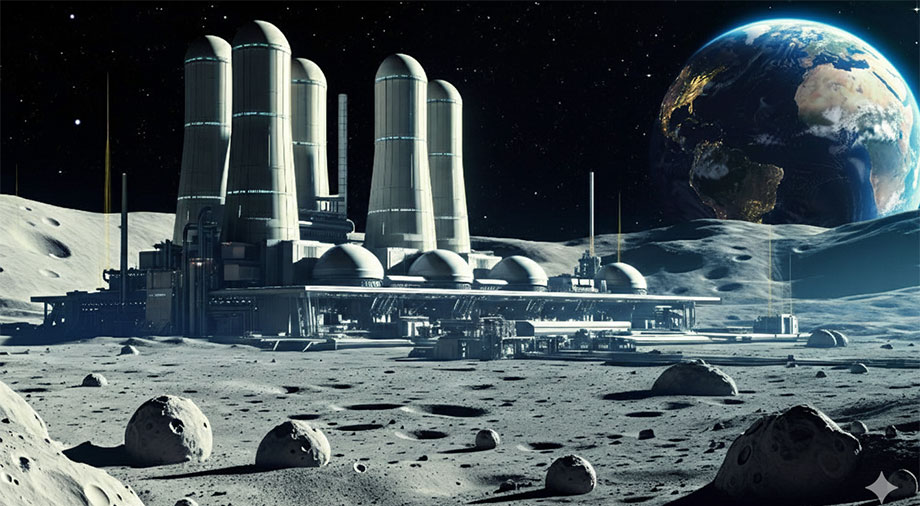
In August 2025, NASA Acting Administrator Sean Duffy issued a directive calling for the accelerated implementation of a U.S. program to build a nuclear reactor on the Moon, with the goal of completing it by 2030. This sense of urgency seems justified: in addition to the United States, both Russia and China have ambitious plans to construct nuclear power plants on the Moon. These countries have agreed to carry out their project jointly and to complete it by 2035. Preliminary information, meanwhile, indicates that the planned American reactor is expected to generate 100 kW of electrical power and be ready for launch by the end of 2029.
But why is deploying a nuclear reactor on the Moon so important for all three countries, and which of them has the best chances of winning this race? We explore this below.
Of what use is nuclear energy in space?
Nuclear power could, in the long term, become the foundation of sustained human activity in space, especially on the Moon, whose exploration is only a matter of time. In his directive accelerating work on deploying a nuclear reactor on the Moon, Duffy noted that such a reactor would help support a future lunar economy and strengthen U.S. national security in space.
Nuclear energy could also play an important role in the context of deep-space missions, including crewed missions to Mars. One of the key reasons is the lack of sufficient solar energy. The Moon has no atmosphere, and its gas density is so low that it does not affect surface processes such as heat exchange or weather phenomena. Moreover, the lunar night lasts up to two weeks, and in some craters, sunlight never reaches the surface at all.
Mars, by contrast, has a thin but real atmosphere with a pressure of about 1% of Earth’s, as well as clouds, winds, and dust storms. The latter can last for weeks, reducing the already variable sunlight to a minimum. Even if solar panels were installed there, they would operate inefficiently, due to the large amount of fine particles in the atmosphere. In other words, relying on solar energy on the Moon and Mars is not feasible, which makes nuclear power a viable alternative solution for both.
According to Dr. Sangwoo Lim, Senior Lecturer in Space Applications, Research and Instrumentation at the University of Surrey, “Building even a modest lunar habitat to accommodate a small crew would demand megawatt-scale power generation. Solar arrays and batteries alone cannot reliably meet those demands.”

Source: npr.org
Additionally, nuclear systems can provide long-term power supply in space at many different stages: for spacecraft launches, powering monitoring instruments and control systems, ensuring the operation of communications systems, and maintaining a stable working environment for the core equipment of a space mission. Nuclear power would make it possible to establish a lunar base for a permanent human presence on the Moon, since it can deliver uninterrupted electricity even during the cold lunar night, when temperatures drop sharply to −133°C (and down to −246°C in deep craters).
In the longer term, nuclear technologies could help enable continuous resource extraction on the Moon and organize their uninterrupted processing. Robotic excavators, 3D-printing systems, and other devices would operate continuously in this scenario and therefore require a stable power supply. This creates a closed loop in which different space technologies complement one another and exist in synergy. On the one hand, power generation enables autonomous resource extraction; on the other, the extracted materials support the further development of the Moon’s energy infrastructure.
According to scientists’ estimates, the Moon currently contains reserves of more than one million tons of helium-3, a stable isotope of helium, whereas on Earth, there are no more than about 35,000 tons, and even those are gradually escaping from the atmosphere into space. Helium-3 is used to fill neutron gas detectors, and its high cooling capability makes it one of the best options for maintaining the extremely low temperatures required for quantum computers, conditions under which they can operate stably. In addition, helium-3 is considered a hypothetical nuclear fuel: scientists believe it has significant potential in modern nuclear energy thanks to its renewability and availability, particularly in the context of extraction on the Moon.

Source: space.com
Chinese researchers from the Shanghai Institute of Satellite Engineering have recently proposed an unusual method for transporting helium-3 from the Moon: using a rotating magnetic system that operates on the same principle as an Olympic hammer throw. Scientists estimate that such an installation could “launch” payloads to Earth twice a day, cutting transportation costs by up to 90%.
China’s interest is easy to understand: it already accounts for as much as 70% of global rare-earth production, and the realization of ambitious deep-space plans would help cement its status as a technological leader, controlling not only terrestrial resources but also future space-based fuel reserves. The United States, for its part, is seeking to prevent a monopoly by its main competitor and to shift the balance in its own favor.
According to Sean Duffy, “To properly advance this critical technology to be able to support a future lunar economy, high power energy generation on Mars, and to strengthen our national security in space, it is imperative the agency move quickly.”

Source: psi.edu
The nuclear reactor directive instructs NASA to solicit proposals from industry for the launch of a 100-kW nuclear reactor by 2030. It is worth recalling that the agency previously funded research into a similar system for use on the Moon, but at that time its output was only 40 kW.
Both power levels are quite modest by terrestrial standards: 100 kW would be enough to supply a small lunar base with energy for several days, while 40 kW would power a single habitation module with a compact laboratory. That said, the plan does not involve just one installation: after the successful implementation of the pilot project, the power system would be scaled up in line with actual needs.
Moreover, there is no need to build a nuclear reactor entirely from scratch: scientists have been developing nuclear power technologies for more than half a century. In this case, it would only be necessary to adapt existing solutions to new operating conditions and to resolve several key challenges, above all, how to design a reactor that, after being assembled on Earth, could be transported to the Moon and safely activated there.
Where on the Moon could a nuclear reactor be located?
A nuclear reactor will provide real benefits only if it is located close to deposits of water ice that are accessible for extraction and processing. In this respect, the Moon is unique: according to NASA, it is 100 times drier than the Sahara Desert, yet it is still covered with water, a fact that was confirmed through analysis of samples returned by the Apollo missions.
Scientists do not have precise data on the exact locations of lunar water ice, but likely sites are already known. Some of this information was provided by the Lunar Reconnaissance Orbiter (LRO), launched in 2009. By studying the region near the Moon’s south pole, it continues to help NASA identify areas containing subsurface water ice and other resources needed to supply equipment, that is, to support the research activities of future missions. In addition, areas with confirmed surface water ice have been identified using the Moon Mineralogy Mapper (NASA’s Moon Mineralogy Mapper).

Source: science.nasa.gov
The instruments listed above are used to collect data, and their subsequent analysis makes it possible to build fairly accurate assumptions. However, only rovers that are physically present at a site can confirm or refute the existence of water ice or other resources in space. A program to launch a robotic rover to study ice deposits on the Moon was canceled in mid-2024, but in September 2025, it became known that it would indeed be sent to the Moon’s south pole. Under the contract, it will be delivered there by Blue Origin by the end of 2027.
The presence of nearby water ice is an important condition for supporting a future nuclear reactor on Earth’s satellite, but not the only one. It is also necessary to design protection for the system against extreme temperature fluctuations, radiation, micrometeoroid impacts, and regolith, which consists of fragments of lunar rock, dust, and sand. When a spacecraft touches down on the Moon’s surface, a plume of regolith is created that damages sensitive optics and electronics in a sandblasting-like effect. For this reason, special protective barriers will be required, or systems will need to be positioned along the particle flight path and behind large boulders. It is also necessary to ensure the removal of waste heat and to account for mechanical loads during landing and liftoff, all of which are complex engineering challenges.
What will American, Chinese, and Russian nuclear reactors be like?
According to Dr. Sangwoo Lim, “Nuclear power [in space] is not just desirable, but inevitable.” He is convinced that solar panels and batteries will not be able to meet the needs of even the most modest lunar habitat. However, to implement a lunar project based specifically on nuclear energy, participants will have to solve an entire range of challenges, from designing a truly reliable system to shortening its production timeline.
Developing a nuclear reactor for deployment on the Moon is not the same as adapting a terrestrial installation to new conditions. All parties are currently looking toward 2030, but an earlier realization of the program would clearly be a technological victory for whoever manages to put the first stable reactor into operation at the Moon’s south pole and secure access to resources.
United States: the long road to nuclear power in space
SNAP-10A, with a power output of 600 W, was the first—and so far the only—nuclear reactor designed by the United States and sent into space. After its launch in 1963, it operated in orbit for just 43 days, until its voltage regulator failed. The reactor is still circling Earth at an altitude of about 1,300 km, while here on Earth, its successor is being prepared.

Source: space.com
Above, we wrote about the initial idea of implementing a 40-kilowatt lunar microreactor: the competition for its development, with a prize fund of $5 million, was announced several years ago. In 2022, following the results of the first stage of the competition, contracts were awarded to Lockheed Martin/BWXT, Westinghouse/Aerojet Rocketdyne, and X-energy/Boeing. They were tasked with developing a preliminary design that included the reactor itself, its power conversion systems, heat removal, control, and power distribution. At the time, NASA’s requirements were as follows: the reactor had to weigh less than six tons and operate without human intervention for ten years, while supporting remote startup and control. In preparation for the next phase of the project, NASA also signed contracts with Rolls-Royce North American Technologies, Brayton Energy, and General Electric to develop Brayton power converters based on the thermodynamic cycle of the same name.
In response to statements by China and Russia, NASA decided to revise its project requirements and now wants to see 100-kilowatt nuclear installations instead. In an interview with IEEE Spectrum, nuclear engineer Katie Huff, Director of the Advanced Reactor Fuel Cycles Laboratory at the University of Illinois Urbana-Champaign, suggested that the agency is likely to choose an adaptation of one of the earlier 40-kilowatt designs, which would be a logical step. Huff believes that a future lunar reactor will be designed using TRISO fuel (tristructural isotropic fuel), a type of uranium fuel, with helium selected as the coolant. The reactor is currently being developed under the Fission Surface Power program.
The reactor will be fully assembled on Earth, prepared for launch, including fuel loading, and equipped with all control elements before transportation. Once on the Moon, it will only need to be commissioned: first, the control rods will be withdrawn, and then the reaction will be initiated using a neutron source, such as californium-252 (Cf-252).

Source: thespacereview.com
China and Russia: big announcements and secret developments
China, as the main competitor to the United States in the new space race, is setting the pace for lunar exploration: together with Russia, it plans to launch a nuclear reactor by 2035. The corresponding memorandum for the project was signed in May 2025 between Roscosmos and the China Manned Space Agency (CMSA).
Official information about this project is limited: the reactor will likely be used by both countries to study and develop the Moon’s south pole as part of the International Lunar Research Station (ILRS) project. Missions that will begin construction on the reactor are scheduled for after 2028.
Everything else regarding the future China-Russia lunar nuclear reactor, however, remains in the realm of speculation based on previous statements or rumors. Like the United States, China has achieved advances in 3D printing technology, which will reduce its dependence on components delivered from Earth. In 2024, Russia reported that technical issues related to the lunar nuclear reactor had been resolved, except for the challenge of effective cooling, and shared plans for constructing a cargo spacecraft. Later, in March 2025, China introduced its first mining robot, which will explore and extract resources on the Moon and Mars. All of this confirms that China and its partners are steadily moving toward creating a lunar nuclear power system.

Source: livescience.com
Why does it matter who places a nuclear reactor on the Moon first?
A reliable and autonomous energy source on the Moon could, in the long term, help ensure a permanent human presence beyond Earth. That is why the competition between the U.S. and China to deploy a lunar nuclear reactor could become a turning point in space exploration, even though the idea of using nuclear power there is not new.
In the 1960s, the U.S. and the USSR began using radioisotope generators powered by nuclear fuel to supply energy to satellites, rovers, and the Voyager 1 probe. But it was only in 1992 that the UN adopted a non-binding resolution that finally regulated the use of nuclear power sources in space. According to this document, a nuclear reactor can be useful for missions where solar energy is insufficient. The resolution does not prohibit the use of nuclear power on the Moon, but mandates that it be done safely and ethically.
Since these provisions are quite general, in practice, the real standards will be set by whoever first manages to successfully operate a nuclear reactor in the face of challenges like radiation, low temperatures, and regolith hazards. Whoever does that will effectively have the power to establish new safety and technological leadership standards that will shape subsequent missions and international agreements in space.
Risks and challenges
In addition to the risks posed by regolith damage, microgravity, and extremely low temperatures, several other technical challenges must be resolved before a nuclear reactor can be deployed on the Moon:
- An emergency could arise before or during landing. If the protective casing of the nuclear system is damaged, a large amount of radionuclides could be released into space, contaminating the environment and endangering future missions.
- Insufficient radiation shielding would increase the risk of illness for astronauts and could cause scientific instruments to malfunction.
- Logistical hurdles will be an ongoing challenge during the delivery of fuel to the reactor, requiring extensive coordination at multiple levels and the implementation of strict safety measures.
- Decommissioning the reactor may also prove difficult due to the lack of necessary infrastructure and “lunar regulations” governing such operations.
Beyond technical issues, legal risks must also be considered. In 2020, eight countries, including the U.S., signed the Artemis Accords (this number has since risen to over 50). These agreements regulate principles of cooperation and activity for the exploration and use of the Moon, Mars, and other celestial bodies for peaceful purposes.
One significant issue concerns safety zones around lunar facilities. According to Dr. Simeon Barber, a planetary science specialist at the Open University, “If you build a nuclear reactor or any kind of base on the moon, you can then start claiming that you have a safety zone around it, because you have equipment there.”
He suggests that this would effectively be equivalent to certain countries claiming a portion of the Moon and restricting access for others. At the same time, China, which is not a party to the Artemis Accords, has its own stance: its official position holds that the Moon is a shared resource for all humanity. While both the U.S. and China insist on their peaceful intentions, their approaches remain radically different, which could set a dangerous precedent.

Source: nasa.gov
Who will win the race?
The new space race between the U.S. and China reached its verbal peak in 2025, after plans for the construction of a Chinese nuclear station on the Moon by 2035 became known. The U.S. quickly responded, announcing intentions to launch its own lunar nuclear reactor by the end of 2030. It is impossible to assess right now who is closer to the goal, primarily because the Chinese side shares almost no information about the project, while the Americans make ambitious statements against the backdrop of shrinking NASA budgets. However, the competition has already moved to a new level: it is no longer about who will plant their flag on the Moon first, but about who will first build the critical infrastructure for a permanent presence there.
In the words of Michelle Hanlon, a Professor of Air and Space Law: “As a space lawyer focused on long-term human advancement into space, I see this not as an arms race but as a strategic infrastructure race. And in this case, infrastructure is influence.”