Have you ever wondered whether the world we see and can physically interact with is just the small tip of an iceberg compared to the Universe’s full content? All visible matter, including star clusters, galaxies, planetary and stellar nebulae, and even ourselves, makes up only about 5% of everything in the Universe. The remaining 95% is like the iceberg’s submerged part, a realm composed of non-baryonic matter. It stays completely invisible to us, even though the overall behavior and the laws governing the Universe clearly point to the inevitable existence of this unseen layer of matter and energy.
Today, we’ll talk about dark matter and dark energy, some of the deepest mysteries of modern astrophysics, whose solution could bring us closer to understanding why the Universe keeps expanding. It might even hint at what kind of end awaits it.
Mysterious interaction with gravity: the fundamental properties of dark matter and dark energy
To start, we should clarify what the terms “dark matter” and “dark energy” refer to. Dark matter is an invisible form of matter that does not emit, absorb, or reflect light. It cannot be seen directly, but its existence is noticeable through its gravitational influence on the visible cosmos, including stars, galaxies, and galaxy clusters. You can compare it to a carousel filled with people: while it is spinning, passengers need to hold onto the rails or fasten their seatbelts so they don’t fall out. But in the case of dark matter, all the mechanisms that hold the “passengers” in place remain invisible to those observing the carousel’s motion.
The realization that dark matter exists came from studying the outskirts of galaxies. Stars on the edges of galaxies rotate so quickly that they would have flown off long ago if held in place only by the gravity generated by their own mass. But their observable mass is insufficient to account for the balance astronomers actually observe. Some additional gravitational force acts on all cosmic structures in the Universe, a force strong enough to keep galaxies bound together. Astronomers explain the origin of this force by the existence of dark matter. Essentially, dark matter is imagined as unknown particles that do not interact with electromagnetic forces, which is why they remain invisible. They interact with ordinary matter solely through gravity, effectively binding all cosmic systems together.
Dark energy, on the other hand, is an unknown form of energy that, unlike dark matter, does not accumulate in specific regions of space and does not act like gravitational “glue.” On the contrary, all studies confirm that dark energy has negative gravity, constantly accelerating the expansion of the Universe. For a long time, it was believed that all objects simply drift apart at a constant speed, but astronomical observations over the past century show that the expansion of the Universe is steadily accelerating. To explain this phenomenon, the concept of dark energy was developed. Put more simply, dark energy seems to be a property of the cosmic vacuum itself, which was previously regarded as “empty” space.
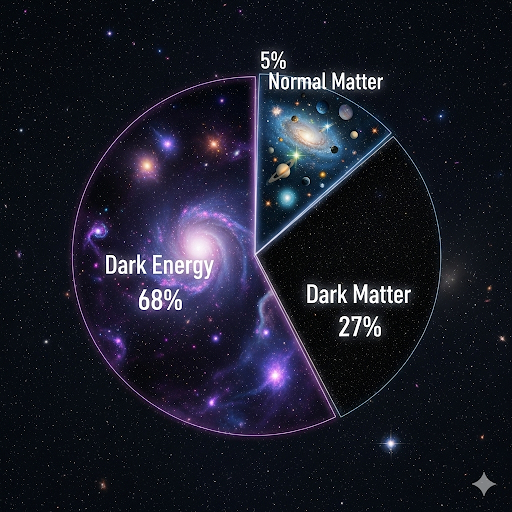
Thus, dark matter and dark energy are two entirely different, but equally mysterious, entities that make up the overwhelming majority of our Universe. According to recent calculations, dark matter should account for about 27% of the Universe’s total content (or roughly 80% of all matter), while dark energy should make up about 68%.
Source: gemini.google.com
As we can see, although both dark matter and dark energy interact with gravity, they do so in different ways. Dark matter holds galaxies together, preventing them from flying apart. Dark matter is also likely responsible for what is known as “gravitational lensing,” which bends the light that reaches us from very distant galaxies, since this light must pass through regions with high concentrations of dark matter. Dark energy, however, may be a property of spacetime itself, constantly creating negative gravity and driving the accelerated expansion of our Universe. But how exactly did astronomers arrive at the concepts of these two phenomena?
Wider than we could have imagined: confirming the accelerating expansion of the Universe
Until the beginning of the 20th century, the idea of dark matter was conceptually useless. Classical Newtonian physics seemed to perfectly explain the motion of planets and stars within the Solar System, as well as the rotation of stars in the Milky Way. Visible matter in space, which astronomers could observe through telescopes, seemed to be the only factor determining gravity.
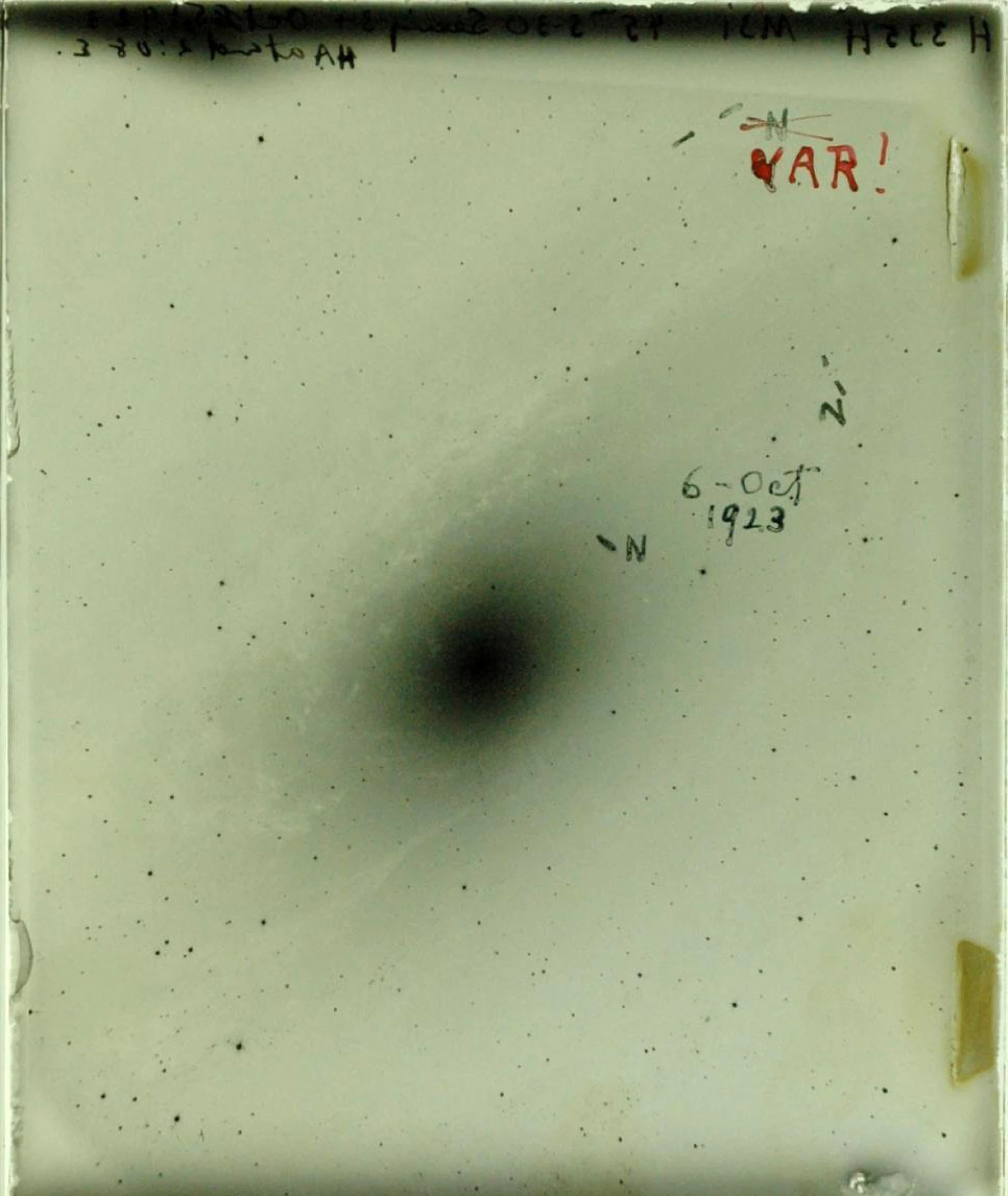
However, in the 1920s, Edwin Hubble, an American astronomer and researcher at the Mount Wilson Observatory in California, made a significant contribution to how we understand the Universe. Observing the night sky through the 100-inch (2.5-meter) Hooker reflecting telescope, Hubble established that spiral nebulae are in fact separate galaxies located far beyond the boundaries of the Milky Way. This discovery fundamentally transformed the scientific community’s idea of the scale of our Universe.

Source: npr.brightspotcdn.com
However, it wasn’t the discovery of new galaxies that impressed Edwin Hubble’s colleagues the most. In fact, once he knew that other galaxies existed, Hubble set himself the task of determining two key parameters: their distance from us and their speed of motion.
To calculate the distance to other galaxies, Hubble used a special type of star, Cepheids, also known to astronomers as “standard candles.” Cepheids are pulsating stars that change their brightness with a specific periodicity. The longer the period of their pulsation, the greater their intrinsic luminosity. Thanks to this, Hubble could determine how bright a star was. This meant that Cepheids located farther away from us, shining from distant galaxies, appeared significantly dimmer than those nearby.
By comparing the true luminosity of a Cepheid (which he knew from its pulsation) with its apparent brightness (which he observed through his telescope), Hubble could precisely calculate how far away a given star was. This methodology was a breakthrough for observational astronomy, allowing astronomers to measure distances to remote cosmological objects, especially other galaxies, with remarkable accuracy.
Source: npr.brightspotcdn.com
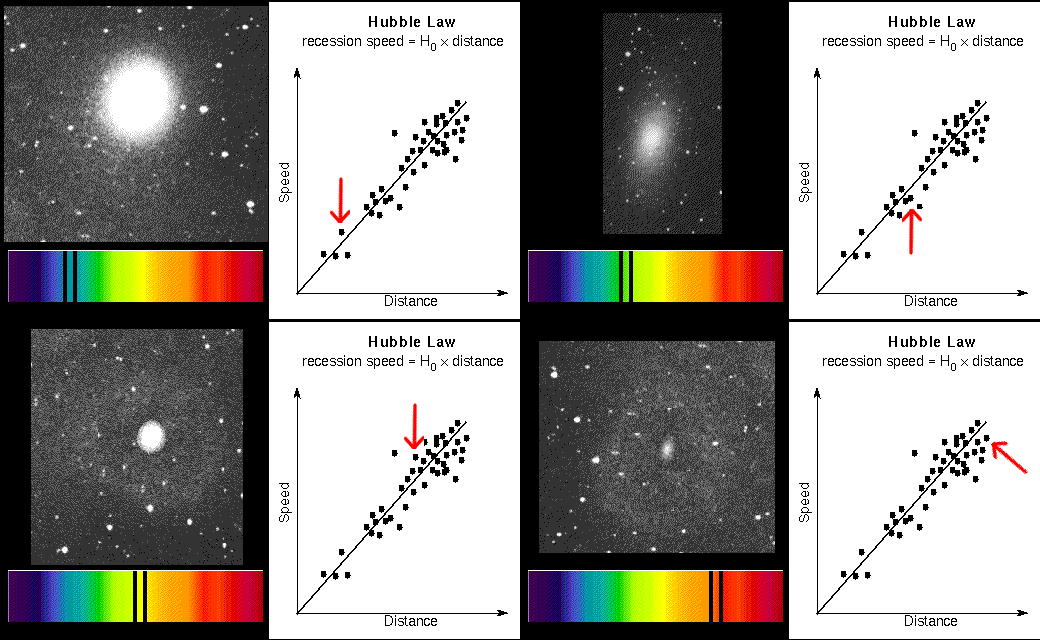
Hubble’s next step was to determine the speed at which these galaxies were moving away. Even before Hubble, astronomers understood that the vast majority of galaxies in the Universe are receding, not approaching the Milky Way. This was clear because of the “redshift” effect, which can be observed using a special optical instrument called a spectroscope. This instrument separates light into spectral components (dark absorption lines) and allows astronomers to determine how the distance to the light source is changing.
When light from an object moving away from the observer enters a spectroscope, its spectrum stretches and the wavelength increases, shifting toward the red part of the spectrum, which has a longer wavelength. Conversely, when an object is approaching, its light appears compressed, and the spectrum shifts toward the blue, which has a shorter wavelength. This is called blueshift. If the light source is not moving relative to the observer, no shift is detected.
The redshift effect was a known principle even before Hubble began his astronomical career. Between 1912 and 1917, the astronomer Vesto Slipher discovered that most spiral nebulae (which, thanks to Hubble, were later identified as separate galaxies) exhibited redshift, meaning they are moving away from the Milky Way. What surprised Slipher was the speed of this recession, which significantly exceeded his expectations and was therefore difficult to explain. Hubble, however, came closer to solving this apparent paradox.
A cosmic equilibrium: evidence for the existence of dark matter
By measuring the velocities of galaxies using the redshift effect and determining their distances through the luminosity of Cepheids, Hubble formulated his famous law: the speed at which galaxies recede from us is directly proportional to their distance. From Hubble’s law, it follows that the farther away a galaxy is, the faster it is moving away from us. But this phenomenon is not caused by the galaxies themselves linearly accelerating through space. Rather, it reflects a property of the Universe itself: it is continuously expanding, and the rate of this expansion is increasing.
Source: astro.wku.edu
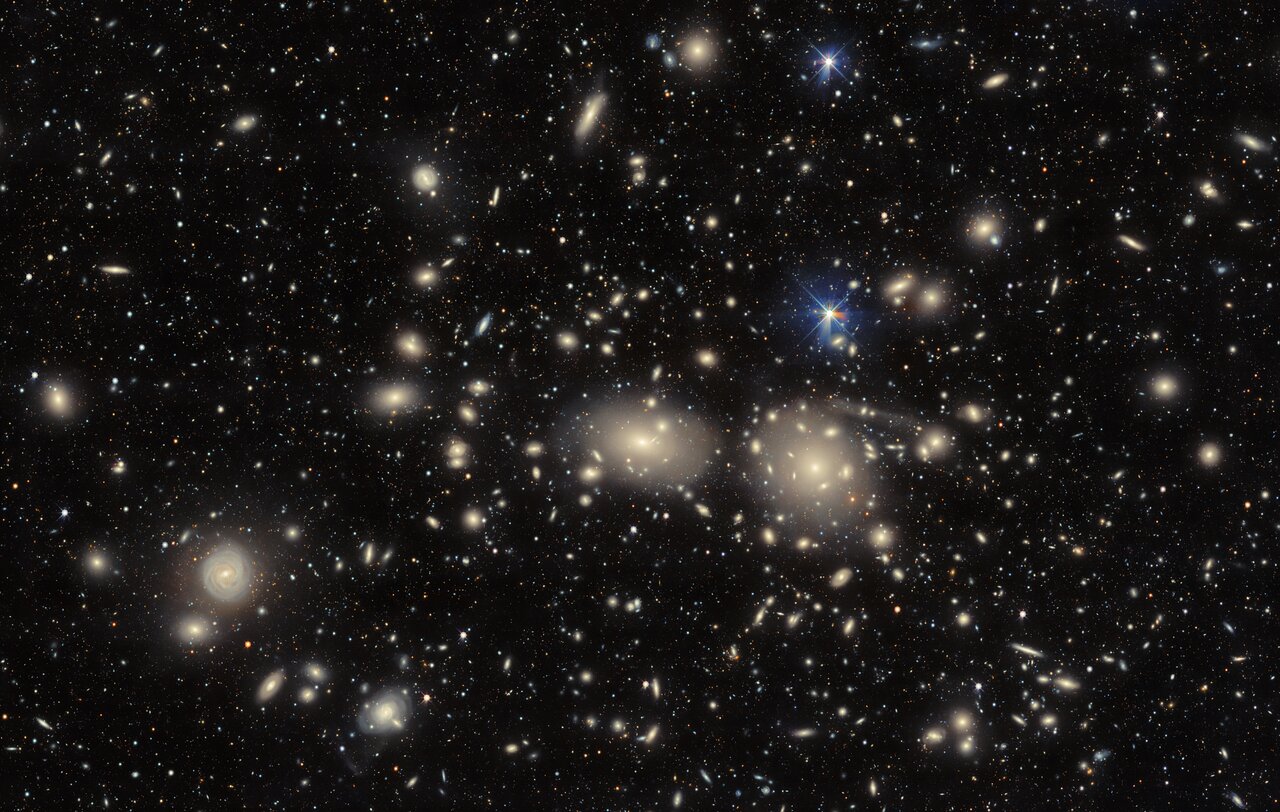
Hubble’s law fundamentally changed scientists’ understanding of the scale of our Universe. But by the 1930s, they were in for another shock. While conducting observations, the Swiss astronomer Fritz Zwicky noticed something remarkable: while studying a cluster of galaxies in the constellation Coma Berenices, he found that their velocities were far higher than what could be explained by the gravitational pull of their visible mass.
According to his calculations, the galaxies should have flown apart, yet they remained bound together. Zwicky proposed that some kind of invisible matter must exist that provides additional gravity and was the first to call this substance dark matter. In Zwicky’s usage, the word “dark” referred not to color but to the mysterious nature of this new kind of matter. Reflecting on its origin, Zwicky fully grasped a truth expressed by Socrates in ancient Greece: he realized that he understood nothing about this enigmatic form of matter.
Source: noirlab.edu
For several decades, Zwicky’s idea remained largely unrecognized until, in the 1970s, the American astronomer, Vera Rubin, confirmed his hypothesis. Studying the rotation speeds of stars in spiral galaxies, she found that stars in the outer regions of galaxies rotate just as fast as those closer to the center. According to the existing laws of gravity, however, distant stars should move much more slowly.
This paradox could only be explained if galaxies were actually surrounded by a massive halo of invisible matter that emits no light but exerts an extremely powerful gravitational influence on all visible, or baryonic, matter. Thus, the modern theory of dark matter was born.
Wandering in the dark: the discovery of dark energy
Even when confronted with the mystery of dark matter, the scientific community still believed the fate of our Universe was settled: its expansion, which began with the Big Bang, was gradually slowing down under the influence of gravity.
Moreover, the “additional” gravity potentially produced by dark-matter halos was expected only to intensify that slowdown. Until the early 1990s, the prevailing assumption in astronomy was that, over time, the Universe would either simply reach a state of balance or, conversely, begin contracting in a “Big Crunch” that would ultimately compress all visible matter back together. Many wanted to believe in such cyclicality, and to many astrophysicists it seemed intuitively logical. For this reason, up to the 1990s, most research focused on determining how quickly the current expansion of spacetime should be decelerating.
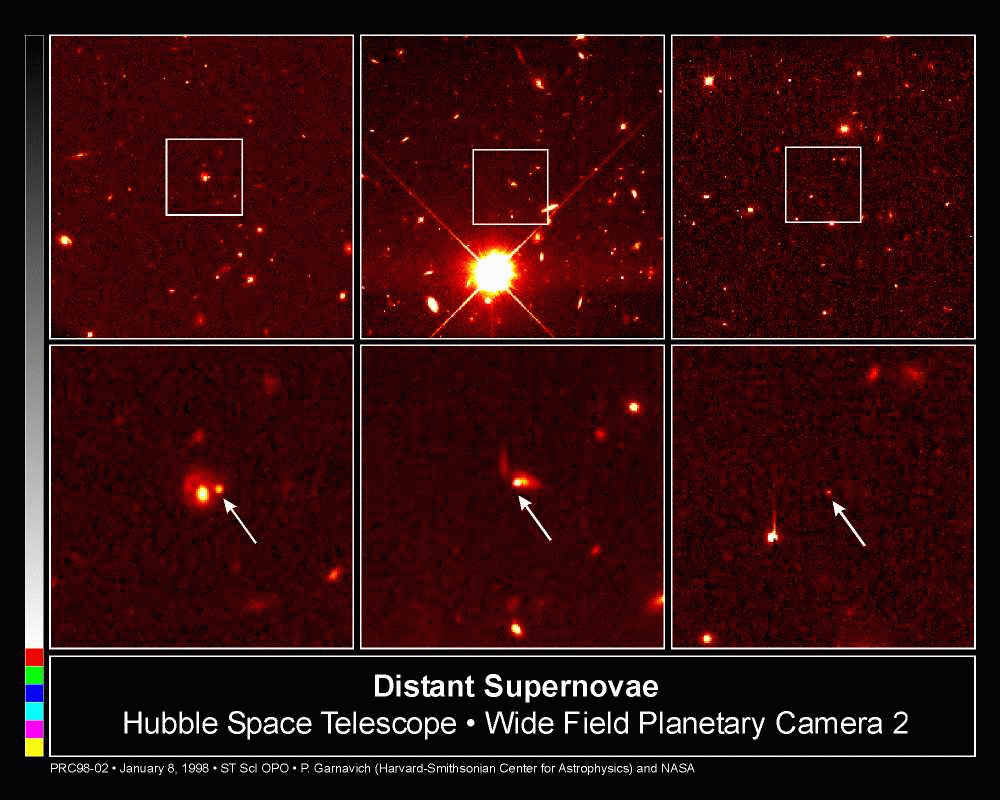
However, in 1998, two independent groups of scientists, the High-Z Supernova Search Team and the Supernova Cosmology Project, obtained shocking results while studying distant Type Ia supernovae. Such stars also served as standard candles that, like Cepheids, enabled astronomers to measure cosmic distances. Both research teams aimed to calculate the rate of the Universe’s expansion, but their data consistently showed that the most distant supernovae appeared dimmer than expected.
Source: lweb.cfa.harvard.edu
These results could only mean one thing: the supernovae were farther away than theory had predicted. Consequently, it appears that the expansion of the Universe is not, in fact, slowing down; on the contrary, it seems that it is accelerating. Such extraordinary findings required the existence of an unknown force that must counteract gravity. This led scientists to hypothesize the existence of dark energy.
The discovery of dark energy once again fundamentally changed our understanding of the cosmos. Whereas the Universe had previously seemed vast but understandable, a machine that, by all logical laws, should have slowed down after the initial acceleration given by the Big Bang, it now became an arena of contest between two opposite and invisible forces: while the gravity of dark matter pulls matter into clusters, the repulsive force of dark energy drives the Universe apart. It was this unexpected revelation that forced astronomers to radically revise their understanding of the fate of the Universe.
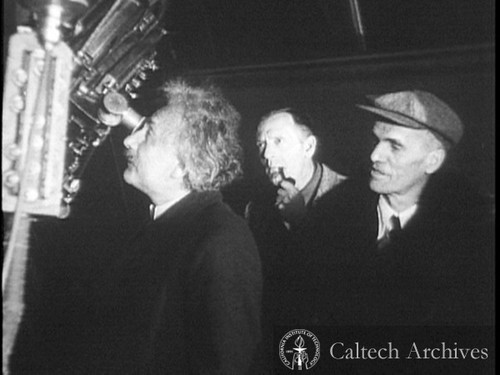
What was most remarkable about the discovery of dark energy was that it had been indirectly described years earlier by Albert Einstein. The simplest model of a Universe constantly accelerating under the influence of negative gravity was the “cosmological constant,” a concept he introduced in 1915 in his General Theory of Relativity. Einstein proposed the idea of the cosmological constant as a general repulsive force (antigravity) to prevent the collapse of a theoretically static Universe. However, this only enjoyed currency for a few years, until Hubble’s law was discovered and the accelerated expansion of the Universe was confirmed.
Source: calisphere.org
That being said, when astronomers discovered that the Universe’s expansion was indeed accelerating much more rapidly than expected, Einstein’s “mistake” came to mind. It turned out that Einstein’s cosmological constant was a rudimentary model of an invisible force acting like “negative gravity.” Ironically, the father of modern physics invented the correct mathematical solution to the wrong question: in Einstein’s case, proof of a false theory of a static Universe.
The presence of dark energy helps describe the possible fate of our Universe. Modern science offers several hypotheses regarding this matter. If the density of dark energy remains constant and it truly represents something like a “cosmological constant,” the expansion of the Universe will continue to accelerate, and galaxies will gradually move farther and farther apart at an ever-increasing speed. Over time, they will become so distant from each other that their light will never reach us. Stars will gradually burn out, and gas and dust will disperse into infinite cosmic nothingness. Such a Universe would become cold, empty, dark, and devoid of stars. Even atoms themselves would eventually drift apart. This scenario for the end of our Universe is known as the “Big Freeze.”
Another possible scenario resembles the first but assumes that the nature of dark energy is even more dynamic. In this case, the density of dark energy would grow over time, and its repulsive force would become so powerful that it would eventually overcome all other forces, including gravity, electromagnetism, and even the nuclear forces that hold atoms together. This process would lead to the destruction of all structures in the Universe. First, galaxy clusters would tear apart, then the galaxies themselves would begin to disintegrate. Next would come stars and planets, gradually torn from their orbits. Eventually, even atoms would be ripped apart into their elementary particles. This dramatic scenario is known as the “Big Rip.”
Practical applications: why should we study dark matter and energy?
Although the foregoing discussion seems mostly to concern huge questions like the ultimate fate of the Universe, the study of dark matter and dark energy is not merely an academic curiosity. Understanding them potentially may hold enormous practical significance, far beyond theoretical science.
First, the discovery and identification of dark matter particles could lead to a true revolution in particle physics. Research into these particles has been ongoing since Vera Rubin’s rediscovery of dark matter. Since then, scientists have developed several hypotheses to explain what dark matter might actually be. The most popular is the hypothesis of Weakly Interacting Massive Particles, or “WIMPs”: massive particles that do not interact with electromagnetic radiation, only with gravity. To date, many experiments have been conducted to detect them, including XENON1T (which has now been replaced by the more powerful XENONnT) and experiments at the Large Hadron Collider. However, so far, none of these experiments has provided direct evidence of dark matter.

Source: cerncourier.com
If the main candidates for dark matter particles, including WIMPs or axions, which interact even more weakly than WIMPs and have even smaller masses, are ever discovered, it would mark the discovery of an entirely new class of matter, not included in the Standard Model that describes all known particles. Such a discovery would not only account for the 27% of the universe attributed to dark matter, but could also pave the way for the creation of new technologies, much like the discovery of the electron once gave rise to modern electronics. Moreover, understanding the nature of dark matter could provide us with a key to unifying gravity with the other fundamental forces of nature.
Second, studying dark matter could help us navigate space and plan future space missions. Observations show that dark matter forms gigantic filamentary structures, known as the “cosmic web,” along which all galaxies are aligned. This “web” is the invisible skeleton of our universe. By understanding the nature of dark matter, we could better map these invisible structures. In turn, this would allow us to locate new galaxies, star clusters, and even potentially habitable worlds. Dark matter might thus essentially serve as a kind of GPS for intergalactic travel.
Source: assets.science.nasa.gov
But the most fantastic prospects involve harnessing dark energy. If it turns out that dark energy is not merely a cosmological constant but some kind of dynamic quintessence, humanity could unlock truly astonishing possibilities. The repulsive effect of dark energy could become the basis for new types of spacecraft propulsion. Theoretical concepts known as “warp drives” propose using dark energy to bend space-time, “compressing” space in front of a spaceship and “expanding” it behind. Such warp drives could potentially allow us to traverse vast distances almost instantaneously, relying on the properties of space itself rather than the reactive acceleration of the spacecraft.
Alternative hypotheses: modified Newtonian dynamics
Despite broad support, the theories of dark matter and dark energy also have their critics, who propose alternative models that do not require the existence of these invisible entities.
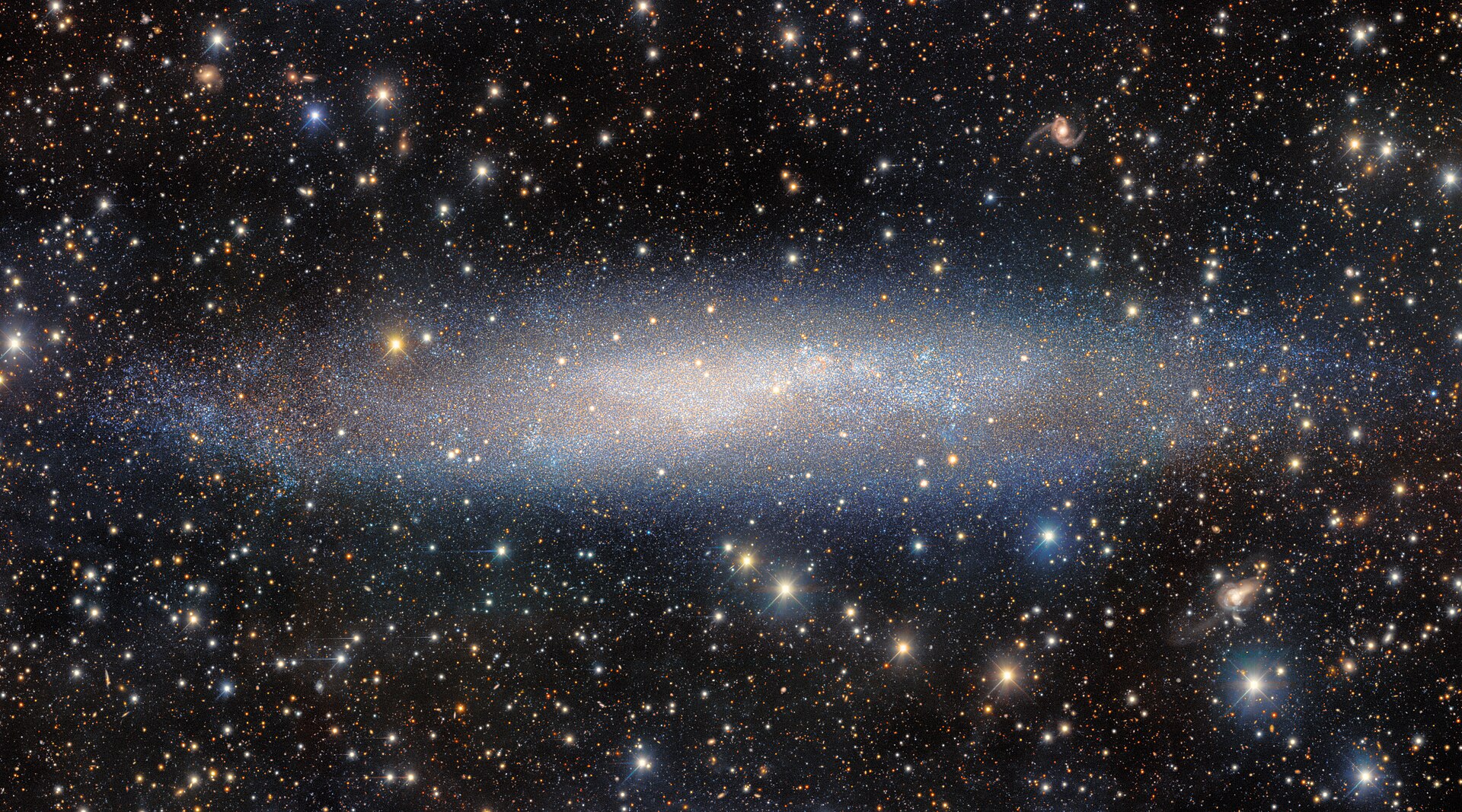
The most well-known of these is Modified Newtonian Dynamics (MOND), proposed in 1983 by Israeli physicist Mordehai Milgrom. His theory asserts that Newton’s and Einstein’s laws of gravity begin to operate differently at very low accelerations, characteristic of the outskirts of galaxies. By modifying the laws of gravity themselves, MOND attempts to explain the rotational speeds of galaxies without invoking dark matter. The popularity of the MOND model grew after it successfully predicted the motion of certain star clusters.
Source: wikipedia.org
However, MOND also has its limitations. It works well at the level of individual galaxies, but still cannot explain large galaxy clusters: the visible mass of these clusters remains insufficient to account for observations, even within the framework of Milgrom’s alternative model. For example, it is known that galaxy clusters generate such powerful gravity that they warp space-time around them, bending light from distant objects, the phenomenon known as gravitational lensing. According to Milgrom’s theory, the forces causing this lensing should correspond to the distribution of visible mass (galaxies and gas). But measurements show that the gravitational effect is much stronger than what visible matter can produce.
Most alternative theories also fail to explain the full range of cosmological observations, particularly the structure of the cosmic microwave background. To date, such alternative theories remain largely theoretical and have not been confirmed as widely as the theories of dark matter and dark energy. This is precisely why the scientific community continues its persistent efforts to probe deeper into space and catch even a glimpse of the hidden 95% of the universe—the submerged bulk of the cosmic iceberg.