We have already covered some of the most outstanding events awaiting European space activities this year; now, let’s look at exciting developments in the space programs of other countries around the world. In 2026, there will be plenty to admire: Japan’s Mars initiative; China’s seventh mission to the Moon; the first uncrewed test of India’s Gaganyaan 1 spacecraft; and, of course, the Artemis program, the first American crewed mission to the Moon in more than 50 years. There are indeed a lot of exciting developments ahead!
Japan’s Martian dream
The long-awaited journey of the Japan Aerospace Exploration Agency (JAXA) to the Martian system is scheduled to launch in September 2026. However, it is not so much the Red Planet itself that attracts the Japanese; rather, the main focus is on Mars’s two moons, Deimos and Phobos. As part of the final phase of the Martian Moons eXploration (MMX) program, JAXA plans to collect and return samples of Phobos’s surface material to Earth. The mission is currently in the stage of designing its main trajectory milestones.

Source: mmx.jaxa.jp
According to preliminary estimates, the spacecraft’s journey to Mars will take about a year. Eventually, MMX will reach a quasi-stationary orbit and conduct a series of flybys of Phobos, during which time it will carry out visual observations and scanning. This extended study is intended to clarify the processes behind the evolution of Martian material, as well as to identify the most likely factors that led to the formation of the unusually shaped Martian moons.
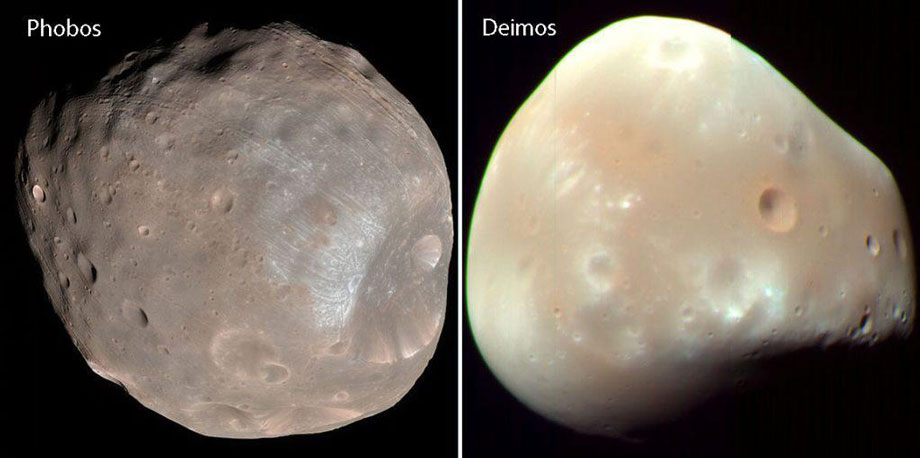
At present, several theories dominate the scientific community in explaining the origin of Phobos and Deimos. One of the most plausible hypotheses suggests that these bodies may be ordinary asteroids that were captured by Mars’s gravitational field after the planet had fully formed. This idea fits well with the non-spherical shapes of both moons. In other words, due to insufficient self-gravity to pull itself into a sphere, Phobos assumed an irregular shape and now resembles a potato measuring about 26 × 22 × 18 km. Another theory argues that the Martian moons are fragments left over from a collision between Mars, at an early stage of its formation, and some other protoplanet comparable in size to Pluto or Venus. In any case, samples of soil from Phobos will provide scientists with extraordinary material for studying the early evolution of planets in the Solar System.
Source: universemagazine.com
From an engineering perspective, the JAXA MMX mission is far from trivial. First of all, if the expedition is successful, Japan will possess efficient, tested technology for transportation along the Mars–Earth route, which would be a significant factor in organizing future Martian missions that may involve building infrastructure. In addition, the mission will test an advanced communication system with Earth, which is a particularly sensitive issue when planning such distant space journeys.
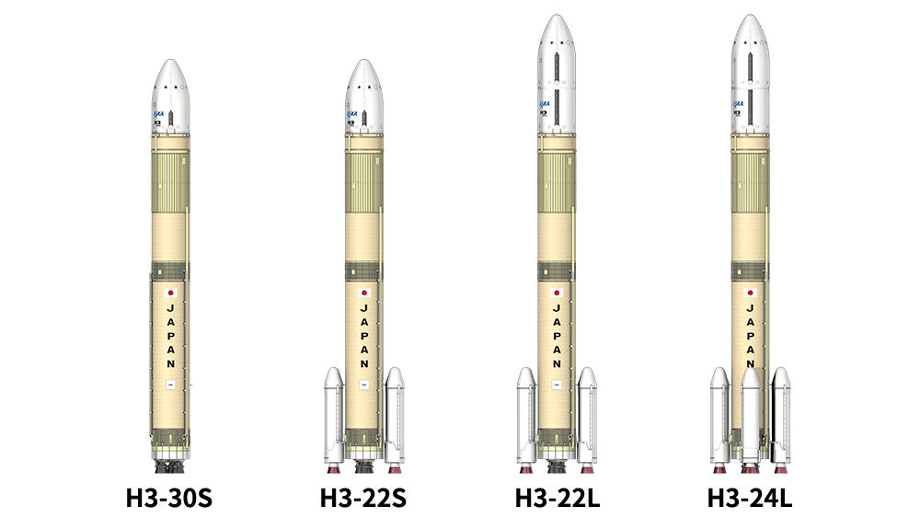
At the same time, the technical difficulty of landing on Mars’s moons lies in their very small size: Phobos, in particular, is 156 times smaller than Earth’s Moon. Add to this the distance, which is almost 1,000 times greater than the Earth–Moon distance, and it becomes clear just how technologically challenging this task really is. Even the most advanced interplanetary communication technologies today mean that a radio signal from Earth takes on average between 3 and 22 minutes to reach Mars, depending on the relative positions of the planets in their orbits. These figures demonstrate that real-time coordination of a landing, using visual feedback from spacecraft cameras and a joystick-style controller, is impossible. However, if MMX has its velocity and landing trajectory precisely calculated in advance, the need for human operator intervention can be significantly minimized. These are exactly the challenges the team preparing the JAXA mission aims to solve.
Source: global.jaxa.jp
Speaking of Japanese interplanetary missions, it is also worth mentioning the still-active asteroid hunter Hayabusa2, which is currently carrying out its extended mission. According to preliminary information from JAXA, the spacecraft may perform a high-speed flyby of asteroid 2001 CC21 (recently named Torifune) in early July 2026. Another asteroid research project, “Demonstration and Experiment of Space Technology for INterplanetary voYage with Phaethon fLyby and dUst Science,” or DESTINY+, is also being prepared. For 1.5–2 years, the spacecraft will slowly raise its orbit around Earth using ion engines, after which it will approach asteroid 3200 Phaethon, the parent body of the Geminid meteor shower.
We will see what the future holds for Japan’s asteroid missions and its Martian initiative. Perhaps as early as 2027, the red circle on the Japanese flag will be firmly associated, for many of us, with the Red Planet.
China’s hegemony: Chang’e 7 and Hubble’s new competitor
Unlike Japan, which in 2026 is targeting distant celestial bodies, China has chosen a very different path in space: one of repetition and refinement. In 2026, China’s list of extraterrestrial missions is set to be expanded with Chang’e 7, the seventh uncrewed Chinese spacecraft to visit the Moon and land on the lunar surface. As of today, Chang’e 7 is the most complex and multi-component mission in the history of China’s lunar program, with its launch scheduled for August 2026.
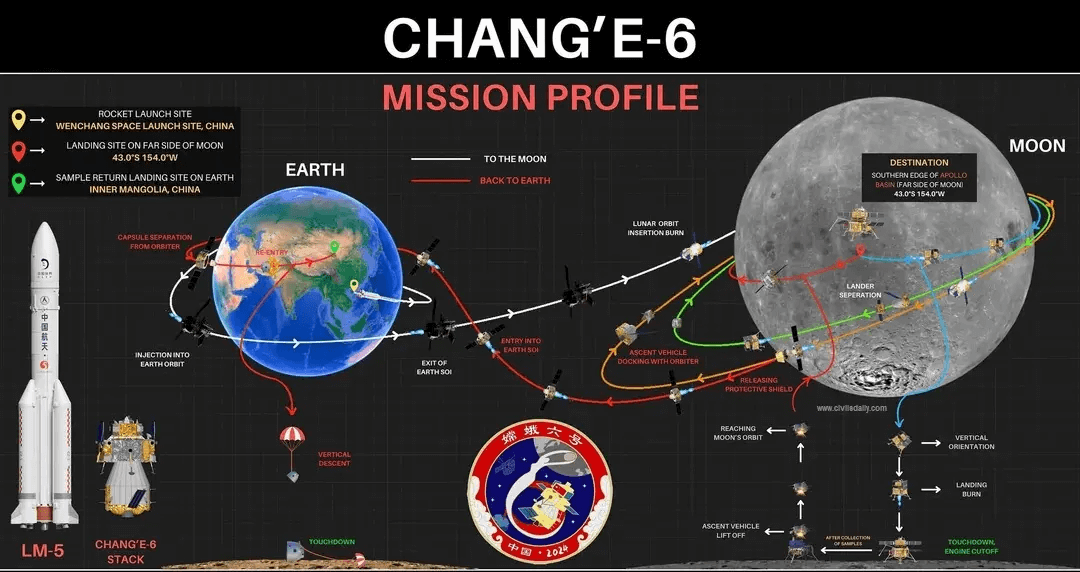
While Japanese colleagues at JAXA are focusing their efforts on exotic distant targets such as Phobos or asteroids, China is demonstrating strategic patience by persistently returning to the Moon. This mission, however, is not merely another flight, but a systemic operation involving four main elements at once: an orbiter, a lander, a rover, and a unique hopper (a sort of flying mini-probe). The key distinction of the Chinese approach lies in the transition from reconnaissance to preparing for the industrial exploitation of lunar resources. This is, in fact, a consistent and methodical program for lunar exploration, where accumulated technologies will be used to build a full-fledged lunar base: the International Lunar Research Station (ILRS). For now, China’s most recent successful lunar mission remains Chang’e 6, during which the country, for the second time in a row, managed to return samples of lunar regolith to Earth in a fully autonomous mode.
Source: civilsdaily.com
The landing site for the new Chang’e 7 probe has been chosen on the illuminated rim of Shackleton crater near the Moon’s south pole, an area of critical interest for future bases. While Japan’s 2026 MMX mission will only attempt to briefly touch Phobos to collect samples, Chang’e 7 is expected to deploy a true automated scientific outpost on the surface of Earth’s natural satellite. The primary objective is direct confirmation of the presence of water ice in permanently shadowed regions that have not seen sunlight for millions of years. To achieve this, China has developed and will later launch a revolutionary flying vehicle that will autonomously travel from illuminated areas into the dark depths of craters to analyze water molecules there.
The technological advantage of Chang’e 7 lies in its use of the world’s first image-based landmark navigation system for ultra-precise landing in the complex terrain of the polar region. Moreover, while most countries are only planning their return to the Moon, China already has a proven communications infrastructure via the Queqiao 2 relay satellite, successfully placed into orbit during earlier missions. At present, no country in the world has its own active analogue of a lunar GPS, meaning China could become the first. This communications system would allow the mission to be controlled in real time, even in areas where direct contact with Earth is impossible.

Source: x.com
The systems installed on Chang’e 7 will be fully focused on survival in the extreme conditions of the lunar night, with temperatures dropping below −100°C. The lander will be equipped with vertical solar panels optimized for the low angle of sunlight at the poles, allowing it to generate power even when traditional horizontal panels lose efficiency. The mission will carry 21 scientific instruments, not all of which are of Chinese origin. In particular, instruments from Italy, Russia, Switzerland, Thailand, and Egypt will be installed on the lunar platform. The main scientific instruments of the lander itself will be a seismograph to study the Moon’s internal structure and a volatile analyzer.
After the landing in 2026, special attention will be drawn to the lunar rover, developed based on the Yutu-2 design, which currently remains the longest-operating lunar rover. Since the start of its activity during the Chang’e 4 mission in 2019, Yutu-2 has traveled more than one mile (about 1,600 meters) and has operated on the lunar surface for over 2,500 Earth days in total. The upgraded version of the rover will feature improved mobility and the ability to autonomously plan routes in the permafrost conditions of the lunar south pole. Unlike Japanese probes, which focus on imaging and spectroscopy from orbit, the Chinese rover will drill into the surface and study the composition of the soil directly at the drilling sites. This is critically important for understanding whether lunar water can be used to produce fuel and support astronaut life. And this will not be the end of the Chang’e program: Chang’e 8 is scheduled for 2028 and will test technologies for 3D printing using lunar regolith.
By the end of 2025, Chang’e 7 was at the final stage of integration testing. All key components, including foreign equipment, had already been integrated into the platform. The final stage of launch preparation is the final calibration of spectrometers, which must be able to distinguish hydroxyl groups from true ice.
The success of Chang’e 7 will make China the first country to possess a complete ground-truth resource map of the Moon’s south pole obtained directly on site rather than from orbit. This will give the country a strong position ahead of the next decade, when competition for lunar resources will move into legal and economic domains. While the world watches Japanese maneuvers in deep space, Chang’e 7 will quietly and professionally bring the era of meticulous lunar exploration to a close, opening the era of its colonization.
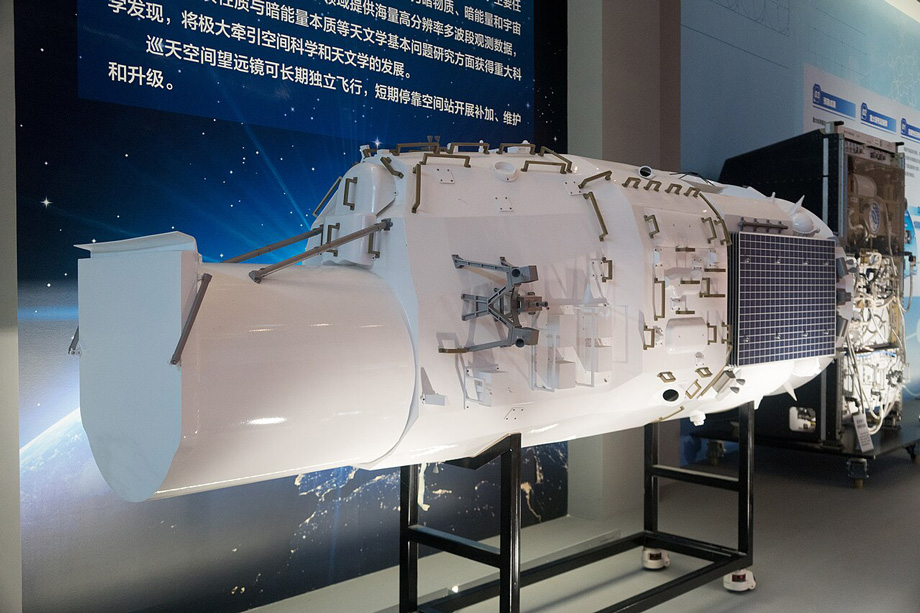
With each new stage of the Chang’e space program, China gradually demonstrates the maturity of its aerospace industry, which is steadily moving toward a phase of scientific dominance. Thus, in 2026, China also plans to place its first large space telescope, Xuntian (full name: Chinese Survey Space Telescope, CSST), into orbit. This is a direct response to the American Hubble, but with a field of view roughly 300 times larger than that of the US observatory.
Source: wikipedia.org
The telescope is expected to operate in the same low Earth orbit as the Chinese space station Tiangong. This is necessary to allow the station’s crew to periodically dock with Xuntian for servicing and upgrades. If the launch proceeds as planned in December 2026, full-scale scientific observations will begin in the first half of 2027, after all stages of mirror and instrument calibration are completed.
ISRO: From its own orbit to the mysteries of Venus and Mars
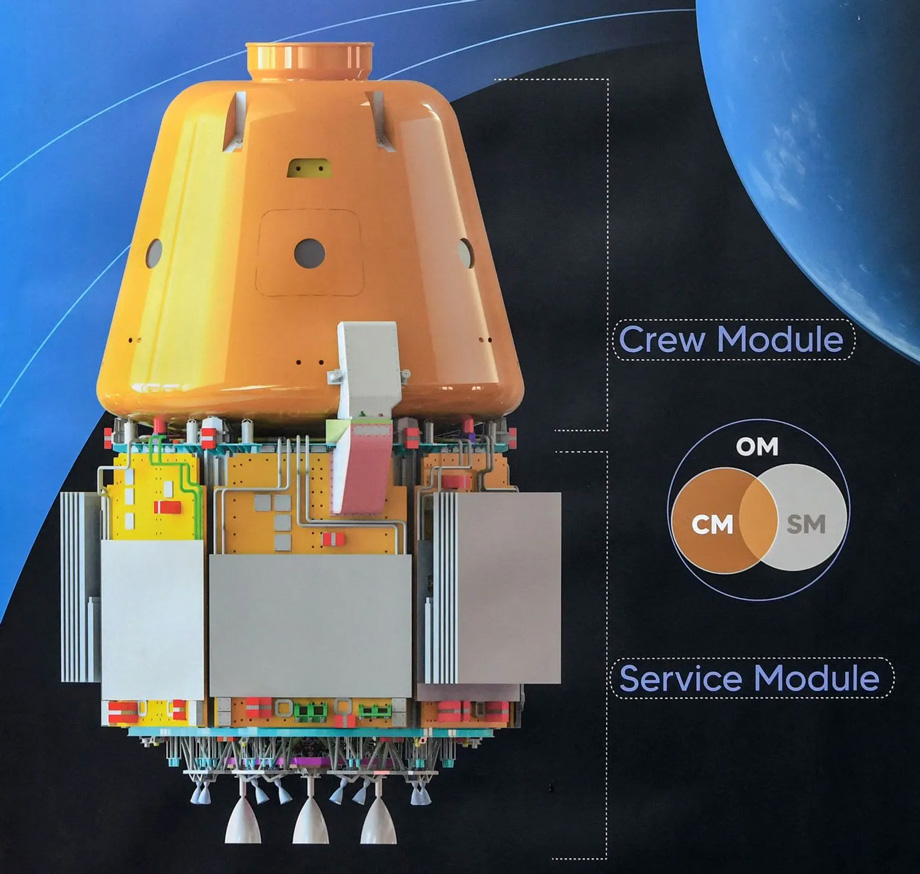
While global powers compete for lunar resources, the Indian Space Research Organisation (ISRO) is preparing its own technological offensive in 2026, one that will firmly secure its status as a space superpower. The centerpiece of the year will be the launch of the Gaganyaan 1 mission, the first test flight of India’s indigenous crewed spacecraft. Although this will be an uncrewed mission, India has chosen to simulate a crew, with the main “passenger” being the female humanoid robot Vyommitra. For Gaganyaan 1, this is not mere symbolism: the robot will be equipped with sensors to measure vibrations and radiation, allowing engineers to verify the capsule’s safety ahead of the planned human mission in 2027.
Preparation for Gaganyaan 1 entered a decisive phase in late 2025, when testing of the launch escape system and parachute systems was completed. During the 2026 mission, the LVM3 rocket will place the spacecraft into a 400-kilometer orbit, where it will spend several days validating life-support and thermal control systems. The mission will conclude with a complex atmospheric re-entry maneuver and splashdown in the Bay of Bengal.
Source: britannica.com
The mission is a matter of national prestige for India, as it will demonstrate the country’s independence in human spaceflight technology. By the end of 2026, two more uncrewed missions in the Gaganyaan series (G2 and G3) are planned. These will serve as the final tests of all systems before the first flight of Indian astronauts, scheduled for 2027.
Alongside preparations for its first spacecraft test, ISRO is also moving forward with other ambitious plans, such as exploring the planets of the Solar System and the next Mars mission, ISRO Mangalyaan-2 (MOM-2). Although 2026 had previously been considered a possible launch window, in November 2025, ISRO chief Dr. V. Narayanan officially confirmed that the mission is now scheduled for 2030. The delay is due to a significant expansion of the mission: India has decided not just to send an orbital probe but to achieve the first soft landing on Mars using a combination of a lander, rover, and mini-copter. This change in concept required more time to develop landing systems for the thin Martian atmosphere, which ISRO plans to work on throughout the coming year.
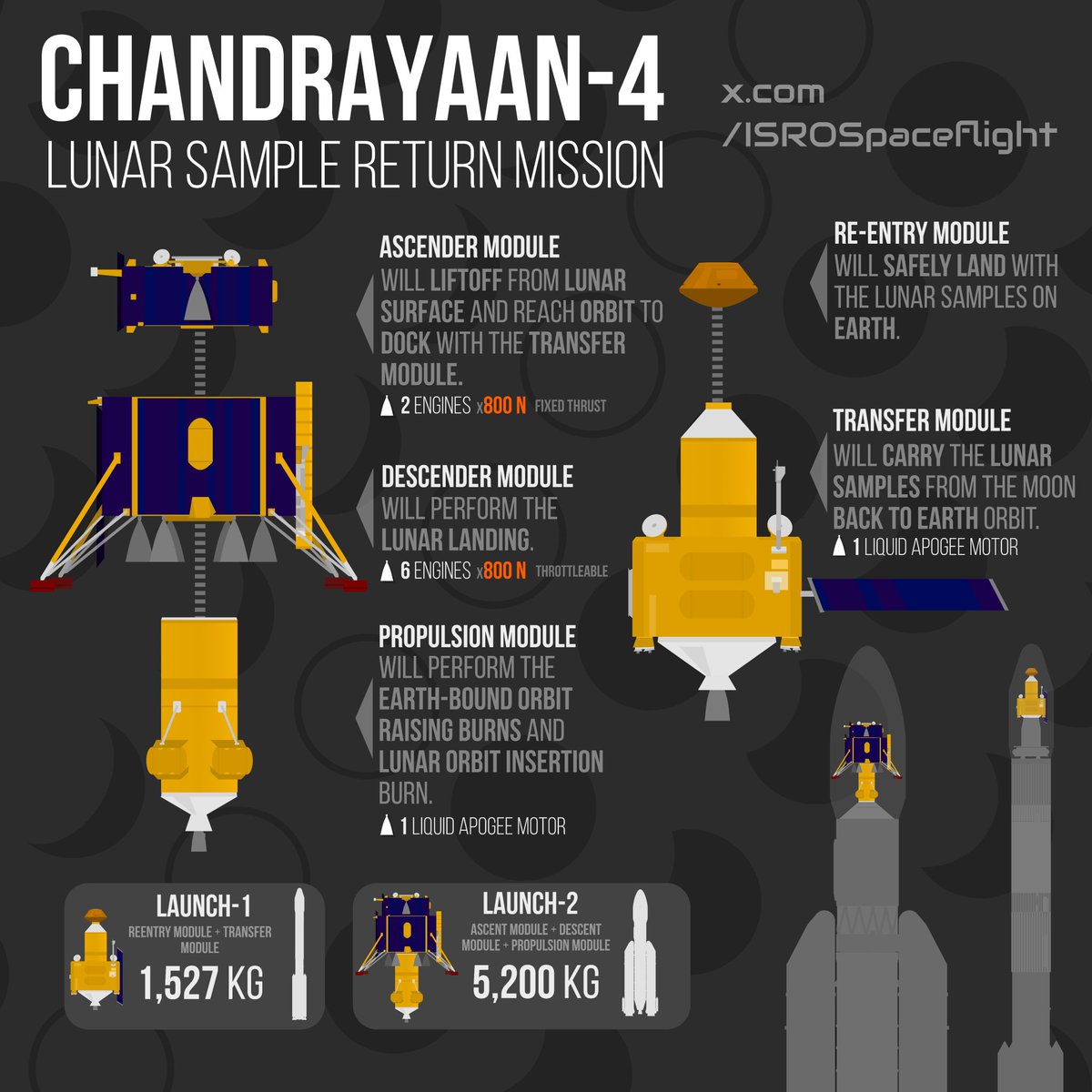
Preparations are also ongoing for the lunar sample-return mission, Chandrayaan 4, planned for launch in 2027–2028. In many ways, India’s Chandrayaan program resembles China’s Chang’e program, though they have significant differences. Recently, it became known that ISRO intends to use a complex multi-module scheme with docking in lunar orbit. For this, India has developed a unique system involving two separate launches, which will place five interconnected modules into orbit with a total mass exceeding 6.7 tons.
Source: x.com
The main complex (Launch-2) will consist of a lander module for a soft landing and an ascent vehicle, which, after collecting regolith samples, must independently lift off from the surface and reach lunar orbit. In orbit, the ascent module will automatically dock with the transfer block (Launch-1). After transferring the collected soil into the return capsule, the transfer module will carry out the return journey from lunar orbit to Earth. The final stage of the mission will be the separation and safe landing of the return module, which will deliver the valuable lunar samples to scientists for study.
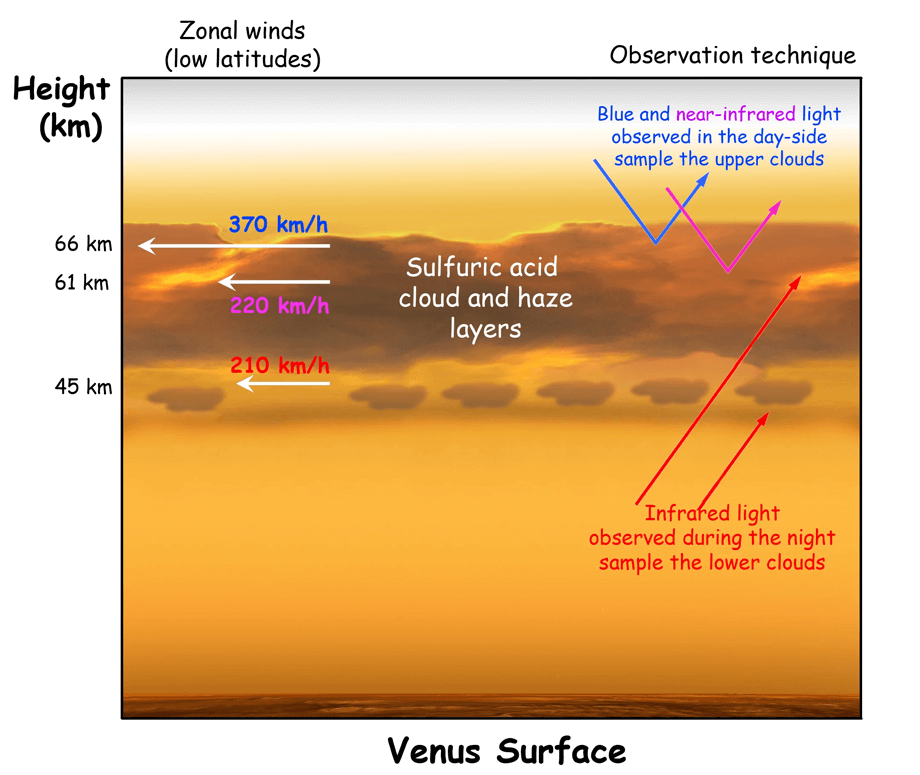
At the same time, India continues preparations for its Shukrayaan 1 mission, which aims to send the country’s first probe to Venus. Like MOM-2, this mission’s launch window has already been postponed, so the most optimistic planned launch date is currently March 2028. Regarding the preparation for Shukrayaan 1, the probe’s main scientific instrument will be a synthetic aperture radar (SAR), capable of penetrating Venus’s dense, extremely toxic atmosphere, which is 95% carbon dioxide. The primary goal of Shukrayaan 1 is to create the most detailed map of geological activity and volcanism on the surface of the second planet from the Sun. Preparations for the Venusian mission also include developing unique systems for protection against overheating and corrosion, since, even at high altitudes, the spacecraft will still operate in a highly aggressive environment.
Source: universetoday.com
ISRO’s extraterrestrial exploration program is thus built on three pillars: the lunar Chandrayaan 4, the Martian MOM-2, and the Venusian Shukrayaan 1. Sequential progress toward each of these goals should make 2026 a very eventful year for ISRO.
Artemis II: the long-awaited return to the Moon’s orbit
While ISRO is conducting tests of the unmanned Gaganyaan 1 capsule, the American Artemis II mission will be preparing to return humans to lunar orbit. Preparations for the mission have now entered the final stage, and at the Vertical Assembly Facility of the Kennedy Space Center in Florida, NASA specialists have already completed the integration of the system’s main components: the Orion spacecraft has been installed atop the Space Launch System (SLS) heavy-lift rocket. This technical milestone represents the culmination of years of work by thousands of engineers and paves the way for a series of comprehensive checks of communications and airtightness before the launch, currently scheduled for spring 2026.
This mission is set to be the first crewed launch. Over the past year, the Artemis II crew has undergone an intensive preparation cycle, including more than 30 full-scale flight simulations. The astronauts, Commander Reid Wiseman, Pilot Victor Glover, and Mission Specialists Christina Koch and Jeremy Hansen, have rehearsed every stage of their 10-day journey, from maneuvers in low Earth orbit to the critical moment of free return after orbiting the far side of the Moon. Special attention was given to testing the Orion life support systems, which will operate in real deep-space conditions with humans on board for the first time.
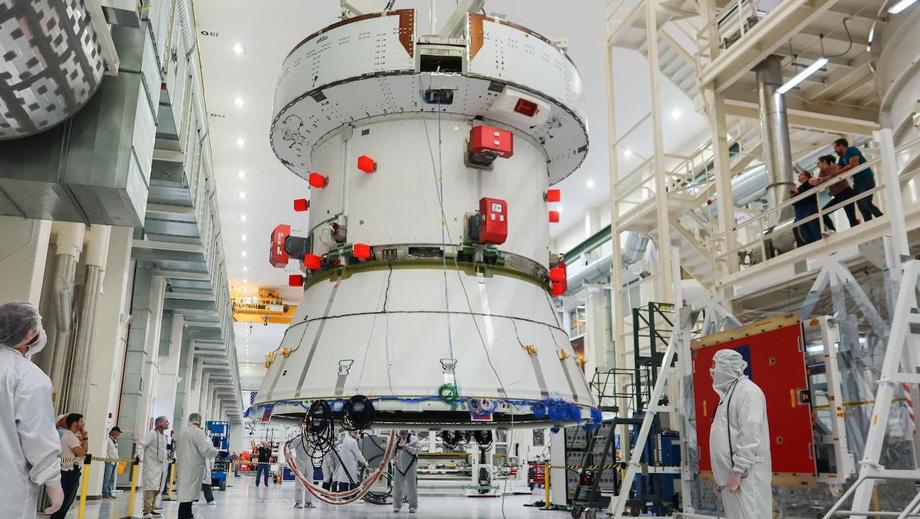
Although Artemis II is often seen as purely an American initiative, it is the embodiment of truly global cooperation. As mentioned earlier, the backbone of the mission is the European Service Module (ESM), developed by the European Space Agency (ESA) and built by Airbus in Germany. It will supply Orion with power, water, oxygen, and the thrust necessary for maneuvers. It must be acknowledged that without this European contribution, the flight would not be technically possible.
Source: spaceref.com
Canada also plays a key role in this historic flight through the participation of Jeremy Hansen, who will become the first Canadian to travel to the Moon. Beyond his direct membership in the crew, partner countries are jointly developing scientific experiments to be conducted during the stay in lunar orbit.
Artemis has already united 48 countries that have signed the Artemis Accords, an international manifesto for the peaceful, transparent, and sustainable exploration of space, as envisioned by the program. And although not every signatory nation has its own space sector, each can contribute intellectually or industrially, creating a unified ecosystem for returning humans to the Moon.
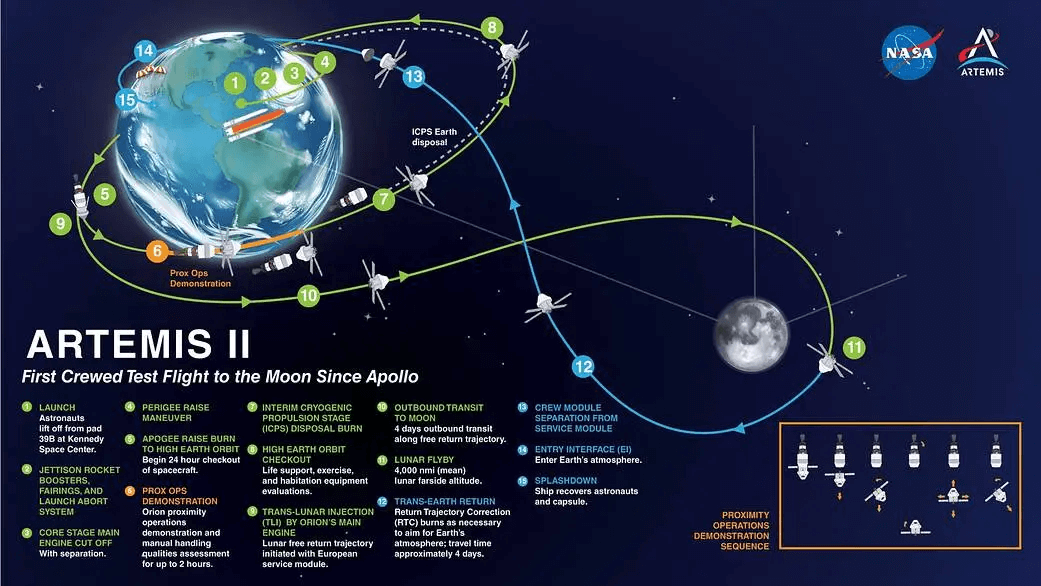
Artemis II will begin with the launch of the SLS rocket, which will place the Orion spacecraft into a high elliptical orbit for a 24-hour check of all crew life support systems. Once the systems’ functionality is confirmed, the spacecraft will perform a maneuver toward the Moon, where the astronauts will execute a gravitational flyby along a free-return trajectory. During the ten-day journey, the crew will, for the first time in half a century, approach the lunar surface to within about 7,400 km, testing technologies for future lunar landings. The final stage will involve the separation of the service module and the high-speed reentry (up to 40,000 km/h) of the crew capsule into Earth’s atmosphere, followed by splashdown in the Pacific Ocean.
Source: nasa.gov
The success of Artemis II is expected to serve as the decisive confirmation of the reliability of all systems before the next stage: landing humans on the lunar surface as part of the Artemis III mission. Very soon, we will see whether humanity is truly ready to once again reach for its lunar dream, postponed for more than 50 years. 2026 will mark an important milestone in testing this readiness.