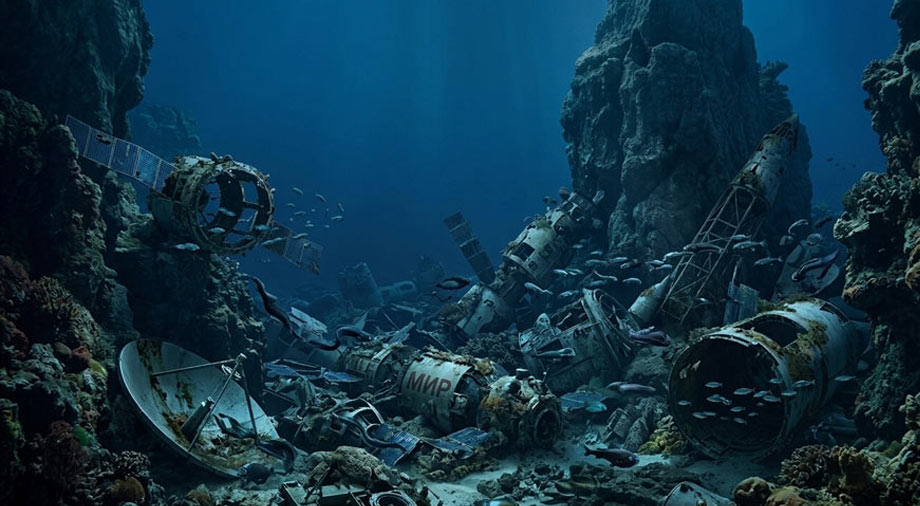
In March 2001, residents of the Fiji Islands in the southern Pacific Ocean witnessed an incredible spectacle: the 130-ton space station Mir crossed the evening sky over the ocean, trailing a fiery plume over one and a half thousand kilometers long. This marked the end of the story of the first modular orbital station, which had served humanity for more than 15 years.
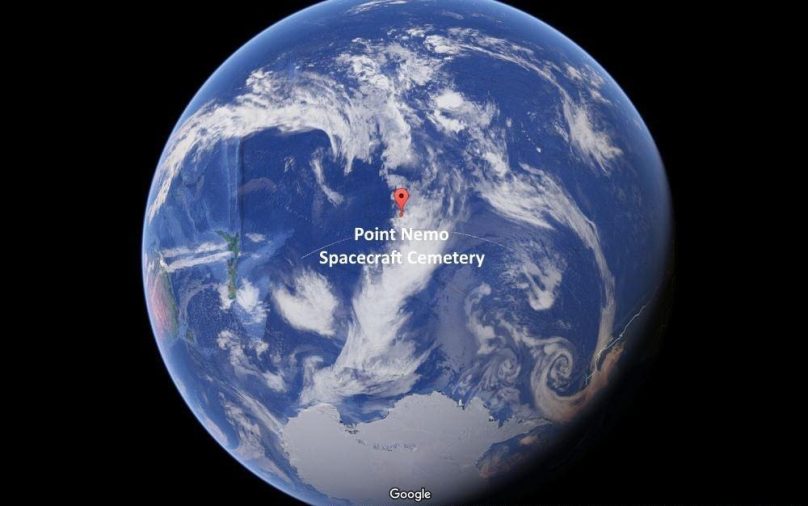
The location chosen for its reentry was not random. Named after Captain Nemo, the hero of Jules Verne’s novels, Point Nemo is the most remote place from land anywhere on our planet. The nearest shore is almost 3,000 km away, and over 400 km separate it from astronauts aboard the International Space Station. Therefore, the name “Nobody” (the Latin meaning of “nemo”) seems rather appropriate: it is truly uninhabited.
Today, the area around Point Nemo hosts the largest graveyard for spacecraft in the world. Around 300 vehicles already rest here, and their number continues to grow: in 2030, the International Space Station, weighing over 400 tons, will also be sent here when the time comes to say goodbye to the largest human-made object in the world.
Source: amusingplanet.com
How to site a spaceship graveyard
The closest one can get to Point Nemo by air is by taking a flight from Auckland, New Zealand, to Buenos Aires, Argentina. Covering a distance of over 10,000 km, you would likely fly over this unique location. It stands out in no way amid the endless ocean: there is neither an island nor any man-made structure to help identify it. Interestingly, it was discovered not by sailors or explorers venturing into the open sea, but by Croatian-Canadian survey engineer Hrvoje Lukatela in 1992, using the computer program Hipparchus. It was Lukatela’s precise mathematical calculations that helped identify Point Nemo as the ideal site for a spacecraft graveyard. The reason is that, even with controlled reentry, it is impossible to predict the exact landing spot of each fragment to the meter. This means that a fairly large, uninhabited, and completely safe zone is required.
“Even with a controlled atmospheric entry, it won’t be a pinpoint landing,” explained Holger Krag, head of the Space Debris Office at the European Space Agency, before the reentry of the third Automated Transfer Vehicle (ATV) in 2013. “The peculiarity of the destruction process is that we have to clear a fairly large area so that all fragments fall within the designated zone.”
Ultimately, a large and uninhabited territory was designated–Point Nemo–which provides space engineers with a wide range of allowable deviations. This location, also known as the Oceanic Pole of Inaccessibility, is situated approximately 2,688 km from the three nearest islands: Ducie (part of the Pitcairn Islands) to the north, Motu Nui (part of the Easter Islands) to the northeast, and Maher (near the coast of Antarctica) to the south. Not only are these three islands uninhabited, but the surrounding waters are also poor in marine life. The low biological activity is mainly due to a strong ocean current: the South Pacific Gyre limits the flow of nutrients. Humans appear here only once a year for the round-the-world sailing race known as the Ocean Race, and historically, no one has engaged in fishing in this area.
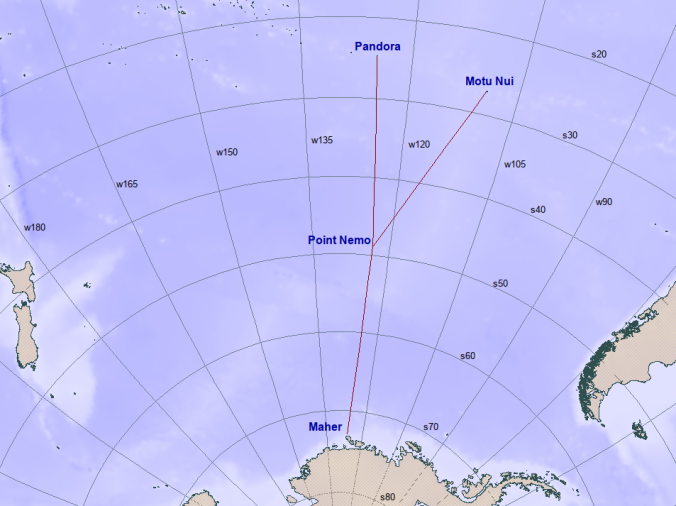
Source: wikipedia.org
Space debris that settles on the ocean floor at Point Nemo has minimal impact on living ecosystems, and not only because of the low biodiversity. During controlled reentry, objects enter Earth’s atmosphere at speeds of up to 28,000 km/h, heating to extremely high temperatures and almost completely burning up upon contact with the water surface. For the most part, only structural fragments that were originally designed to withstand extreme temperatures and pressure changes, such as fuel tanks or rocket boosters, remain intact.
Point Nemo’s most famous burials
The spacecraft graveyard was used for the first time in 1971, and by the beginning of 2026, it held the submerged fragments of around 300 different vehicles. Several national agencies have utilized this location, so it contains satellites, cargo spacecraft, stations, and other objects previously owned by the USA, China, Russia, and other countries.
The Soviet Mir space station remains the largest object ever buried in the cold waters of the Pacific Ocean after its 15 years of service. At an altitude of 100 km, just along the Karman line, its solar panels and several other fragments separated from the station due to the intense atmospheric entry. These pieces, heated to a plasma state, were observed by the residents of Fiji, as well as by Mir’s designer and a group of cosmonauts who had spent several months on the station. In total, between 20 and 25 tons of fragments fell into the ocean out of the station’s original 135 tons.
You can see the final seconds before the Mir station fell into the ocean in this video:
Next to the remains of Mir rest fragments of six Salyut stations and over 140 unmanned Progress cargo ships that, beginning in 1973, ferried supplies between the International Space Station and other spacecraft. Experts estimated that the station may have broken into roughly 1,500 pieces, the largest about the size of a car. Although supposedly surviving fragments were sold on the black market for a long time, their authenticity was never confirmed, nor is there evidence that anyone actually recovered them from the ocean.
Five spacecraft were also deliberately sunk in this uninhabited part of the Pacific by the European Space Agency between 2008 and 2015. These were ATVs (Automated Transfer Vehicles) used to deliver fuel, water, food, and scientific instruments to the International Space Station.
The site also received spacecraft from the Japan Aerospace Exploration Agency (JAXA), including single-use cargo ships that delivered experimental equipment (including microscopes and telescopes), food, and even the world’s first “space avatar,” a remotely controlled robot developed by the Japanese company ANA Holdings. The last of these ships was safely deorbited at Point Nemo in 2020.
In a few years, the history of the International Space Station, the largest human-made object ever built, will come to an end. After partner countries stop supporting the station in 2030, it is scheduled to be deorbited in early 2031. For this final mission, NASA selected SpaceX, signing a contract worth $843 million. SpaceX is developing the U.S. Deorbit Vehicle (USDV), which will bring the station down from orbit and ensure its debris lands within the designated area at Point Nemo.
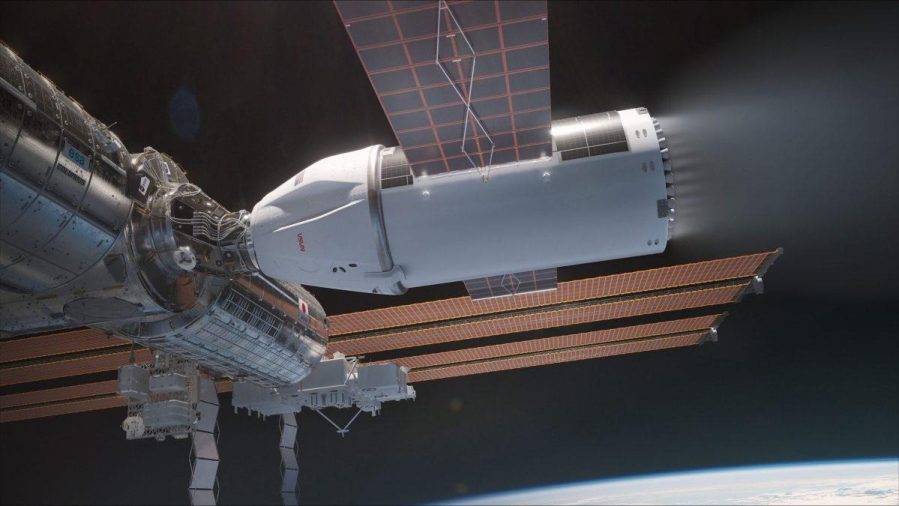
Source: spacenews.com
Environmental impact
A significant portion of space debris burns up in the atmosphere before fragments of satellites, cargo ships, or space stations reach the Pacific Ocean. However, despite the remoteness from land, the intense ultraviolet radiation, and the weak ocean currents in this region, the question of the long-term impact of ecosystem pollution remains unresolved.
In 2019, researchers detected aluminum particles in the atmosphere near Point Nemo and determined that their origin was neither terrestrial nor meteoritic. This led to the hypothesis that the particles were formed as a result of spacecraft disintegration during atmospheric reentry. This means they could potentially cause pollution even before reaching the depths of the ocean. Later, in 2023, a team of scientists from the National Oceanic and Atmospheric Administration (NOAA) led by Daniel Murphy confirmed this hypothesis. Analysis of stratospheric aerosols showed that about 10% of particles in the upper atmosphere contain metals from burned-up satellites, including aluminum, lithium, and copper.
The researchers warned that, with the increasing number of launches, the concentration of these particles could rise significantly and eventually affect the ozone layer. Even so, the waters remain relatively clean, and the region has been recorded as having a fairly low level of plastic, which has long been a major environmental problem.

Source: shippingandfreightresource.com
For now, the greatest concern is the future deorbiting of ISS fragments, which will not completely burn up in the atmosphere during reentry. A few years ago, this issue sparked debate at the United Nations, and several Latin American countries spoke out against it due to the potential environmental risks of an ocean splashdown. It is also possible that residues of toxic fuel could enter the ocean waters. Indeed, somewhere in the southern Pacific, there is still a radioisotope thermoelectric generator that survived the deorbit of the Apollo 13 lunar module, which will remain radioactive for approximately 2,000 more years.
Looking to the future
There is a likelihood that Point Nemo will continue serving as a spacecraft graveyard for many years. However, space agencies are aware of the associated risks and challenges, so they are seeking alternative methods for disposing of spacecraft. For example, some satellites, instead of being deorbited and sunk, are moved to supersynchronous orbits, also called “graveyard orbits.” However, this approach has several drawbacks: it requires a lot of fuel, and only geostationary satellites are suitable, not those originally intended for low Earth orbit. Additionally, leaving defunct satellites in high orbit is risky due to the potential for explosions from leftover fuel or batteries.
In the future, most spacecraft will be designed with space debris reduction in mind. They are planned to be made from materials that melt at lower temperatures, which will significantly reduce the likelihood of surviving atmospheric reentry and impacting the Earth’s surface. NASA and ESA are already partially following the “Design for Demise” (D4D) concept and are switching to aluminum fuel tanks instead of titanium. Titanium requires a higher melting temperature (1600°C versus 660°C for aluminum), so components made of titanium often reach Earth largely intact.
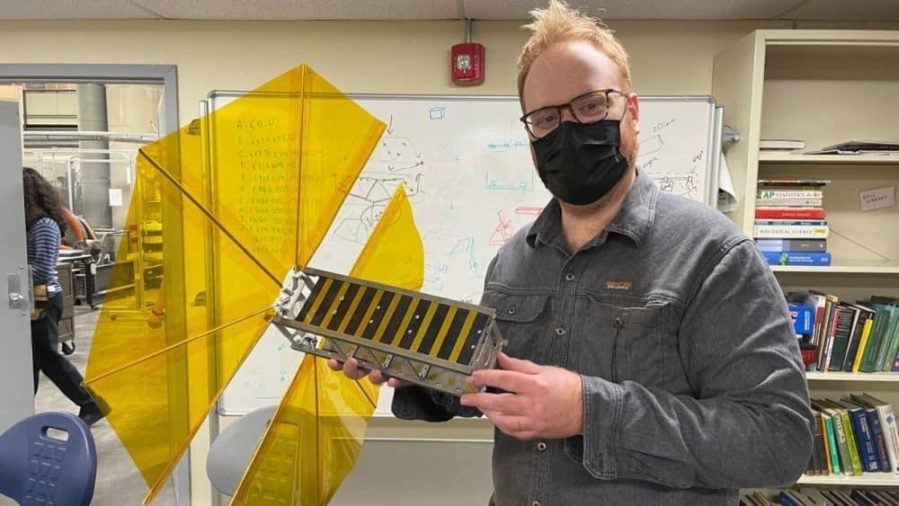
Source: ceramics.org
NASA has already applied a similar approach in the Global Precipitation Mission (GPM), where engineers replaced traditional titanium tanks with aluminum tanks wrapped in composite material. The results of this experiment showed that aluminum structures reliably burn up during atmospheric reentry, unlike their titanium counterparts. Meanwhile, in its Clean Space initiative, the European Space Agency emphasizes the need to replace titanium tanks with aluminum alloys, but notes that this alone may not be sufficient. As additional measures, ESA suggests using flax-based composites instead of carbon fiber where possible, and designing electronics and batteries to break apart into smaller pieces before reaching Earth.
At the same time, the number of satellites in orbit continues to rise steadily: by the end of 2025, there were four times as many as in 2020. The same trend is seen in launches: at the start of the decade, annual launches barely exceeded 100, while by the end of last year, there were 324 launches (315 of which were successful), according to Space Stats. This means that the volume of space debris will continue to grow, even with the advent of reusable rockets, while Point Nemo will steadily accumulate new residents. In a few centuries, it will become a valuable source of knowledge for future archaeologists.